

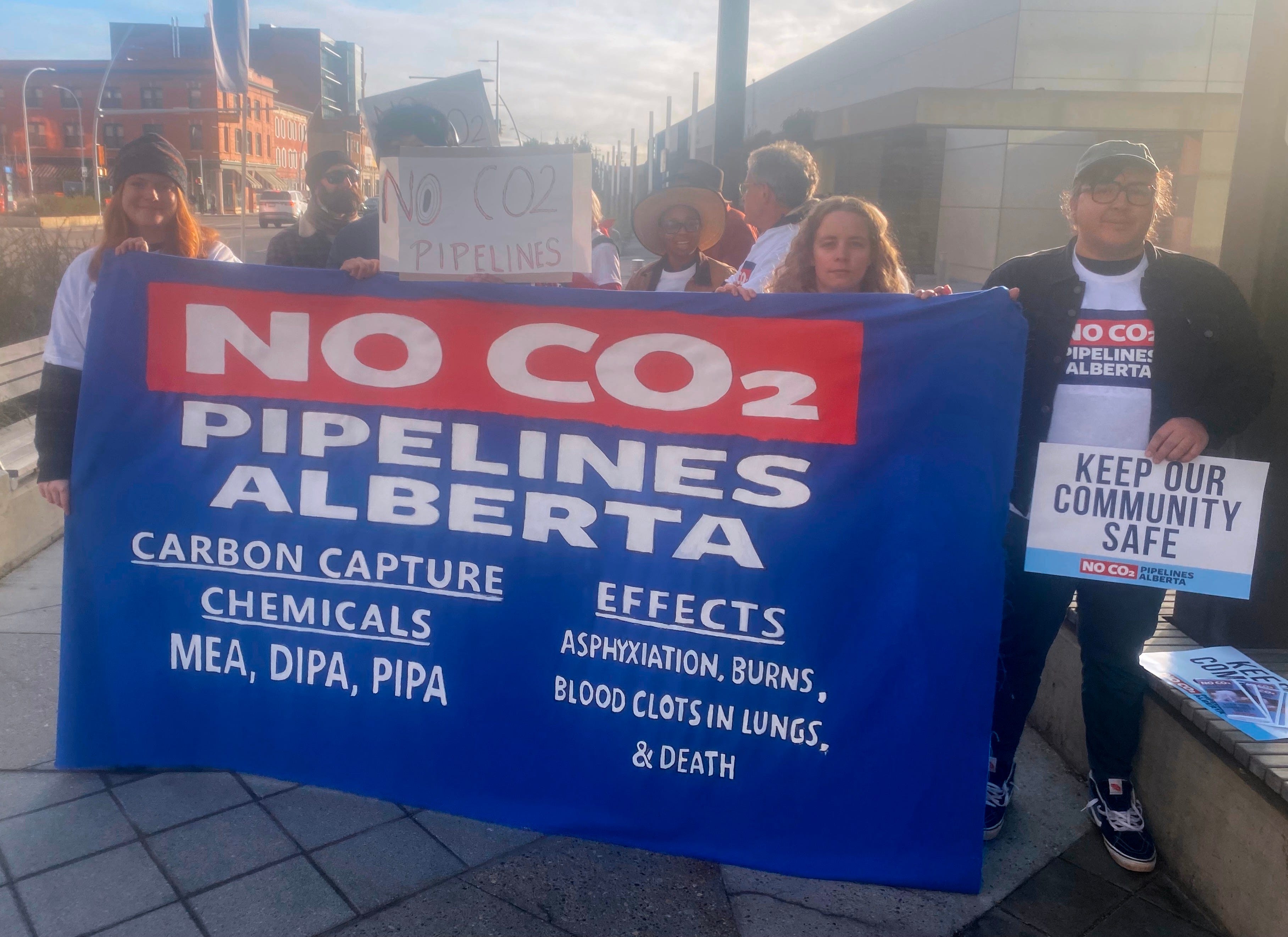
Fossil fuel executives making their way into this year’s Carbon Capture Canada conference Tuesday were greeted by a group of protestors outside the Edmonton Convention Centre.
The group of protestors, representing a coalition of rural landowners, environmentalists and First Nations, was small, but this year’s conference was also far more sparsely attended than in previous years.
Prime Minister Mark Carney, we’re told, has prioritized the $20-billion Pathways Plus carbon capture and storage project, with its 400-km network of pipelines to transfer CO2 from tar sands mines to a storage hub near Cold Lake, as a condition for supporting a new million barrel a day bitumen pipeline to the B.C. coast.
Based on this framing, you might think that industry was being forced to pay for carbon capture as a means being able to build a much-coveted pipeline. You would be wrong.
Both projects are going to be largely publicly funded, and the Alberta government is initiating the pipeline proposal in the absence of a private sector proponent, with Pembina Pipeline Corporation taking a 10% stake in the project and the rest divided up by the federally owned Trans Mountain Corporation and Alberta Petroleum Marketing Commission.
The Oil Sands Alliance — made up of CNRL, Suncor, Cenovus, Imperial Oil and ConocoPhillips — has been pushing hard for the Pathways project for five years, claiming it would allow them to reach net zero by 2050 while increasing production by capturing 68 million tonnes of CO2 a year.
Now that the biggest players in the tar sands have gotten their wish, it turns out the project will be capturing just 16 million tonnes — a reduction of more than three quarters — while the estimated $30 billion it will cost to build is almost double the initial estimate of $16 billion, most of which will be funded with federal and provincial tax credits.
But these numbers don’t capture the environmental and public health risks of creating a sprawling network of CO2 pipelines underground, which the provincial government has exempted from environmental oversight with the feds’ blessing.
“CO2 is toxic and an asphyxiant, so it puts land, life and water at risk. It's going to be the proposed largest proposed pipeline in the world and there's no environmental impact assessment,” said Dr. Amil Shapka, one of the protestors gathered outside the convention centre on the crisp September morning.
“Think about that — never before done on this scale, no environmental impact assessment. To me, that's reckless. That's short-term thinking, and it's not in the public interest.”
The retired physician in the County of St. Paul was a founding member of No CO2 Pipelines Alberta — an “alliance of cowboys and Indians,” per Athabasca Chipewyan First Nation Chief Allan Adam, that launched in March to prevent CO2 pipelines from going through their land.

“A good chunk of northeast Alberta is about to become a toxic dump,” predicted Shapka. “This is putting future generations at risk, and for what?”
Adama Bundu is the national youth president of the National Farmers Union (NFU) of Canada, which passed a resolution in 2024 opposing the large-scale deployment of carbon capture “to extend the social license of fossil fuel corporations to continue with their ‘business-as-usual’ operations.”
She said the NFU’s opposition to carbon pipelines is a natural extension of its work “in the belly of this beast of abandoned oil infrastructure,” raising the concerns of farmers who have inactive wells on their property, which impacts their ability to grow crops.
The big question for the carbon capture industry is what to do with all the carbon. According to research from Oil Change International, the vast majority of carbon capture projects have used CO2 to conduct enhanced oil recovery, which uses sequestered carbon to increase pressure and drill wells to their last drop.
Former prime minister Justin Trudeau made companies that use sequestered carbon for enhanced oil recovery ineligible for the federal carbon capture investment tax credit he unveiled in 2022.
In his effort to eliminate or weaken every aspect of Trudeau’s meagre climate legacy, Prime Minister Mark Carney removed the ban on enhanced oil recovery.
Bundu said this arrangement reveals carbon capture to be a “greenwashing scam” to give inactive or low-producing wells a “second boost,” putting more money in oil and gas executives’ pockets.

Gerry Hofs was outside the convention as a member of Seniors for Climate Action Now (SCAN).
She referenced an infamous 2020 carbon pipeline leak in the small town of Satartia, Miss., the scene of which a first responder likened to a “zombie movie.”
Given the sheer scale of the proposed Pathways pipeline, Hofs is concerned that many more of these sorts of leaks could occur along its route.
“Oil companies can pay for it if they want this, but even if they're going to pay for it, it doesn't make any sense,” she said. “There's nothing positive about it.”
Hofs’s fellow SCAN member, Gail Stevens, told The Orchard that she’s protesting against the carbon pipeline because she’s concerned “about the welfare of all life, our children, and the biodiversity that keeps the planet healthy.”
“Carbon capture is a very inefficient long-term investment of tax dollars that could be better spent on renewables, which have free input sources, and other nations in the world have got on that science-based commitment,” said Stevens.
Premier Danielle Smith has effectively pulled the plug on Alberta’s renewable industry, imposing onerous land-use requirements and recycling fees that don’t apply to oil and gas.
By disincentivizing fossil fuel alternatives, Smith is using state levers to make carbon capture appear as the only game in town for reducing emissions.
In contrast to previous years at Carbon Capture Canada, the convention only used only half of the conference room. Another distinction was the absence of Premier Smith.
Instead, attendees were offered remarks from Minister of Energy and Minerals Brian Jean, who admitted that the main motivation behind Pathways is to ensure the fossil fuel industry’s long-term viability.
“Pathways would make Alberta bitumen among the lowest emission intensity barrel of heavy oil on the entire planet, helping to future-proof this oil industry,” said Jean.
Measuring emissions per barrel is a bait-and-switch favoured by industry since the province became the first to introduce an industrial carbon trading system under former premier Ed Stelmach.
Reducing emissions per barrel doesn’t mean much when you’re expanding production by an even greater amount.
Pathways CEO Kendall Dilling acknowledged that industry’s major players are so keen on carbon capture as a means of securing a new pipeline — funded largely with other people’s money, naturally.
He described Pathways as a “concierge service” from industry to the government, boasting of its “excellent relationship with the Major Projects Office that was established explicitly to help major projects of national interest move forward.”
“That is working very, very well for us,” said Dilling.
The U.S.-Israeli war on Iran, which prompted the closure of the Strait of Hormuz, has been a “great opportunity for us,” he added.
The concurrent trade war with the U.S., said Dilling, “has galvanized Canadians into realizing that we need to build infrastructure to develop and diversify markets so that we aren't so entirely exposed to those kind of geopolitical wobbles.”
That same day, Prime Minister Carney announced at his global investors summit in Toronto that he will spend $36 billion to expand the share of companies’ tax deductible capital assets to 65% from 15%. Dilling described this policy as “one of the key pillars” of Pathways’ government lobbying.
“You just see these things getting knocked off one after the other, one after the other,” he said.