

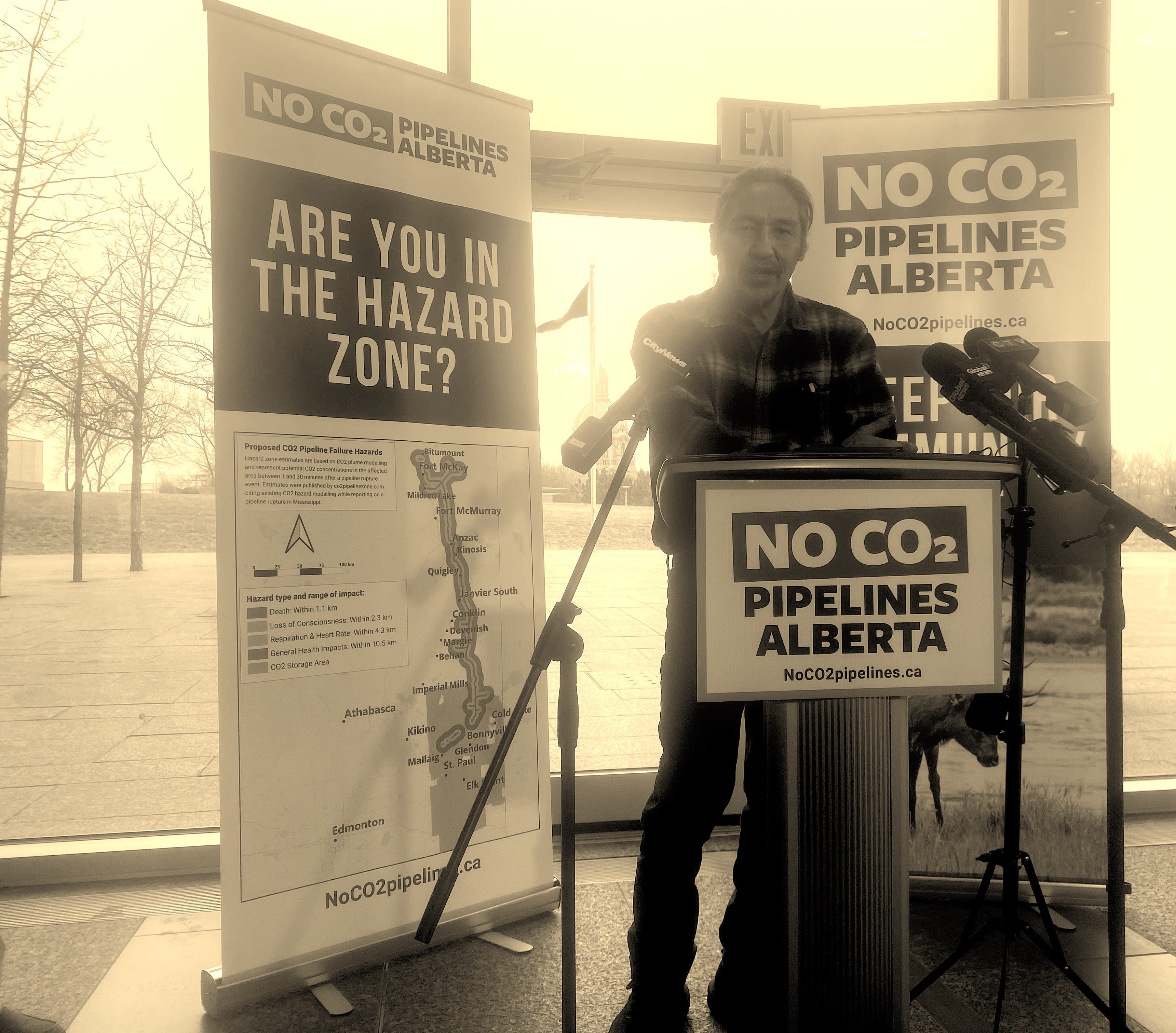
Chief Allan Adam of Athabasca Chipewyan First Nation was in Edmonton on Tuesday to help launch what he called a “new alliance of the cowboys and Indians” united against a multi-billion dollar carbon capture hub promoted by some of Canada’s largest oil companies.
Chief Adam was referring to a group of rural Albertans and First Nations leaders organized under the umbrella of No CO2 Pipelines Alberta, a campaign which kicked off with a news conference at the Queen Elizabeth II Building near the Legislative Assembly building.
He was joined by Nigel Robinson, a member of Cold Lake First Nations in Treaty 6, of Keepers of the Water, Glenn Norman of the National Farmers Union, rural landowners Penny Fox and Amil Shapka, and environmental lawyer Anna McIntosh of Ecojustice.
“Today, we unite the old phrase of a cowboy and Indian tale, as we come together to sort out some of the problems created by the people who sit in the building behind us,” Adam said, referring to the Legislative Assembly.
The proposed Pathways project consists of a 600-km network of pipelines transporting CO2 captured from 13 tar sands facilities in northeast Alberta to a 18,000 km2 carbon storage hub near Cold Lake, where it will be injected underground. It would be the largest carbon capture project in the world.
Chief Adam likened the environmental consequences of injecting CO2 underground to constantly injecting a substance into your body.
“It’s going to spread and it’s going to grow. This is what’s going on here. From an environmental perspective, we are going to cook Mother Earth from the inside,” he said.
The project is being promoted by the Oil Sands Alliance (formerly known as the Pathways Alliance), which consists of Canadian Natural Resources Ltd. (CNRL), Cenovus Energy, Suncor Energy and Imperial Oil, a subsidiary of ExxonMobil.
These companies together made $24 billion in profit in 2025, more than enough to cover the project’s estimated initial cost of $16.5 billion, yet CNRL is the only of these companies that have budgeted for carbon capture in 2026, with just $125 million set aside, an increase from the $90 million CNRL budgeted for 2025.
The Pathways project is a centrepiece of the so-called “grand bargain” that Prime Minister Mark Carney and Premier Danielle Smith signed in Calgary in November, alongside rushed approval for a bitumen pipeline to B.C.’s northern coast and a re-negotiated industrial carbon price.
One of No CO2 Pipelines Alberta’s primary concerns is the safety risk of any pipeline leakages, which have occurred throughout the U.S., where carbon capture projects are more common.
According to a 1998 study from the Dakota Gasification Company in North Dakota, a CO2 pipeline rupture can create a 760-feet “kill zone.”
Researchers with No CO2 Pipelines Alberta took the data from this study and mapped it onto the Pathways pipeline route proposed by the Oil Sands Alliance to the Alberta Energy Regulator (AER), which shows a kill zone running from the CO2 storage area up to Fort McMurray and Fort McKay.
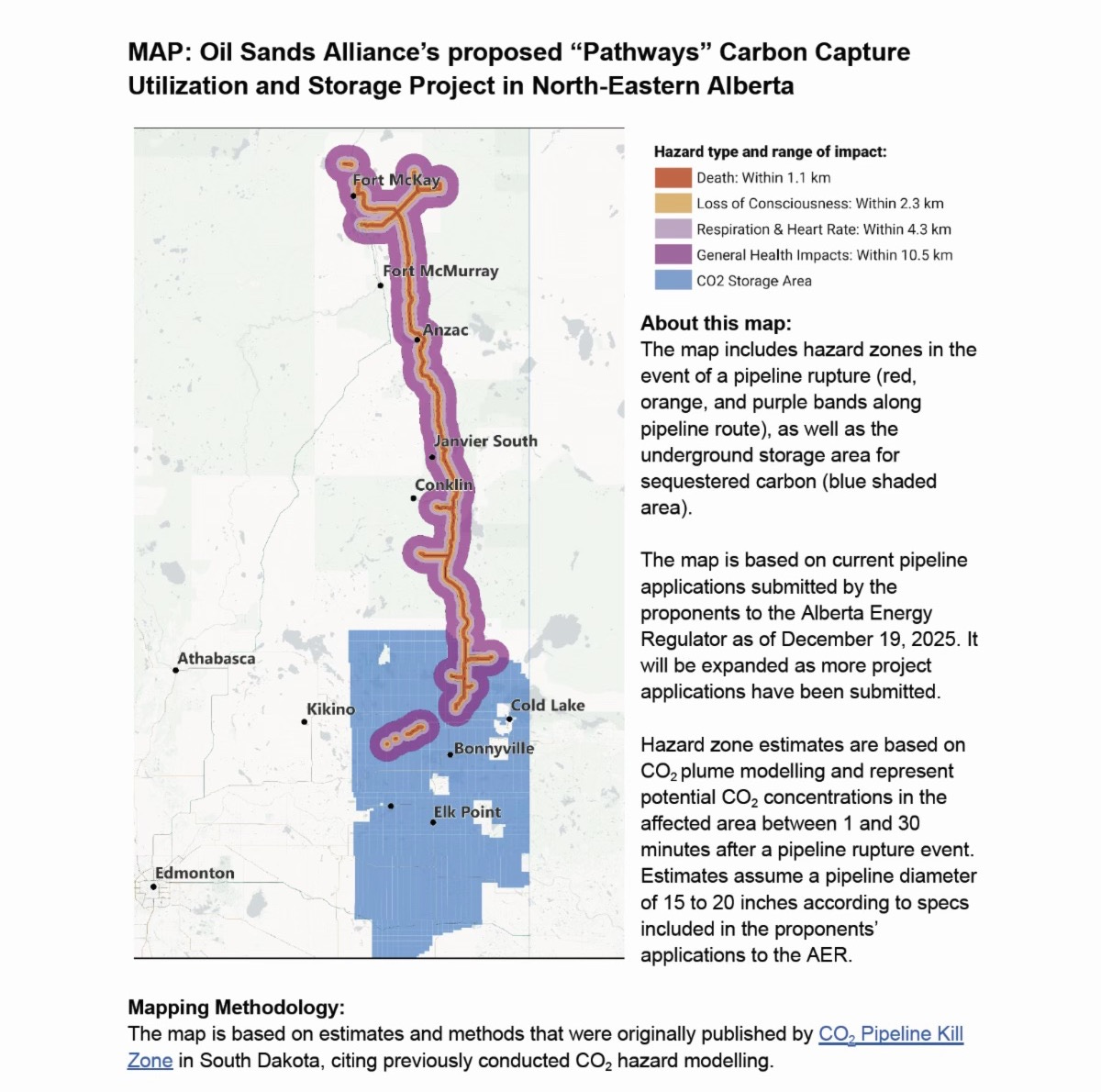
The AER allowed the Oil Sands Alliance to apply for more than 100 individual permits for each step of the project, rather than the project as a whole, enabling its proponents to side step the normal environmental assessment for a project of this magnitude.
Nigel Robinson said this means that there are likely more permits coming, which will be added to the map.
“The more communities see themselves and the people they love in these outlying zones, the more the resistance will grow,” predicted Robinson.
The key demand of No CO2 Pipelines Alberta is to subject the entire project to a federal impact assessment, which the federal government can subvert under the Building Canada Act if it declares a project to be in the “national interest.”
Dr. Amil Shapka, a retired physician and dentist who owns an acreage in St. Paul County, said his property is in “close proximity” to the mapped out danger zone.
“I’m not a rabid environmentalist, nor am I anti-oil and gas,” said Shapka. “When it comes to pipelines, I don’t know a lot about a lot, but I am learning fast, and what I do know is a bad idea when I see one, and this is a really bad idea.”
A CO2 pipeline is “not just another pipeline,” but is “uniquely dangerous,” since CO2 is “both an asphyxiant and toxic,” he added.
He referenced a notorious 2020 pipeline leak of contaminated CO2 in Yazoo County, Mississippi, which required the evacuation of hundreds and hospitalization of dozens, with a local cop likening the scene to a “zombie movie.”
“Personally, I do not want to be a zombie,” Shapka quipped.
Penny Fox, who also owns property in St. Paul County and is an “adjacent landowner” to the proposed pipeline, emphasized the “disrespect and disconnect” that she’s witnessed from the Pathways proponents.
“Most of the people in our community had no idea that the world’s largest CCS [carbon capture and storage] project was coming to our community,” Fox recounted.
Who was the Pathways Alliance? Where did they come from? What did they want? There was no local office, no community representative speaking to our municipal councils, our chambers of commerce, or any of the residents, keeping them updated along the way. They were not seen at community events. They were not shaking hands. They weren’t tooting in their horns about this world’s largest project. They were disconnected from our community entirely.
She said the alliance held a single meeting for a few hours with community members, “and they closed the doors, away they went, not to be seen again.”
“Do I trust these oil and gas companies to protect my family and my water? No, I don’t. Can I sleep easy at night knowing the risk that this project brings. No, I can’t,” said Fox. “Therefore, I must say no to CO2.”
Chief Kesley Jacko of Cold Lake First Nations has said of the Pathways project: “They’re ramming it down our throats.”
He was unable to attend Tuesday’s event, but said in a statement that his concerns with a lack of consultation have been heightened by Carney and Smith’s dealmaking.
“Our communities hold all of the risk and none of the economic benefits of this project—it’s completely unacceptable. Our Nation is not a garbage dump for American-owned oil companies,” said Jacko.
The four Oil Sands Alliance companies are together 60% American-owned.
Glenn Norman, a cattle and grain farmer in Red Deer County who serves as the National Farmers’ Union regional director for Alberta, warned that Pathways is being “used to extend the social license of fossil fuel corporations to double production and continue with their business-as-usual operations,” which will make farming even more difficult.
Premier Smith has pledged to double oil and gas production, pitching carbon capture as a means of “transitioning away from emissions … while exporting more oil and delivering more energy.”

The Oil Sands Alliance has itself estimated that the Pathways project would annually capture 10 to 12 megatonnes of CO2 by 2030. Oil and gas emissions in Canada were 205 MT in 2023, meaning Pathways would reduce emissions by 5% at best.
“It’s a drop in the bucket,” said Norman.
Citing the risks of CO2 leaks on the groundwater they depend upon, farmers in the eastern Australian province of Queensland successfully blocked carbon capture projects from proceeding.
“Farmers are going to do the same right here. Ask Albertans, what’s more important to them, access to fresh water and local food ,or a multi-billion dollar handout to foreign oil companies? I think the answer will be clear,” Norman said.
William Heidecker, a rancher in Coronation, Alta., who serves as the president of the Alberta Surface Rights Federation, wasn’t present at the announcement, but provided a statement.
Considering how oil and gas companies have proved unwilling to address CO2 leaks from their inactive wells scattered throughout properties in rural Alberta, Heidecker said he doubts the “ability of industry to truly intern carbon dioxide subsurface for eternity.”
In February, Premier Smith and Prime Minister Carney signed a draft co-operation agreement on impact assessments and environmental reviews, which was one of the steps outlined in their November memorandum of understanding (MOU).
If the agreement is finalized, major projects in Alberta will adopt a “one project, one review” regime, which will remove the federal impact assessment process’s oversight over provincial environmental reviews.
In November 2024, Beaver Lake Cree Nation, Cold Lake First Nations, Frog Lake First Nations, Heart Lake First Nation, Kehewin Cree Nation, Onion Lake Cree Nation, and Whitefish (Goodfish) Lake First Nation #128 wrote to then-federal environment minister Stephen Guilbeault demanding an impact assessment on the Pathways project.
Lawyer Anna McIntosh emphasized that an impact assessment is essential to comply with environmental and Indigenous law.
“It is a basic principle of environmental law that you need to look before you leap,” said McIntosh. “You don’t make a decision and then figure out what the impacts might be afterward. You first assess whether those impacts are acceptable, and then you grant approvals, then you make decisions. “
McIntosh noted that it’s unclear at this point whether the Pathways project is within the scope of February’s co-operation agreement.
The November MOU, she emphasized, pledges to “work cooperatively with Indigenous parties in Alberta to consult and accommodate on the CO2 pipeline and capture and storage facilities related to Pathways.”
“They committed, and there’s that obligation to consult with First Nations, and I don’t understand that that has happened yet,” said McIntosh. “Indigenous communities are still waiting for Canada to respond.”
No CO2 Pipelines Alberta has a series of rural town halls planned for the next couple of months, with stops in Mallaig, located in St. Paul County, on April 26, Lac La Biche on May 6 and Edmonton on May 13, with additional dates to come.
.
Thanks for this informative article.
We need more good local coverage of the shenanigans planned for our back country in Alberta......and more education for Albertans who don't yet know that our alluvial soil is the real long term advantage we have in Alberta. Allowing foreign owned companies to suck up our tax revenue to build fast projects of questionable long term value is not any 'memorandum of understanding' educated Albertans should easily 'understand'.
Capturing a fraction of the CO2 produced in extracting raw bitumen........in order to run toxic CO2 pipes, often not to permanent underground storage, but to unclosed under performing well heads on farmer's land............so that the CO2 can be used as a pump to bring up the last dregs of fossil oil or gas..........IS NOT A GREENHOUSE GAS MITIGATION PLAN....its another fossil fool boondoggle to create new revenue streams for a dying industry............
In competition with a dying climate, to see how much more money they can rake in before the ecosphere we all depend on, tanks completely. We're with the cowboys and Indians......have been, since a similar alliance in Nebraska helped defeat the Keystone XL
Let's lasso these grifters and send them back to the country that might need them, now that the Age of Fossil Fuels and Fools is dying in Trump's clever war in the Middle East.
I'm very happy to hear that there's finally some organized resistance to the pathways alliance madness. It's a plot to let them keep on extracting tar forever. What we really need is a transition to renewable energy. That's what the climate crisis demands. ( see https://leapmanifesto.org/en/the-leap-manifesto/ )