

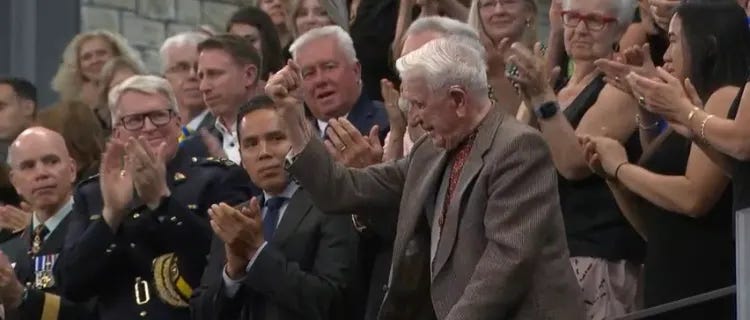
The Court of King’s Bench has ruled that the University of Alberta was within its rights to refund a $30,000 endowment made in the name of Yaroslav Hunka, a nonagenarian veteran of a Ukrainian Waffen-SS division who became the subject of international scrutiny when he received two standing ovations in Canadian parliament.
Shortly after the September 2023 incident, which occurred during Ukrainian President Volodymyr Zelenkyy’s visit to the House of Commons, UAlberta VP of academic Verna Yiu announced that the Hunka endowment would be terminated.

As Duncan Kinney and I reported for the Progress Report in October 2023, UAlberta’s Canadian Institute for Ukrainian Studies (CIUS) has more than $1.4 million in endowments named after people who fought with the 14th Waffen-SS Grenadier Division, also known as the Galicia Division, as well as the Nazi collaborationist Ukrainian Insurgent Army.
In her Aug. 7, 2026, ruling, Justice Debra Yungwirth acknowledged that her decision to permit the Hunka endowment’s termination “may also impact other charitable endowments administered by CIUS,” given the existence of other endowments donated in honour of Galicia Division fighters.
However, a UAlberta spokesperson told Edmonton Journal reporter Jonny Wakefield, who first reported Yungwirth’s decision, that the university “will not undertake the time- and cost-intensive application process required to seek court approval to terminate or alter” other endowments.
Martin Hunka established the Yaroslav & Margaret Hunka Ukrainian Research Endowment Fund in honour of his parents in October 2019 to support research into the Ukrainian Catholic Church — namely Metropolitan Andrei Sheptytsky and Metropolitan (Cardinal) Iosyf Slipyj.
“Yaroslav’s association with the Galicia Division was disclosed to the University when the trust was created,” Justice Yungwirth noted.
Later in the decision, she added:
When accepting the Hunka donation, it is clear that the University did not thoroughly consider the possible implications if the donation and its association with a member of the Galicia Division came to light. That oversight does not determine the outcome of the application, but it explains why the later public controversy created a conflict that the University had not adequately anticipated when the Hunka Trust was first established.
The Hunka endowment only ever provided $1,952 to the CIUS to fund a foreign academic’s travel to do research at two UAlberta libraries, the court heard during two days of proceedings in April.
The university refunded the original endowment donation to Martin Hunka on Oct. 12, 2023, with the endowment’s earnings transferred to a separate fund to be used by the CIUS. On Oct. 30, Hunka deposited the refund cheque in his bank account.
About a year later, he transferred the $30,000 into a lawyer’s trust account. On Jan. 25, 2024, UAlberta filed an application to the Court of King’s Bench to receive approval for the endowment’s termination over Hunka’s objections.
At issue was whether a charitable trust, such as an educational endowment, can be terminated under the province’s 2023 Trustee Act — a question which Yungwirth emphasized had yet to be tested in court.
Section 67 of the act outlines the conditions under which a trust can be altered or terminated. Hunka argued that because it doesn’t specifically mention charitable trusts, his endowment cannot be terminated.
Yungwirth rejected this argument.
“It would also lead to an absurdity if the legislation made it impossible to terminate charitable trusts. Circumstances may arise, like in this case, where the termination of a charitable trust must be considered and may be appropriate,” she wrote.
The act states that the court must take into consideration “the benefit or detriment to any person that may result from the court approving or declining to approve any proposed variations.”
Hunka argued that refunding the endowment would be detrimental for the CIUS in general and research on the Ukrainian Catholic Church in particular.
UAlberta argued, in Justice Yungwirth’s words, that since he’s already been refunded, “Mr. Hunka is in possession of the funds and is free to distribute them to any scholar he sees fit.”
Acknowledging that the university’s fiduciary duty to the Hunka endowment as its sole trustee conflicted with the board of governors’ “broad and multi-faceted” obligations to the university, the judge concluded that this “conflict strongly supports termination of the Hunka Trust.”
“The University cannot be faulted for choosing a course of action that advanced some interests over others,” Yungwirth wrote.
Hunka’s lawyer, Julian Savaryn, told the Journal that his client is considering an appeal.
Julian Savaryn is the grandson of Peter Savaryn, who served as UAlberta’s chancellor from 1982 to 1986, co-founded the CIUS and was himself a proud Galicia Division veteran.
Lubomyr Luciuk’s witness qualifications questioned
During April’s hearings, each side objected to the admissibility of evidence submitted by the other.
The only evidence that was ruled inadmissible in full was an affidavit and report written by Lubomyr Luciuk, a controversial political geographer at Royal Military College who has previously defended Hunka and the Galicia Division.
Luciuk wrote a December 2022 Ottawa Citizen op-ed arguing that Ukrainians should be included in the National Holocaust Monument, in which he falsely stated that a plaque at the monument doesn’t acknowledge non-Jewish Holocaust victims and mused about defacing the monument.

In his report, Luciuk argued that Hunka wasn’t antisemitic, nor did he participate in any Nazi atrocities.
Justice Yungwirth ruled that these considerations are irrelevant to the question at hand, which is whether the university has a right to close the Hunka endowment under the province’s Trustee Act and if so, what procedures it must follow.
She added that the university didn’t terminate the endowment because they believed the elder Hunka is antisemitic or a war criminal, but because of “concerns about the public perception” of honouring a Waffen SS veteran.
Yungwirth concluded that even if Yaroslav Hunka’s personal beliefs were relevant, she doesn’t regard Luciuk as a “properly qualified expert.”
“In my view, Dr. Luciuk is not entitled to opine on Yaroslav’s actions or the subjective beliefs he held while serving in the Galicia Division,” she wrote.
Luciuk hasn’t acknowledged a request for comment. This story will be updated in the event he responds.
That’s the first piece of good news I’ve heard in a while in this upside-down, inside-out moral universe we’ve been operating in at Waffen SS University in the province of we-love-Nazis Bumpkinland. As far as I know, the university administrators have not disposed of the other Waffen SS bequests.
To paraphrase Michael Palin as he shot at an audience memberduring a Python sketch, "Bloody Nazis!"