

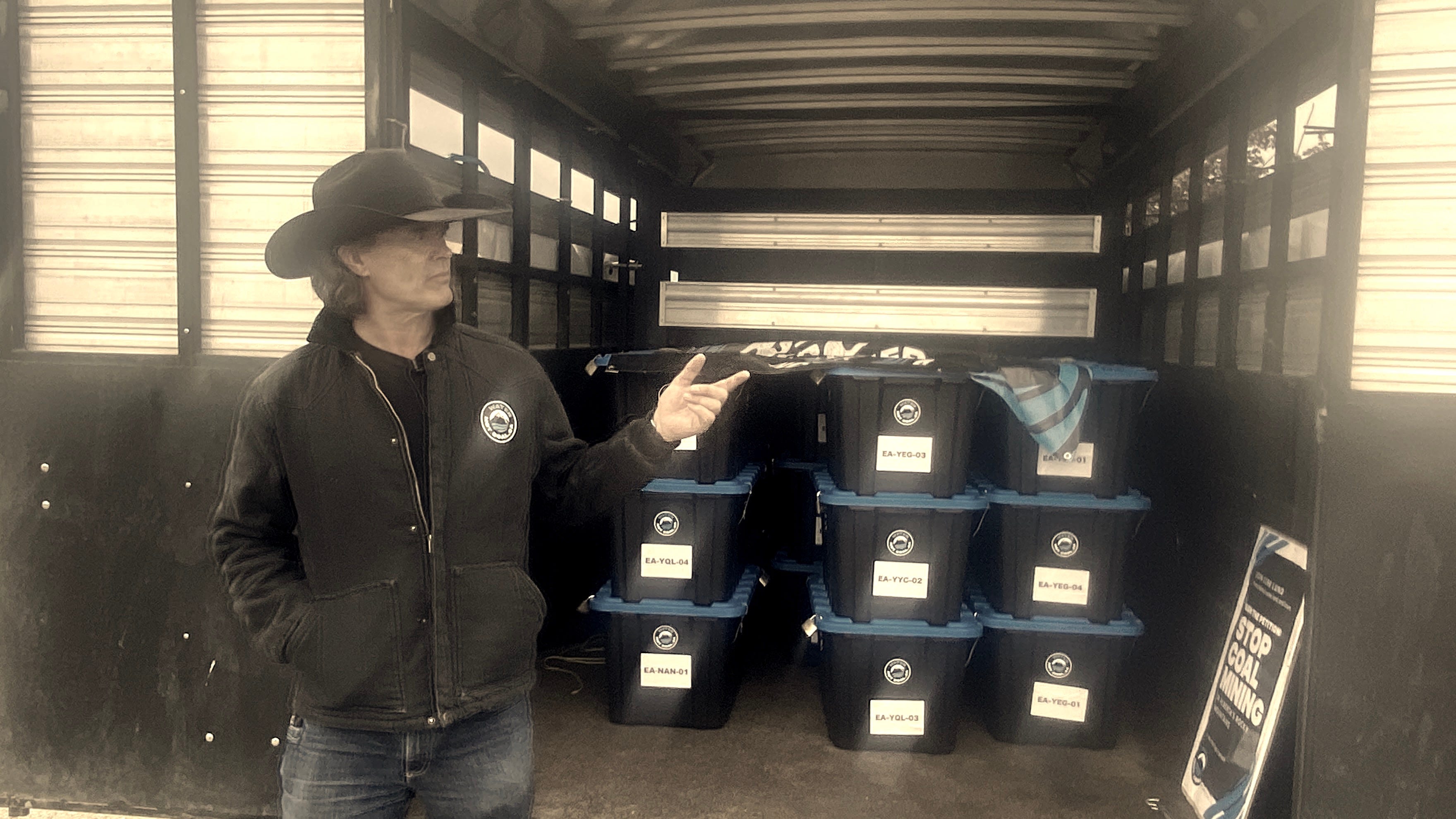
Country singer Corb Lund arrived at Elections Alberta’s Edmonton office in a horse trailer Wednesday to drop off what he estimates are 200,000 petition signatures to put banning new coal mining in the Rocky Mountains on October’s growing referendum ballot.
According to Water Not Coal spokesperson Laura Laing, the citizen-initiative referendum campaign had 3,000 volunteers spread “corner-to-corner across the province,” collecting signatures in all but the province’s three most remote northern ridings.
The campaign had until Wednesday to collect 177,732 signatures in support of asking Albertans whether they agree that:
The Government of Alberta shall prohibit through legislation all coal exploration and mining activities within the Eastern Slopes of Alberta’s Rocky Mountains, other than mines that are in actual production as of January 1, 2026. For clarity, this prohibition includes Northback Holdings’ Grassy Mountain Project and Valory Resources’ Blackstone Project as well as any projects to expand any producing mines.
Lund told reporters that he expects “nothing less than the government to use our question … precisely as it’s on the signature sheet.”
The question would certainly add a different flavour to the premier’s recent referendum-maxxing, with 10 questions already scheduled for Oct. 19. These include whether to have a future independence referendum, varying degrees of immigration restrictions and constitutional changes that would give provinces (and their premiers, incidentally) more power.
Chris Chang-Yen Phillips, an environmental historian whose research focuses on the Rocky Mountains, was one of a few dozen supporters who showed up to witness Lund deliver the petition signatures, despite intermittent rain throughout the day.
“This was such an obvious question that so many Albertans just have absolute consensus on. We don’t want to pollute our waterways, we don’t want to dig up our Rockies and foothills, and I wanted to be a part of that movement,” Phillips told The Orchard.
He noted Albertans have a long history of environmental advocacy, from the Whale Society of Edmonton in the 1980s, which pushed for a global moratorium on whale hunting, to photographer Gladys Reeves’s efforts in the 1920s to protect Edmonton’s River Valley and “Indigenous people protecting this land for thousands of years.”
“We’re just the latest in a long chain of stewards,” said Phillips.
He added that when it comes to protecting the environment, “there’s not a huge urban-rural divide” as is often presumed.
Local volunteer Kathy Fisher, who recently collected signatures in Camrose, a town of 20,000 about 95 km southeast of Edmonton, said the campaign “created connective tissue between communities,” establishing “linkages which weren’t there before.”
The movement to protect the eastern slopes of the Rockies from the predations of foreign coal companies brought together environmentalists, rural land owners and Indigenous communities beginning in 2020.
That’s when then-premier Jason Kenney rescinded the province’s 1976 coal policy, which banned open-bit coal mining on the eastern slopes of the Rockies. Kenney backtracked due to public outcry, issuing a moratorium on coal mining and exploration in the eastern slopes in 2022.
The provincial government has paid $238 million in settlements with Atrum Coal and Evolve Power for issuing the moratorium after they had purchased leases for coal projects.
In January 2025, Energy Minister Brian Jean lifted the moratorium for projects that were already underway, including Northback’s open-pit Grassy Mountain and Valory’s underground Blackstone projects.
A joint federal-provincial review panel rejected Grassy Mountain in June 2021, citing “significant adverse environmental effects.”
After an April 2024 meeting between Northback and Alberta Energy Regulator (AER) executives, as reported by Andrew Nikiforuk at The Tyee, the AER approved exploration permits for Grassy Mountain.
‘Sometimes these are long fights’
Fisher, who’s originally from Montreal, comes from a legacy of conservationist struggle. Her father was involved with the Montreal Parks and Playgrounds Association, which sought to preserve Mount Royal from industrial development.
It took until 2005 for the province to establish the Mount Royal Natural and Historical District.
“Sometimes these are long fights,” added Fisher.
She isn’t the only Water Not Coal volunteer whose environmentalism is intergenerational.
Dylan Pitman’s father was part of the movement to stop the Alberta-Pacific pulp mill in Athabasca, which produced then-environment minister Ralph Klein’s famous one-finger salute to environmentalists.

“We lost that fight. That pulp mill is there and that river is all the worse for it,” said Pitman.
He added that this movement feels different, given the impressive array of groups aligned against coal mining in the eastern slopes.
“We have all these organizations and different people that get out there and connect all across the province,” Pitman said.
Coal companies complain; Lund calls ‘bullshit’
Both coal companies named in the Water Not Coal petition — Northback and Valory — issued separate statements on June 10 in response to its apparent success.
“Alberta has a proud history of developing projects to meet global demand for our resources, and there is strong support for this project,” an unsigned statement from Northback reads, referencing a 2024 plebiscite on coal mining that was confined solely to the Crowsnest Pass, which received 72% support.
Grassy Mountain, if built, won’t be located in the Crowsnest Pass but in the Municipal District of Ranchland, which attempted to fight the mine in court.
“They cherry picked a group of people who want the jobs who will not suffer the effects of the mine. They pretend that’s democracy, and it’s just propaganda bullshit,” Corb Lund told reporters.
Valory CEO Ian Slater said it’s “disappointing to see misinformation about this industry, especially in Alberta,” without specifying which of the campaign’s claims he disputes.
“At Valory, we are committed to developing this resource responsibly through an underground mine operating under Alberta’s rigorous environmental and regulatory standards,” wrote Slater.
“The facts are simple: this project will create jobs, support local communities, protect our land and water and help supply a resource the world continues to need.”
Lund said that these companies are “in a heavy duty PR campaign right now because they’re feeling the heat.”
“As soon as they get in there, in my estimation, they’ll do what almost every coal company does, which is start to push back against the regulations and lobby the government to loosen them,” he predicted.
Prairie Mines and Royalty ELC received an environmental protection order in May after a berm collapsed at its Coal Valley Mine, polluting the Lovett River with wastewater, which isn’t the first time the company has faced environmental sanctions.
“They’ll pay the fine and just keep going,” said Lund.
If the coal mining question is added to the ballot in October, which Premier Danielle Smith has indicated is her intention, expect Northback and Valory to spend big on efforts to shift public opinion in support of coal mining.
“The fortunate thing about our position is that we’re correct. They can spend all the money they want,” said Lund.
My partner was one of the petition signature gatherers........and I am proud to oppose coal mining on our eastern slopes. Those slopes are where every river on the Canadian plains rises, and they need intact trees and uncleared slopes to hold that water and release it gradually over the season. Otherwise, you get floods in the spring, and droughts by August. As climate change proceeds, having enough water for agriculture and people's needs is going to be tricky...........we don't need our watersheds stripped and degraded for a 1% royalty from Australia, or anywhere else.
We need forested eastern slopes, clean water and healthy trout streams going forward. Coal has to be history........its a dirty fossil fuel, not an economic opportunity for anyone.
Ingamarie is quite correct. A pristine Eastern Slopes is not a nice thing to have, it's a necessity. And I say this as someone who couldn't sign Corb's petition because I live in B.C., on Vancouver Island. The corporate types (often, but not always, foreign) and their Canadian sycophants need to be held in check and the people of Alberta need to tell their political 'masters' in Edmonton to get on with it!