

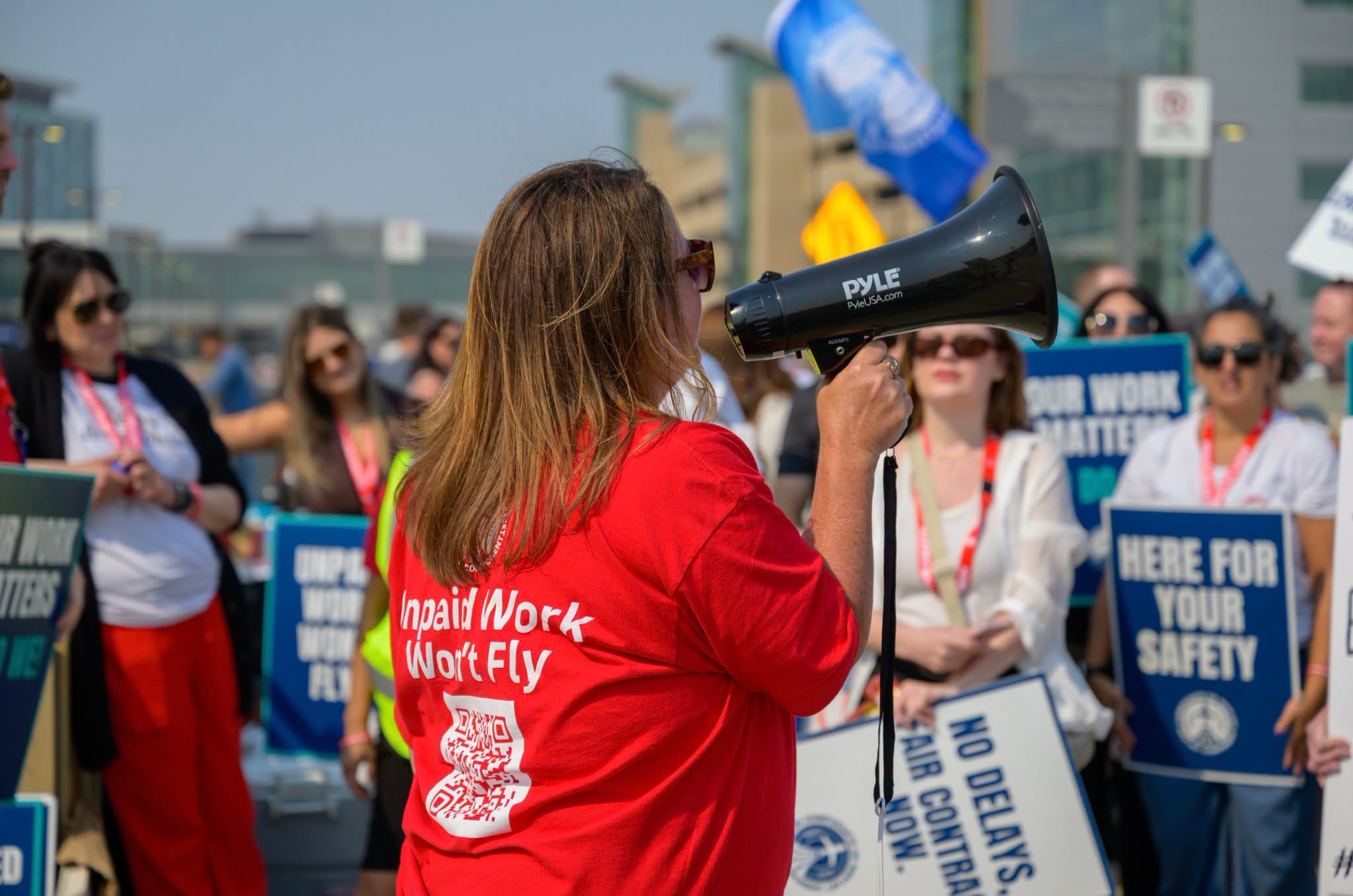
Following a one-day Sunday strike, 4,400 WestJet flight attendants represented by CUPE Local 8125 have reached a tentative agreement phasing out unpaid work hours over three years.
Across the aviation industry, flight attendants are solely paid a full wage when the plane is in the air. “Ground work” is unpaid, or at a sub-minimum wage rate at best, which averages out to approximately 35 hours of unpaid labour each month, per CUPE.
This unpaid work was a key issue as to why WestJet workers voted 99% in favour of strike action in July after 10 months of negotiations.
WestJet isn’t a publicly traded company, so we don’t know how much profit it makes. But Gerald Schwartz, the CEO of its private owner, the Onex Corporation, is reportedly worth $1.6 billion.
Unpaid work was a contentious issue during the 2025 strike by 10,400 Air Canada flight attendants, represented by several CUPE locals.
In a deal reached after Air Canada staff refused a federal back-to-work order, airline workers now receive 50% of regular pay for ground work conducted an hour pre-flight beginning this year, which gradually increases to 70% in 2028.

Details of WestJet’s tentative agreement with CUPE, which members will vote on in September, were disclosed by the union on Thursday.
By the start of 2028, WestJet flight attendants will be paid half their regular wage for all ground work – not just work occurring an hour before takeoff.
“My initial comparison with the Air Canada deal is that this seems to be a step beyond because, ultimately, WestJet flight attendants will get some compensation for all hours of unpaid work,” Adam King, a labour studies scholar at the University of Manitoba and author of the Class Struggle newsletter, told the Globe and Mail.
Don’t want to give money to Substack? I totally get it. You can also support me on Ko-fi, either through a one-time donation or regular subscription.
Additionally, the WestJet cabin crew will receive a 13% pay hike, including back pay retroactive to January 2026. It will be followed by a 2.75% increase in 2027 and an additional 2.5% in 2028. Cumulatively, that’s 18.25% over three years.
By contrast, an arbitrator imposed a cumulative wage increase of 20.25% over four years on most Air Canada workers in February 2026. This deal had been previously rejected by 99% of its CUPE’s Air Canada flight attendants, who pointed to a 28% compounded inflation rate in the decade since the previous contract went into effect in 2015.
While neither agreement is ideal, the WestJet workers’ gains stand on the shoulders of Air Canada’s staff, with both serving to stigmatize the notion of unpaid labour, which will undoubtedly be useful in future industry-wide labour negotiations.
There was much speculation in advance of the WestJet work stoppage regarding whether the government would order the flight attendants back to work; they never did, allowing the strike to last a full day.
Prime Minister Mark Carney and his Jobs (not Labour) Minister Patty Hajdu likely sought to maintain a patina of labour peace, if only for their electoral aims, by avoiding a repeat of last year’s heavy-handedness, in which the federal government invoked section 107 of the labour code to order the workers back to their jobs after just 12 hours.
This threat must have loomed large in the background of the somewhat less brief WestJet strike, forcing CUPE to take a deal eliminating free labour for WestJet flight attendants but not going all the way in eliminating ground work inequities.
The Calgary-based airline, seeking to cut its losses after Sunday’s disruption forced the cancellation of 425 flights in the midst of a long weekend, knew it had to reach a deal — the sooner the better for its bottom line.
Awareness that the government could potentially invoke section 107 at any time no doubt strengthened the employer’s hand, but the Air Canada CUPE members’ defiance last year also demonstrated the limits of state coercion on behalf of corporate interests.
That could very well change with labour code reforms Carney has planned. Corporate leaders are asking the prime minister to introduce “proactive tools” to curtail workers’ ability to engage in their Charter-protected right to strike.
If corporate Canada and Carney think that legislating away the right to strike will reduce labour unrest, they’re in for a whole lot more disruption, on the ground and in the skies.
It is very angering and wrong that flight attendants on both West Jet and Air Canada are not paid 100% of their wages for all work that they do. Like the BC Nurses union, when they engaged in Work to Rule strike actions to do only essential work, it shows how unpaid duties are downloaded on these professionals. In the short and long run, it will continue to hurt Westjet’s and potentially Air Canada’s profits and employees. Passengers like me now try to avoid flying on Westjet because of the precarious and unreliability of Westjet when there is always a looming strike.
Funny how these are primarily female dominated work forces. The monopoly of industries in Canada continues.