

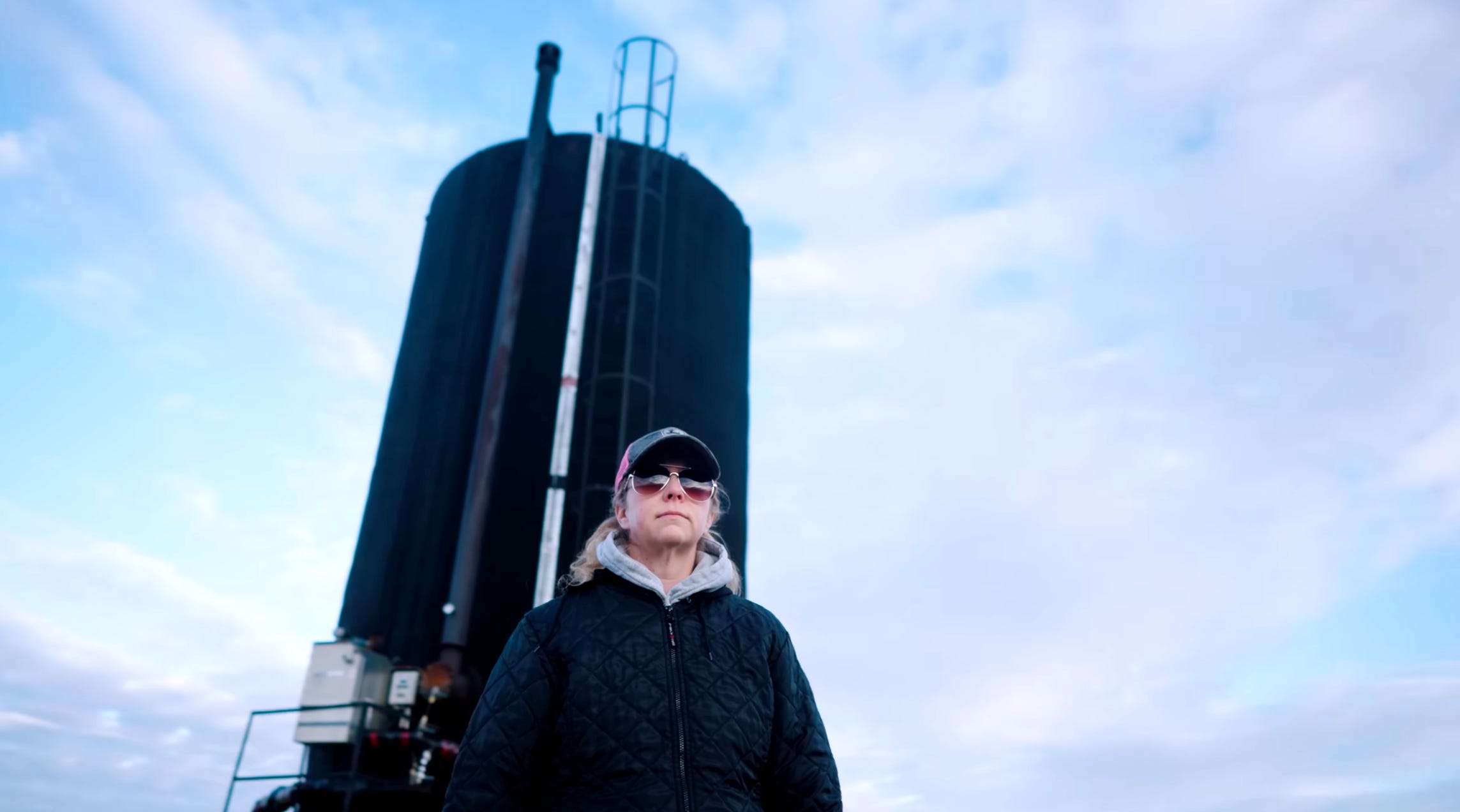
A group of rural landowners is taking the Alberta Energy Regulator (AER) to court for collecting only a fraction of the funds from industry needed to clean up orphan wells.
The AER set its orphan well levy at $154.56 million for this year — a 7% increase from the previous year. But the figure still falls far short of the $1.66 billion in closure costs estimated by the Orphan Well Association, the industry-funded organization that assumes liability for insolvent companies’ non-producing wells.
Susanna Calabrese, a lawyer with environmental law charity Ecojustice, announced the application for judicial review at a Tuesday news conference in Calgary alongside landowners Mark Dorin, Bill Heidecker, Teresa Patry and Dwight Popowich.
They’re asking the Court of King’s Bench to order the AER to recalculate the levy, in the application’s words, “to sufficiently cover the closure work that needs to happen each year to protect the health and safety of Albertans.”
Regular Orchard readers will likely be familiar with Calabrese and Popowich for their efforts to address the alleged conflicts of interests of oil and gas industry consultant, advisor to Premier Danielle Smith and AER board member David Yager through the province’s ethics commissioner and the AER’s internal mechanisms.


Dorin and Heidecker represent the Polluter Pay Federation and Alberta Surface Rights Federation, respectively, which are listed as co-applicants alongside Ecojustice, Patry and Popowich.
The group of landowners say they attempted to address the orphan well levy’s 87% funding shortfall through the AER internally, but the regulator refused to hear the case.
This time, they’re taking the AER to court, arguing that the shortfall is a violation of the Oil and Gas Conservation Act subsection 73(2), which mandates the levy “be sufficient to cover” this year and previous years’ cleanup costs, as well as any unexpected future influx to its inventory.
“The principle is simple: companies should pay for the liabilities they create, not Alberta taxpayers. But that safety net is falling further and further behind,” said Calabrese.
“The number of orphan sites continues to grow while the funding available to clean them up is not keeping pace. And when the levy falls short, the risk and ultimately the cost doesn't disappear. It gets pushed onto Albertans.”
Don’t want to give Substack money to support my work? I totally get it. You can also support me with a one-time donation or recurring subscription on Ko-fi, which as far as I know, doesn’t monetize Nazis.
Calabrese noted how the orphan well inventory nearly doubled overnight with the bankruptcy of Long Run Exploration earlier this year, which added about 4,000 wells to the backlog — roughly the same number of certificates the association has issued for restoring well sites back to their original state since it was established in 2002.
NDP and conservative governments alike have provided a total of $335 million in interest-free loans to the Orphan Well Association and subsidized more than $148 million in industry’s unpaid surface lease payments to landowners.
Rural municipalities have also had to forego $250 million in unpaid property tax revenue that the provincial government says is unrecoverable.
Calabrese suggested that the levy is set so low because the nominally independent regulator is being influenced by input from government and industry advocates.
“In our view, that is an improper delegation of its legal responsibility,” she said.
Teresa Patry, a farmer and rancher near Vermillion in central Alberta, highlighted the human cost of allowing orphan wells to accumulate on people’s property.
“When people hear words like orphan wells or liability management, it can sound like a policy debate. For those of us living beside these sites, it's not a matter of policy; it's personal and it affects our daily lives,” she said.
A recent study from the Pembina Institute found that orphan wells in Alberta and B.C. emit more methane annually than B.C.’s entire upstream natural gas industry.
In addition to its particularly potent effect on trapping heat in the atmosphere, exposure to high concentrations can cause respiratory and heart issues.
Active wells can also leak methane, as Patry has experienced with two aging oil wells on her property, which she suspects could be the cause of “unexplained health concerns,” including her son coughing up blood and daughter developing a growth on her thyroid.
The AER hasn’t given her answers.
“For years, my family has lived with uncertainty about what these sites mean for our home, our land, our health and our future,” Patry said. “Living with that uncertainty takes a real toll.”
A major shortcoming of Alberta’s regulatory framework for oil and gas is that there’s no mandatory timeline for closing inactive wells, let alone restoring the land to its pre-drilling state.
“They can sit on the landscape for decades, and indeed do,” said Calabrese.
It took eight years for an inactive gas well in the middle of an alfalfa field on Popowich’s property in Two Hills to be declared an orphan. The AER told him that it could take another decade or longer for the land to be restored.
For Popowich, these delays highlight how the existing orphan well levy framework is unsustainable.
“What the regulator is trying to do is not overwhelm the Orphan Well Association. They know themselves that they messed up by not properly funding it. The more wells that we send as orphans to the association, the more funding they need,” he said.
Mark Dorin, who has an inactive well owned by Whitecap Resources on his property in Didsbury, emphasized that the longer cleaning up orphan wells is delayed, the more it’s going to cost the public.
“This is why we need sufficient funding to retire these wells within a reasonable period of time — so that the period of time that taxpayers are compensating landowners on behalf of defunct oil companies doesn't drag out to decades, which is what's happening now,” he explained.
Bill Heidecker, president of the Alberta Surface Rights Federation, has dozens of inactive wells on his ranch near Coronation in eastern Alberta.
“This matter didn't have to end up going to court,” said Heidecker. “For years, landowners have been patient. We've given the regulator the benefit of the doubt.”
While landowners have played by the established rules, industry has been allowed to bend them to its will.
“Albertans deserve a regulator that actually regulates,” added Heidecker. “Because at the end of the day, this isn't just about wells. It's about accountability, and it's about whether Albertans can trust the systems that are supposed to protect them.”
Heidecker said that he’s sympathetic to concerns that an increased levy could put an undue financial burden on smaller oil and gas producers, who are particularly sensitive to fluctuations in energy prices.
“If you've got the funds, you should pay it, because there's always going to be a time when, say, gas is down and oil's up, or oil's down and gas is up,” he explained.
“There's always going to be weak players, so you can't just not collect on the basis of a few people that might go into receivership.”
In a statement, an AER spokesperson declined to comment specifically on “matters before the courts,” but emphasized the AER’s recent 7% increase to the orphan well levy, which was “endorsed” by the Alberta government in its most recent budget.
“The [Orphan Well Association] is a non-profit organization that works with the Government of Alberta, the AER and the oil and gas industry to manage the environmental risks of assets licensed to defunct oil and gas companies,” the spokesperson added. “This process is funded almost entirely by industry.”
Since 2022, the association has closed more than 8,900 orphan wells, the statement continued.
“This work has allowed municipalities, farmers, ranchers and recreational users to reconnect with what the landscape has to offer in Alberta,” it read.
The judicial review will be heard in court on Sept. 22. Read the full application here.
Sept. 8, 3 p.m.: This piece was updated to include comment from the Alberta Energy Regulator.
Preorder my book
My new book, Dark Phoenix: The Rise, Fall, and Re-emergence of Danielle Smith, comes out Oct. 13.
I’m using every opportunity I can to remind Orchard readers to preorder it. Preorders are an importantly early step in the process of book promotion, because they signal general interest to booksellers, influencing the number of copies they purchase and how prominently they’re displayed.
Strong preorder sales will also influence the degree of media attention the book receives, providing it with further visibility.
You can preorder Dark Phoenix to your local independent bookstore through the publisher’s website. The book is also on sale via Amazon or Indigo, if that’s your thing.
If you’re in Edmonton, I’ll be celebrating the book’s release on Oct. 13 at the Aviary, where I’ll be talking to my friend and fellow freelance journalist Dani Paradis about the premier, in addition to reminiscing about the various right-wing events we’ve attended together.
Tickets are $25 in advance, $30 at the door, and include a copy of the book, which I will gladly sign for you.
Do other jurisdictions have this much trouble with reclamation or cleaning up orphan wells? How is it handled in Saskatchewan of BC?