


About two hundred people gathered in front of the Sturgeon County building in Morinville, Alta., — on the Sunday of August long weekend no less — to protest Meta’s planned $13-billion AI data centre for the region, which has been all but rubber-stamped by the provincial government and county council.
The event was organized by 20-year-old county resident Ben Baril, who told The Orchard he was spurred to action by a “sense of betrayal” by municipal and provincial officials, noting the “existential crisis” facilitated by the extraction of natural gas necessary to fuel the one gigawatt data centre.
In April 2025, the county quietly amended its land-use bylaw to permit the building of AI data centres, but there’s been no public debate or vote on this specific 2.9-million square-foot hyperscaler facility, which is already in the process of being built.
Baril emphasized that he’s not entirely against the use of AI, but is concerned by the scale by which it’s being foisted on the public by an alliance of Big Tech and government.
“Obviously, there are use cases for AI, but the scale that it's being built out of is just completely unsustainable,” he added.
Other prominent concerns are the data centre’s anticipated water usage — both for cooling servers and powering them — the impact of increased electricity demand on power rates, the noise they make, their use of otherwise arable agricultural land and the digital surveillance widespread AI adoption enables.
Baril noted a “broad support for ending egregious crime against us and our environment” that transcends traditional political divisions in his rally remarks.
An online Leger poll conducted in July found that four out of five Canadians are concerned about data centres’ impacts on the environment and power bills.
Wayne Chambers, another local resident, bemoaned how no county officials were present to attempt to hear residents’ concerns.
County Mayor Alanna Hnatiw has argued that the public hearing on updating the county’s zoning bylaw, which faced no opposition, was sufficient consultation.
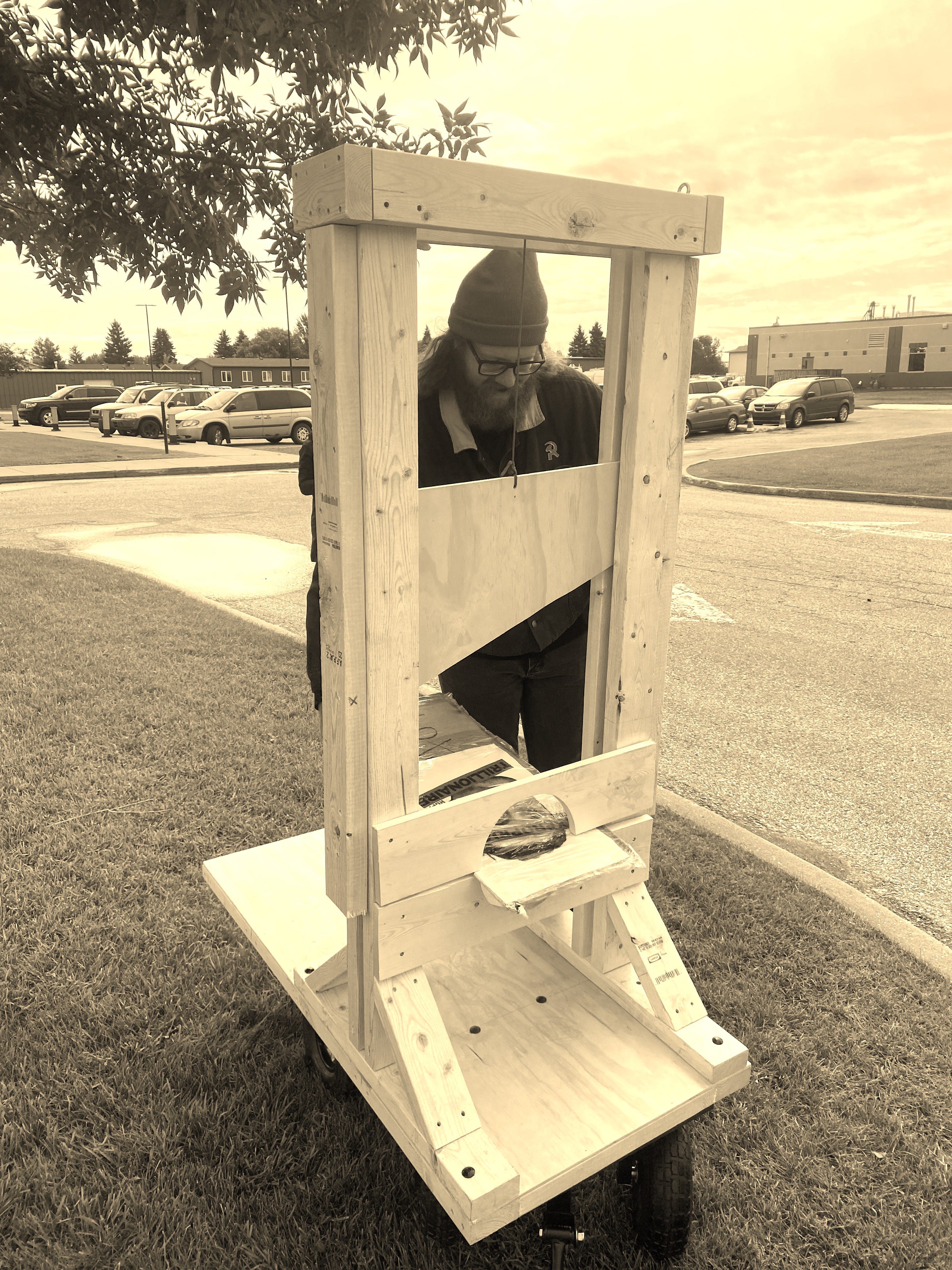
“They should be going in there,” Chambers said in an interview, gesturing towards a mock guillotine brought by a group of Trotskyists to the protest before emphasizing that he was speaking proverbially.
“That's the guillotine of justice. It's the beheading of our rights, and you're supposed to be representing the people. Does this look like you're representing us?”
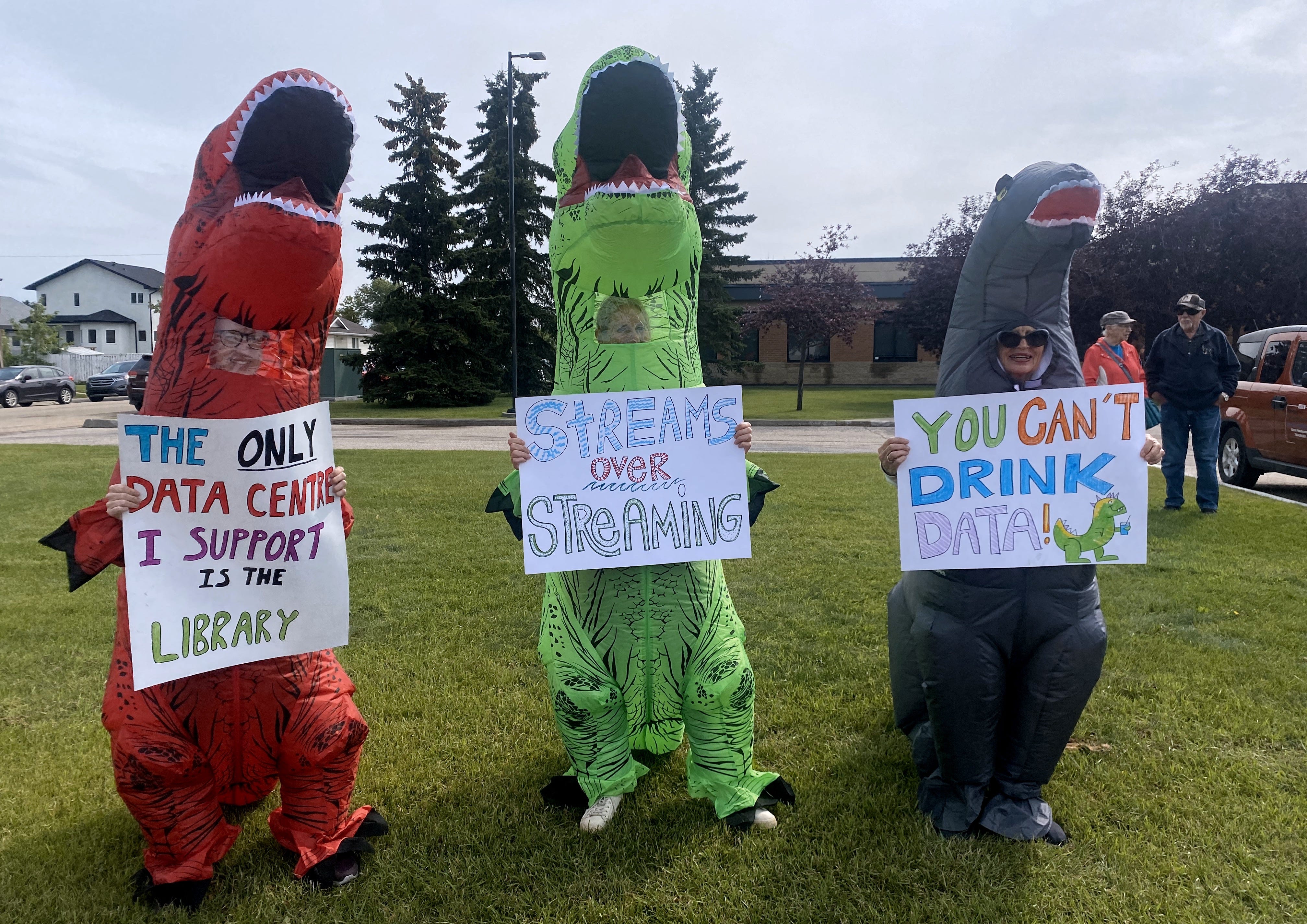
A group of senior citizens dressed in dinosaur costumes — likely a familiar sight to attendees of protests against the provincial government in Edmonton lately — were in attendance.
One of them is retired University of Alberta English professor Janice Williamson.
“The Albertosaurus is kind of an emblem of our province, and we thought we would be dinos because we know about extinction. We've been here for millions of years,” explained Williamson.
“We understand how that works, and we don't want the human species to go extinct.”
Meta boasts that the data centre will create 3,000 construction jobs and then 300 operational jobs, figures repeated by Alberta Premier Danielle Smith.
Williamson said these relatively modest job figures aren’t worth the facility’s environmental and financial costs.
She identified the scale of this particular data centre and its use of fossil gas as especially concerning, contrasting the UCP government’s approach to building data centres with B.C.’s NDP government, which has capped data centre power usage at 400 megawatts for the next two years.
Ninety per cent of proposed AI data centre capacity is in Alberta, the CBC reported in June.
“We're just kind of a rogue state. Our government is selling us all out, and there's no proper vetting of any of these proposals,” said Williamson.
Given the composition of B.C.’s energy grid, its data centres will be mostly powered by renewable energy, although B.C. Green leader Emily Lowan has criticized the province’s government for adopting a "build-first regulate-later model" that takes corporate claims of minimal water usage at face value.
The plan is for Meta’s Sturgeon County facility to be mostly powered by its own $4.6-billion, 934-megawatt power plant, the Greenlight Electricity Centre, with plans to double its generation capacity in future years, which proponents argue will eliminate the data centre’s strain on the electricity grid.
The plant is expected to be operational in 2030 — two years after the data centre begins its phased opening.
A guy named Jim, who wouldn’t provide his surname but said he lives near the future data centre, showed up at the event to argue with protestors.
Echoing the premier and Meta, he said that data centre water usage concerns are overblown, citing the “closed system” it uses to recycle a limited amount of water.
But isn’t the water that could be used for any other purpose?
“I don't know about that,” he replied. “It's like your toilet. You take water into your toilet. It sits there, right? Well, the water is being used in the AI centre too. It's used for cooling, but it doesn't leave the system.”
While closed-loop water systems can reduce — but not eliminate — data centres’ direct use of water, they require increased electricity generation to properly function, which is itself a water-intensive process.
While the UCP government has taken a firm position in support of data centres, the Alberta NDP has committed to a “listening tour” to determine what its position should be.
The NDP is doing WHAT!!! Seriously !???I
Let's just say that if I see anyone bent over with their "ear to the ground" I will wind up my size 9 tootsie and give them a swift kick in the you-know-what!
And what does the Federal NDP have to say....Not that the mainstream media will ever, ever ask Avi Lewis anything.
Remind me not to ask to use Jim's toilet.