

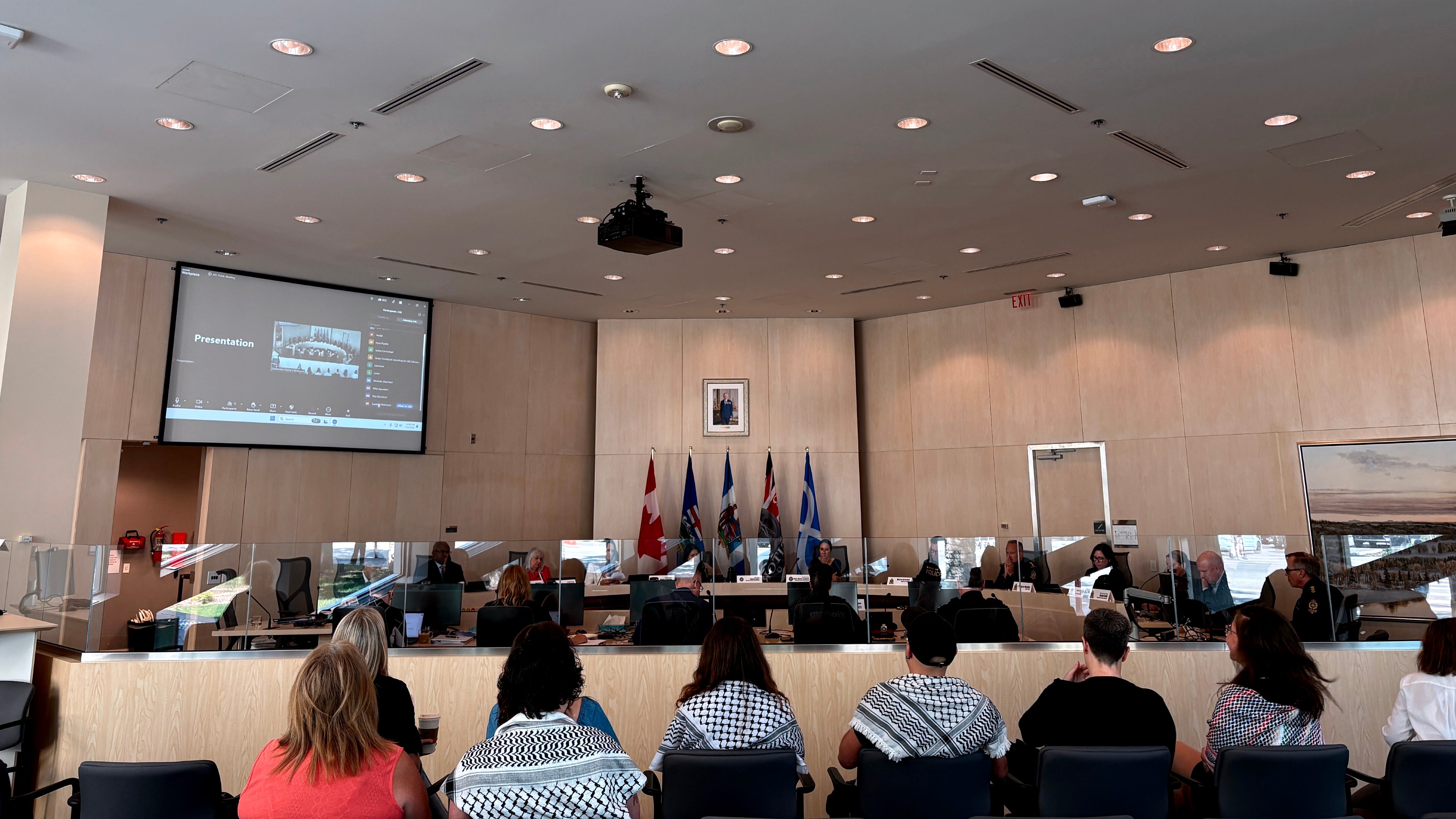
The body ostensibly tasked with providing civilian oversight to the Edmonton Police Service (EPS) isn’t interested in hearing criticism of Chief Warren Driechel’s February trip to Israel.
On Thursday, the Edmonton Police Commission (EPC) held its first meeting since this newsletter revealed that Driechel travelled to two illegal West Bank settlements, which Canada has never recognized as part of Israel, and met with a paramilitary police unit that executed two unarmed Palestinians on camera.

The chief also visited a facial-recognition surveillance system in occupied East Jerusalem that monitors Palestinian residents 24/7 before meeting with a representative of a mysterious “Company C.” Edmonton police have piloted facial-recognition software on body-worn cameras from Corsight AI, an Israeli firm.
It’s unclear if anyone on the EPC was aware of these details, let alone the trip itself, when it was unilaterally approved by chair Ben Henderson, a former city councillor, who attended the July 16 meeting virtually.
Following a butchered land acknowledgement at the meeting’s outset from commissioner Karen Leibovici — a former Liberal MLA and ex-city councillor — EPC vice-chair Shazia Amiri laid out the contours under which speakers could address the commission.
“Commission meetings are not a forum for discussing international conflicts, geopolitical events, or matters outside the commission's mandate,” said Amiri.
“The commission has made it clear that matters related to conflicts in the Middle East are outside our mandate and will not be addressed as part of this forum.”
She added that the EPC is in the midst of a policy “review of the police chief’s business travel … to determine whether any changes are required,” which will be discussed at a future meeting.
Amiri did not elaborate on why having a review in process should preclude members of the public from expressing their concerns with his choice of destination.
As CityNews reported last week, several members of the public, all of whom have been critical of Driechel’s Israel trip at previous meetings, have been banned from speaking at EPC meetings until 2027.
In 2024, the EPC unanimously passed a motion empowering executive director Matthew Barker to filter out speakers whose past commentary he regards as “defamatory, derogatory, and demeaning.”
The narrowing of what the EPC considers within its purview put those who were permitted to speak in a bind, noted Katy Ingraham, a local police accountability advocate who was the first speaker at the meeting.
“I don't actually really quite understand the public engagement portion of these meetings anymore. As someone who has engaged in this process for years now, it seems like we're tip-toeing around democracy,” she told commissioners.
In an interview outside the EPC chambers at city hall, Ingraham elaborated on her concerns.
“This commission has been continually moving the goalposts as for what the public can talk about,” she told The Orchard. “As a civilian oversight body, who is your allegiance to? Because it is certainly not the public who has very valid questions about transparency and accountability.”
Given the fine line between geopolitics and the Israeli policing practices Driechel went to study, some of the speakers who got through the EPC censors were able to provide substantive critiques.
Local nurse Kelsey Lyseng suggested that the EPC update its policies to prevent police from engaging in “partnerships or training exchanges with countries that are subjecst of documented human rights violations.”
This same suggestion was made at a previous meeting by Youssef Deiab, one of the speakers who have been suspended from addressing the commission.
Beth Capper, an English and film studies professor at the University of Alberta, linked the EPS’s piloting of Corsight AI technology to Driechel’s Israel trip, specifically citing this outlet’s reporting. (Thanks Beth!)
“The police chief's visit to Israel, where police have many documented abuses and human rights violations against Palestinians … raises fears about racial profiling and human rights violations here in Edmonton, particularly in Edmonton's Indigenous, Palestinian, Muslim and Arab communities,” said Capper.
“The privacy concerns that come with the adoption of facial-recognition technology only compound these issues.”
Other speakers who raised these concerns, however, were shouted down by the acting chair.
The afternoon’s penultimate speaker, another nurse, was repeatedly interrupted by Amiri — once after she mentioned the number of health-care workers murdered by Israeli forces and again when she raised issues with the procurement of Corsight’s technology.
“But it’s related,” she objected after Amiri’s second interruption.
“It’s actually not,” replied Amiri.
When the nurse attempted to explain its relevance, Amiri said her time was up and called on security to physically remove her.
The final speaker was Ryan O’Toole, an Indigenous woman who attempted to connect the EPS’s disproportionate use of force against Indigenous people in Edmonton to Israel’s violence against Palestinians, which has been characterized as genocidal by the International Association of Genocide Scholars and a United Nations commission of inquiry.
“What happens to Palestinians happens to us as Indigenous Peoples. We are not two separate struggles. We fight for our lives in the face of dispossession of land, surveillance and elimination,” said O’Toole.
“Miss O'Toole, I've already been quite clear, so your time is now up,” Amiri interjected.
“No, but this has to do with...”
“Thank you so much for that,” added Amiri, who again dispatched peace officers to kick a member of the public out of the meeting.
The EPC isn’t alone in its unwillingness to discuss details of Driechel’s Israel jaunt.
The corporate press has been as uninterested in reporting the documented details of Driechel’s trip as it has been in providing the context for why a police chief’s trip to Israel at this moment is so incendiary.
With rare and honourable exception, mainstream news reporting on Driechel’s travel neglected to mention that the International Court of Justice (ICJ) ruled in 2024 that Israel’s occupation of Palestinian territories is illegal and “tantamount to apartheid,” that the ICJ is currently hearing allegations of genocide against Israel, or that Israel’s minister who oversees its national police — Itamar Ben-Gvir — is sanctioned by Canada.
The substance of Driechel’s critics’ complaints was removed from the equation. Meanwhile, Israel’s supporters were permitted to state as fact with zero pushback that criticizing the police chief’s travel choices is itself a form of stochastic antisemitic violence.
Mayor Andrew Knack, who was initially critical of Driechel’s Israel travel, has since gone silent. He didn’t respond to The Orchard’s inquiry about the chief’s itinerary after it was first reported.
Edmonton-Strathcona NDP MP Heather McPherson, who serves as the party’s foreign affairs critic, did respond, calling the details of Driechel’s trip that this newsletter uncovered “deeply disturbing.”
Her statement to The Orchard is worth quoting at length:
The Edmonton Police Service should not be taking lessons from paramilitary forces engaged in an illegal occupation and accused of multiple human rights violations including extra-judicial executions. Chief Driechel and the EPS need to be transparent with the public and come clean as to what exactly the Chief was doing on this trip, who he met with and why, and how Israel’s dangerous and dehumanizing military policing practices in the illegally occupied West Bank will be applied in Edmonton.
Chief Driechel declined to speak to reporters after Thursday’s meeting.
The extent to which we in the west are up to our armpits in support for genocide should bring a chill to all of us. Because what we condone for one part of the human family, will, sooner than we might imagine, come for those we love.
Countries breaking international law........or refusing to honour it are rogue nations. They should be sanctioned for their criminality.........a criminality that often includes passive acceptance of other rogue nation's sanctions and unlawful actions like freezing other nations assets.....
But alas. We are still an outpost of the Amerikkan Empire....and in Alberta, that still seems normal for many.