

Tl;dr
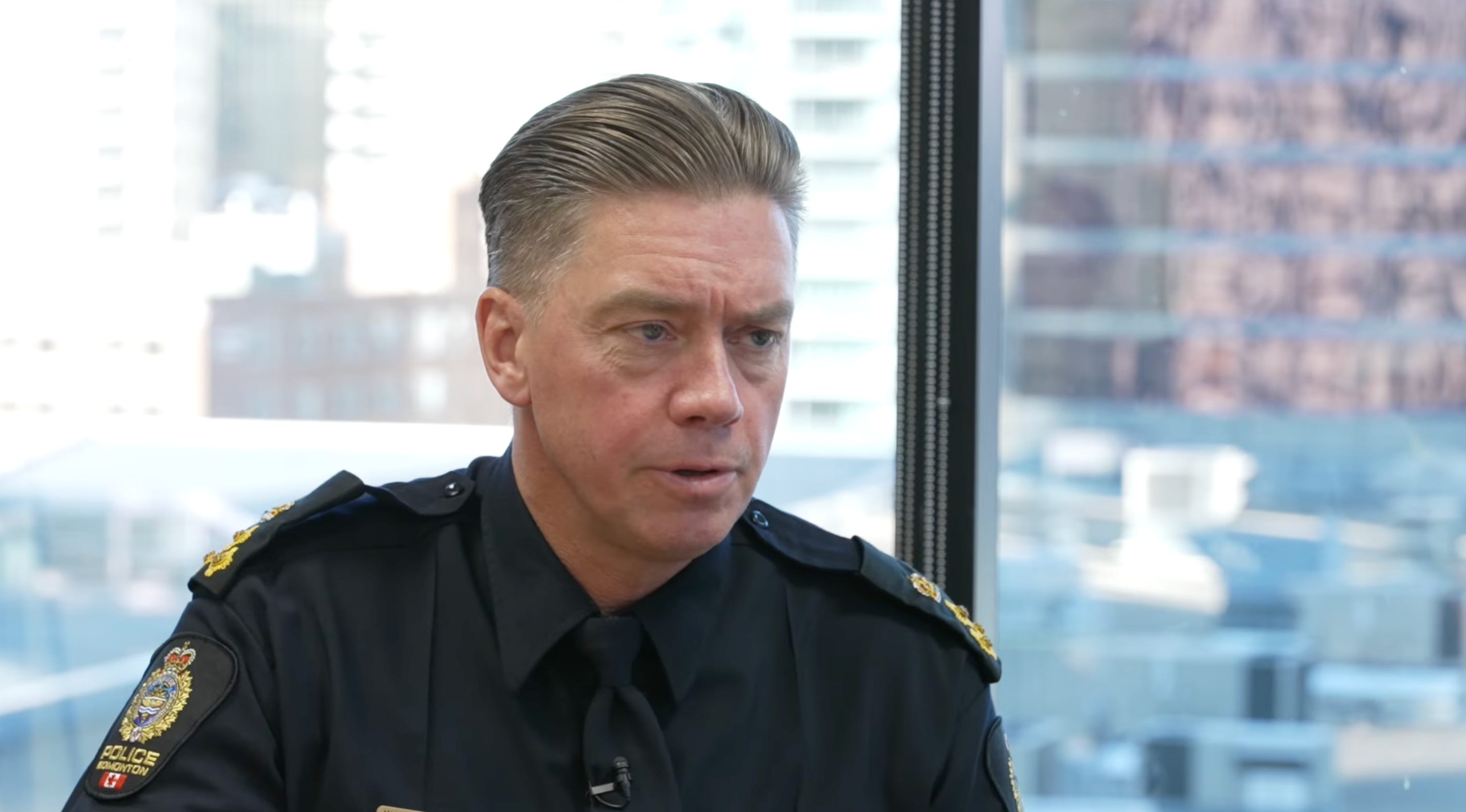
Edmonton Police Service Chief Warren Driechel visited the illegal West Bank settlements of Beit Horon and Qasr al-Yahud during his February 2026 trip to Israel. The trip was funded and organized by the U.S.-based Major Cities Chiefs Association.
Delegates met with the undercover Yamas Ayosh - Judea & Samaria Unit, which is under the direct command of the Israeli military. In November 2025, the unit killed two unarmed Palestinian men in the West Bank after they had surrendered in what the UN human rights chief called an “apparent summary execution.”
The trip included business class flights from Newark to Tel Aviv and back, with delegates staying for a week at the Ritz-Carlton Herzliya, a five-star coastal hotel where rooms cost a minimum of $745 USD a night.
One of the top sponsors of the Major Cities Chiefs Association is Axon, which manufactures the body-worn cameras that Edmonton cops are required to wear. Axon has partnered with the Israeli company Corsight AI — a firm with ties to former prime minister Stephen Harper — to implement facial-recognition technology on its cameras, which has been piloted in Edmonton.
The visit included a stop at the command and control centre for Mabat 2000, a network of CCTV cameras throughout occupied East Jerusalem that uses facial recognition technology to surveil Palestinians. Amnesty International has called the system an instrument of “automated apartheid.”
Edmonton’s police chief repeatedly travelled to illegal settlements in the occupied West Bank during his February 2026 trip to Israel and met with an undercover border police unit that had recently executed two unarmed Palestinian men after they had surrendered, according to documents obtained through access to information.
Edmonton Police Service (EPS) Chief Warren Driechel also visited a 24/7 facial recognition surveillance centre in occupied East Jerusalem that Amnesty International has described as part of a system of “automated apartheid,”
Driechel travelled to Israel from February 15 to 23 with the Salt Lake City-based Major Cities Chiefs Association (MCCA), which fully funded the excursion.
The MCCA paid to fly Driechel and six other police chiefs on business class from Newark to Israel and back. The trip included accommodation at the Ritz-Carlton Herzliya in Tel Aviv, a five-star luxury hotel on the Mediterranean Coast where a room costs a minimum of $745 USD a night.
The identities of the other delegates are redacted in the documents obtained by The Orchard, which include correspondences regarding the trip within the EPS and between the EPS and MCCA. The documents also include Driechel’s itinerary, and a briefing that was prepared upon his return to Edmonton.
The trip was unilaterally approved by Edmonton Police Commission Chair Ben Henderson without any public discussion among commissioners.
While there’s no indication from the available documents that Driechel met with him, Israel’s national police is overseen by Itamar Ben-Gvir, a convicted criminal notorious for his extremist rhetoric and behaviour. In June 2025, Canada, Australia, New Zealand, Norway and the U.K. all placed sanctions on Ben-Gvir for his role in facilitating violence against Palestinians.
The visit included meetings with local and national police forces, and tours of communities in southern Israel that were targeted in the Hamas-led Oct. 7, 2023, attacks, and the Yad Vashem Holocaust museum, as well as other historical and holy sites.
Upon reviewing Driechel’s itinerary, Michael Bueckert, the vice president of the advocacy group Canadians for Justice and Peace in the Middle East, told this newsletter that it was “much worse than any of us expected.”
“This tour is like an overview of all of the main institutions and actors directly involved in the apartheid control of the Palestinian people as a whole in so many ways,” said Bueckert.
In July 2024, the International Court of Justice (ICJ) issued an advisory ruling that Israeli occupation of the Palestinian territories it conquered in 1967 — namely, the West Bank, East Jerusalem and the Gaza Strip — is illegal and “tantamount to apartheid.”
The ruling adds that consequentially, states are “under an obligation not to render aid or assist in maintaining the situation created by Israel’s illegal presence in the Occupied Palestinian Territory.”
The ICJ is in the process of hearing a separate case brought forward by South Africa in early 2024, arguing that Israel is committing genocide in Gaza — a position shared by Palestinian, Israeli and international human rights groups, as well as the International Association of Genocide Scholars.
This context was almost entirely absent from local coverage of Driechel’s Israel excursion, which was first reported by CityNews in March.
In his post-trip briefing, Driechel said the trip provided him with “insight into policing under complex, rapidly evolving and extremely divisive conditions.”
Kevin Walby, a criminologist at the University of Winnipeg, told The Orchard that he understands why a Canadian police chief would want to travel abroad to learn best practices being applied in other jurisdictions.
He questions, however, why Driechel would travel to Israel if that was his aim.
“The fact that a Canadian police service would go to learn about apartheid policing should, just on the face of it, shock Canadians,” said Walby, who reviewed the documents.
He added that Canada already has discriminatory policing for Black, Indigenous and other racialized people, but that the EPS appears to “want more of it,” reflecting a “broader approach that mirrors what the Israeli police are doing.”
“Ultimately, the whole point is to ratchet up social control to the same levels that social control is doled out in Palestine,” said Walby.
The EPS did not acknowledge a list of detailed questions this newsletter sent about the trip documents.
Visiting illegal settlements
The MCCA delegation twice crossed the Green Line, which demarcates Israel’s internationally recognized borders, to enter settlements in the occupied West Bank.
The Canadian government’s longstanding position is that it “does not recognize permanent Israeli control” over the occupied territories, including the West Bank and East Jerusalem, and regards Israeli settlements as illegal and a “serious obstacle to achieving a comprehensive, just and lasting peace.”
On Feb. 21, delegates began the day with a tour of Qasr al-Yahud, a site in the Jordan Valley believed to be where Jesus was baptized.
Despite being located on the West Bank’s eastern border with Jordan, access to the holy site is controlled by the Israeli government.
On the morning of Feb. 23, the trip’s final day, Driechel travelled to Beit Horon, a settlement in the West Bank that is site of the Israel Border Police’s main instructional training facility, Bahad Magav, where he and other delegates received a briefing.
In the afternoon, delegates returned to the Israeli side of the Green Line to visit the Nitzani Oz checkpoint, which is located on the border of Tulkarem, a Palestinian city and refugee camp in the West Bank.
There they met with Yamas Ayosh - Judea & Samaria Unit, an undercover unit in the occupied West Bank, which Israeli officials refer to by its Biblical name, Judea and Samaria.
One of Driechel’s key talking points following the trip was that he met strictly with policing officials, not any government or military leaders.
But in his briefing, Driechel acknowledged how the National Israel Police’s “military origins continue to influence its operational model,” citing its “discipline and readiness,” and “command and control structures.”
“Readiness basically means readiness to apply lethal force — shoot to kill,” explained Walby. “That is a model that police here even say they’re trying to move away from.”
Driechel also noted the national force’s “exceptionally high level of integration with other security and enforcement bodies, including border services, patrol forces, and counterterrorism units.”
According to a 2023 report from the Institute for National Security Studies at Tel Aviv University, the Israel Border Police is “subordinate to the IDF’s Central Command in all matters related to its operations in the [occupied] territories.”
On Nov. 25, 2025, less than three months before Driechel’s trip, Yamas forces operating in the northern West Bank city of Jenin shot and killed two unarmed men — Al-Muntasir Abdullah, 26, and Yousef Asasa, 37 — after they had surrendered.
The Associated Press reported on the killing, which was caught on video:
In a video shown on Palestine TV, which has no sound, the two men come out of a garage holding their hands up and lifting their shirts to show they are not carrying explosives. They are ordered to the ground and kicked by one of the policemen. They are then ordered back to the garage. In a video shown by Egyptian TV station Al-Ghad, the men are ordered back to the entrance of the garage. As they are on the ground and surrounded by troops, gunshots are heard and the men slump down, apparently lifeless. At least one soldier is seen firing his weapon.
UN High Commissioner for Human Rights Volker Türk condemned the two men’s “apparent summary execution” as a “brazen killing.”
Israel’s far-right National Security Minister Itamar Ben-Gvir travelled to the Yamas unit’s base the day after the killings to “hug the heroic fighters” and promote their commander to deputy superintendent.
The Orchard asked the EPS if Chief Driechel was aware of this recent history when he met with the unit, but received no response.
Within the Green Line, MCCA delegates met with police officials in Rishon LeZion, the Gaza border town of Sderot, and the Palestinian cities of Nazareth and Taybe.
The identity of an official the delegates met in Rishon LeZion is redacted.
According to reporting from CNN, Israeli police have solved just 15% of homicides in Palestinian communities within the Green Line, compared with 65% in Jewish communities.
Controlling the message
The ATI documents include emails between EPS chief of staff Patricia Misutka, director of external relations Lauren Wozny and two MCCA representatives whose names are redacted, in which the EPS grants the U.S.-based organization oversight of communications regarding the delegation.
On Feb. 6, after the EPS began receiving media inquiries, Wozny wrote: “are we ok [sic] to confirm he will be visiting Israel (no mention of delegation) and that for security purposes we are unable to share additional details until he has returned?”
The MCCA official responded: “If you need to confirm the trip now, please do not mention the delegation (MCCA, other participating chiefs, etc.). Whatever you plan to distribute after the meeting, can you share it with us first?”
On March 6, Wozny wrote to the MCCA, referencing CityNews’s impending story:
Sounds like the trip went well.
Just following up on this as the Chief has an interview with a local media outlet regarding his trip next week. If you have any key messaging you’d like us to reference, let us know and we will build that into his briefing. We’ll be writing a generic statement for any other media that may follow up as a result, which I will share with you for info once it’s written.
Internal messaging among EPS employees from before and during the trip reveals an awareness that Driechel’s Israel jaunt would be controversial among the public whose interest he is sworn to serve.
On Feb. 11, Misutka wrote an email with the subject line, “Fw: MCCA Delegation to Israel — CONFIDENTIAL,” which relayed Driechel’s itinerary and other trip details to EPS Deputy Chief Nicole Chapdelaine, Wozny and legal counsel Megan Hankewich.
“Sharing for the purpose of managing leaks and messaging in advance of Chief’s return, as well as for potential investigation info. Please do not share beyond what is absolutely essential,” wrote Misutka.
This newsletter asked the EPS to elaborate on what Misutka meant by potential investigation, but received no response.
A Feb. 20 email from Police Operations Chief Devin Laforce to Wozny and J’lyn Nye, a former journalist and broadcaster who is now the EPS’s director of marketing and digital media, suggests that the Edmonton Police Commission (EPC) was kept out of the loop about the trip that their chair approved.
In the email, Laforce notes that the chief had a meeting scheduled with the EPC to discuss his trip at some point in early March.
“The one caveat, and you need to ensure, [sic] that the Chief does not meet with media on this topic until after he has had a chance to speak with the EPC,” wrote Laforce.
The University of Winnipeg’s Walby said that these exchanges reveal that the EPS’s “allegiance as an institution is to these other policing bodies.”
“They don’t have an allegiance to the citizenry, “ he said, adding:
It points to some bigger problems with Canadian police. They’re not really accountable to us through police boards or any other modality. They do whatever they want, they partner with whomever they want, they’re actively spinning what they’re doing, so you can see the PR machine that they have kick into action here.
Who is Company C?
On the trip’s penultimate day, Driechel and the other delegates received a briefing in occupied East Jerusalem on the mass use of facial-recognition technology, which the EPS has piloted on a smaller scale, before meeting with a representative of an unidentified firm.
One of the MCCA’s top sponsors is Axon, a U.S. military contractor which provides the association with $150,000 a year as a “capstone sponsor.”
In December 2025, EPS acting superintendent Ken Martin boasted about EPS being “the first police service in the world to test Axon’s facial recognition technology” on officers’ body-worn cameras.
CBC investigative journalist Taylor Lambert reported in April that while Axon provides the body-worn camera hardware, the facial-recognition software comes courtesy of the Israeli company Corsight AI, whose technology the Israeli military has deployed to conduct surveillance in Gaza.
Corsight AI is co-owned by the Israeli AI firm Cortica and Awz Ventures, a Canadian investment firm that boasts former prime minister Stephen Harper as both a partner and president of its advisory committee.
Corsight officially launched in 2019 after Awz Ventures provided it $5 million in funding, and three of its five board members are Awz partners.
On Feb. 22, according to Dreichel’s itinerary, the MCCA delegation received a security briefing at Mabat 2000 - Old City Command and Control in occupied East Jerusalem.
Mabat 2000 consists of a network of thousands of CCTV cameras that extract biometric data from Palestinian residents of East Jerusalem without their consent.
“The system enables Israeli authorities to identify protestors and keep Palestinians under constant observation, even as they go about their ordinary daily activities,” reads a May 2023 Amnesty International report entitled Automated Apartheid: How Facial Recognition Fragments, Segregates and Controls Palestinians in the [Occupied Palestinian Territories].
After a guided tour of holy sites in Jerusalem, the itinerary lists a 1 p.m. “lunch with Company C.”
At 2 p.m., the delegates had a security briefing and tour with the Israel Border Police, followed by two timeslots that are listed as “TBD.”
The EPS didn’t respond to inquiries about whether “Company C” was Corsight, nor whom delegates met with during the TBD timeslots.
“The purpose of the trip was educational, and no contracts, equipment or training were procured during the trip,” reads a statement EPS spokesperson Cheryl Voordenhout sent to media in March.
In his briefing to the EPS, Driechel mentioned technology in the context of “identifying, prioritizing, and acting on credible threats quickly and effectively.”
“Those posing security threats often use technology to carry out their actions. This means police must be leaders in technological advancement to proactively respond to and counter attacks,” he wrote.
Bueckert of CJPME said that the combination of the EPS piloting Israeli facial recognition technology and the chief’s tour of an Israeli surveillance hub underscore how “these tours are inappropriate.”
“There’s nothing really to learn, unless you are open to thinking about the Edmonton public as a hostile population to be subdued, repressed and terrorized,” he said.
‘There’s no bridge building at this point’
When news of the trip broke, the National Council of Canadian Muslims issued an open letter signed by more than two dozen local organizations and mosques that called for Dreichel’s resignation.
“For many members of Edmonton’s Muslim community, particularly those with family directly impacted by the ongoing genocide, this decision has caused deep pain,” reads the March 11 letter.
“It has also significantly undermined trust in the Edmonton Police Service at a moment when trust between police and communities is more important than ever.”
Bueckert of CJPME said that “all of the concerns from the community about this trip, and what it means for how the police views its relationship to its community at home, have totally borne out.”
”It’s incredibly grotesque, immoral and absolutely disqualifying,” he added.
The Jewish Federation of Edmonton accused Driechel’s critics of engaging in “libels and accusations that are divisive and seek to normalize anti-Israel sentiment and hate,” and circulated a petition calling on Edmontonians to “stand with Chief Driechel against the extremists.”
Driechel told CityNews that he travelled to Israel because, like Edmonton, both Jews and Muslims live there, and that he wanted to “understand what’s occurring there and how it’s informing what’s going on in our own cities.”
In his post-trip briefing, Driechel wrote without elaboration that he was “mindful that it offered a single lens on complex issues, and that there are other perspectives and realities to consider.”
The Orchard asked the EPS what measures Driechel has taken to consider other perspectives and realities, which went unacknowledged.
The chief has refused to apologize for the trip. “What can I be sorry for?” he told reporters. “I’ll continue to work with the community on their concerns.”
But will the community continue to work with Driechel?
Mousa Qasqas, a local activist who hails from the West Bank, has taken flak from fellow Palestinian-Canadian community members for his previous willingness to engage with the EPS when organizing pro-Palestinian protests in the city.
“Now I’m of the opinion we need the police chief gone,” he told The Orchard upon learning of Driechel’s Israel itinerary, emphasizing that he was speaking only for himself.
“He went to an area that is considered illegal by his own government. That, to me, is too much. There’s no bridge building at this point. There’s no reconciliation. There’s nothing we can do.”
Edited by Richie Assaly
Solid reporting and a helluva story.
Another eye opening, comprehensive report Jeremy.