

This story was originally published in Alberta Native News.
Sturgeon Lake Cree Nation (SLCN) was in court Tuesday in an effort to stop the collection of signatures for a citizen-initiated referendum on Alberta independence.
SLCN filed a lawsuit in January against the provincial government, the federal government and Alberta’s chief electoral officer for permitting the petition process to proceed. It’s one of four legal challenges launched by First Nations against the province facilitating an independence referendum.
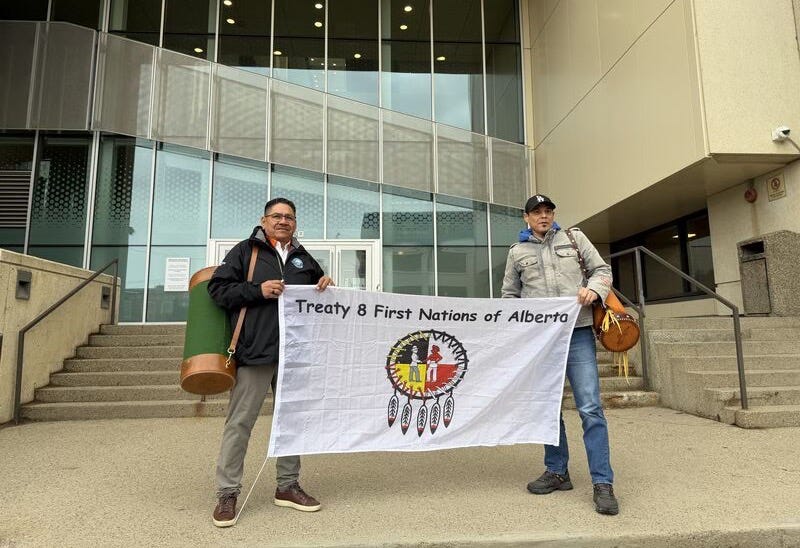
“It didn’t need to get to this point, but now that we’re here, we really want to express to all governments that First Nations aren’t going anywhere,” SLCN Chief Sheldon Sunshine told reporters outside of the downtown Edmonton courthouse where the case is being heard.
The Treaty 8 First Nation argues that since Alberta isn’t a party to the Treaty, it cannot begin discussions about altering the Treaty without First Nations’ consent.
“Only a Treaty party has jurisdiction to initiate such amendments. And as a consequence, certainly only a Treaty party can initiate the process to terminate the Treaty,” SLCN’s lawyer Orlagh O’Kelly told the Court of King’s Bench.
SLCN’s challenge of the separatist petition centres on the Justice Statutes Amendment Act (Bill 14), which was passed into law in December. Among other changes, legislation amends the Citizen Initiative Act to remove a prohibition on citizen initiatives that are unconstitutional.
The legislation was passed after Court of King’s Bench Justice Colin Feasby ruled that the outcome of Alberta independence would violate section 35 of the 1982 Constitution Act, which enshrines “aboriginal” and Treaty rights, because those rights only exist in Canada.
“Despite full knowledge of this legal finding, Alberta did not appeal it. Instead, they ignored and undermined the court’s findings and the Treaties,” said O’Kelly.
The passage of Bill 14 enabled the separatist organization Stay Free Alberta to begin collecting signatures to put Alberta independence on the ballot.
But O’Kelly argued the implications are much wider, enabling the initiation of other referendums that could ask to curtail other rights, including the ability of children with complex needs to attend public schools, gay marriage or abortion.
Tuesday’s hearing was narrowly focused on whether Justice Shaina Leonard should grant SLCN’s request for an injunction against the collection of petition signatures.
O’Kelly emphasized that SLCN’s injunction request is “not a big, sweeping injunction.” The First Nation isn’t seeking to repeal Bill 14 in its entirety, but only the section that permits unconstitutional referendums.
She added that the changes in Bill 14 create a “binding process,” in which the chief electoral officer “shall” order a referendum if a referendum petition meets the diminished requirements in the Citizen Initiative Act.
“This is mandatory language. It means that if the signature threshold is met, that it will go to a referendum,” said O’Kelly.
Bill 14 amended the Referendum Act to add that “if the results of a referendum are binding, the government that initiated the referendum is not required to implement the results” of an unconstitutional referendum, but O’Kelly argued that this is “discretionary.”
Chief Sunshine said that if SLCN’s injunction is successful, he anticipates Premier Danielle Smith will change the law again to accommodate separatists.
“This is one fight of many that are upcoming,” he said. “These laws weren’t built for us, but we have to live within them because we’re forced to, not because we want to.”
In its argument for an injunction, SLCN focused on the “irreparable harm” that will occur if the referendum is allowed to proceed, referring to harm that cannot be financially remedied.
In this case, harm includes damage to the Treaty relationship, disinformation on Treaties’ role in debates over separatism, racism, and foreign interference.
“Without an injunction, if … the petition goes to a referendum and it’s ultimately determined that this was unconstitutional or unlawful, the harm is done, even if the referendum is unsuccessful,” said O’Kelly.
She added that proving irreparable harm, “unless it has occurred or is ongoing, is by definition prospective.”
“If you have a refugee facing deportation, they say they fear death in their own home country … they do not need to go back there to prove that they will face death. They provide evidence, and the court can make reasonable inferences to decide whether to stay or not stay deportation,” O’Kelly said.
Alberta Justice lawyer Neil Dobson described a referendum as a “policy tool in terms of determining whether there is sufficient support in the electorate” for a proposal, with the government maintaining final discretion over its implementation.
“An injunction would remove an avenue to have those concerns heard and addressed in a public forum,” said Dobson.
He argued that “there are other drivers for the harms” described by SLCN, although he didn’t specify what they are.
“The issue of separation and the desire for separation isn’t a result of the bill being passed. It’s not a result of the Citizen Initiative Act process,” Dobson said.
He added that the referendum process encourages democratic values of “compromise, negotiations and deliberations.”
“No one has a monopoly on truth, and our system is predicated on the faith that in the marketplace of ideas, the best solution to public problems will rise to the top,” Dobson said. “Inevitably, there will be dissenting voices.”
Outside the courthouse, Stay Free Alberta lawyer Jeffrey Rath claimed to reporters that O’Kelly “deliberately omitted” section 35.1 of the Constitution from her arguments, which he said “directly respects and entrenches First Nations rights to be consulted in the context of any devolution of federal powers relating to First Nations.”
O’Kelly repeatedly invoked section 35 in her arguments, including the subsection Rath mentioned.
“There is no unbridled right to petition for the breakup of Canada, nor is there unbridled parliamentary supremacy,” O’Kelly said in court. “Even the Government of Alberta is not above the rule of law in the Constitution of Canada, namely section 35.1, which protects our general and Treaty rights.”
Chief Billy-Joe Tuccaro of Mikisew Cree First Nation was at the courthouse to support SLCN.
“This is all about resources and us as Treaty 8 First Nations are not going to allow that to happen. We know that that’s the big push behind all this,” said Tuccaro. “If people want to leave, by all means, go anywhere you want. It’s that simple.”
Mikisew Cree Nation has initiated its own court proceeding against the provincial government’s “referendum regime,” which isn’t being heard this week.
Proceedings continue Wednesday with arguments from Athabasca Chipewyan First Nation.
Thank you Jeremy for sharing facts & news with another eye opening informative report on the Alberta separation and referendum issue. The quote from the loud minority is very telling about today’s dystopian world:
“No one has a monopoly on truth, and our system is predicated on the faith that in the marketplace of ideas, the best solution to public problems will rise to the top,” Dobson said. “Inevitably, there will be dissenting voices.”
People now have a license to Trump marketplace ideas and make facts and truth relative. ‘Injustice is okay if there are dissenting voices.’ Thank you independent media for quelling misinformation and disinformation.
Glad this is in front of the Courts!