

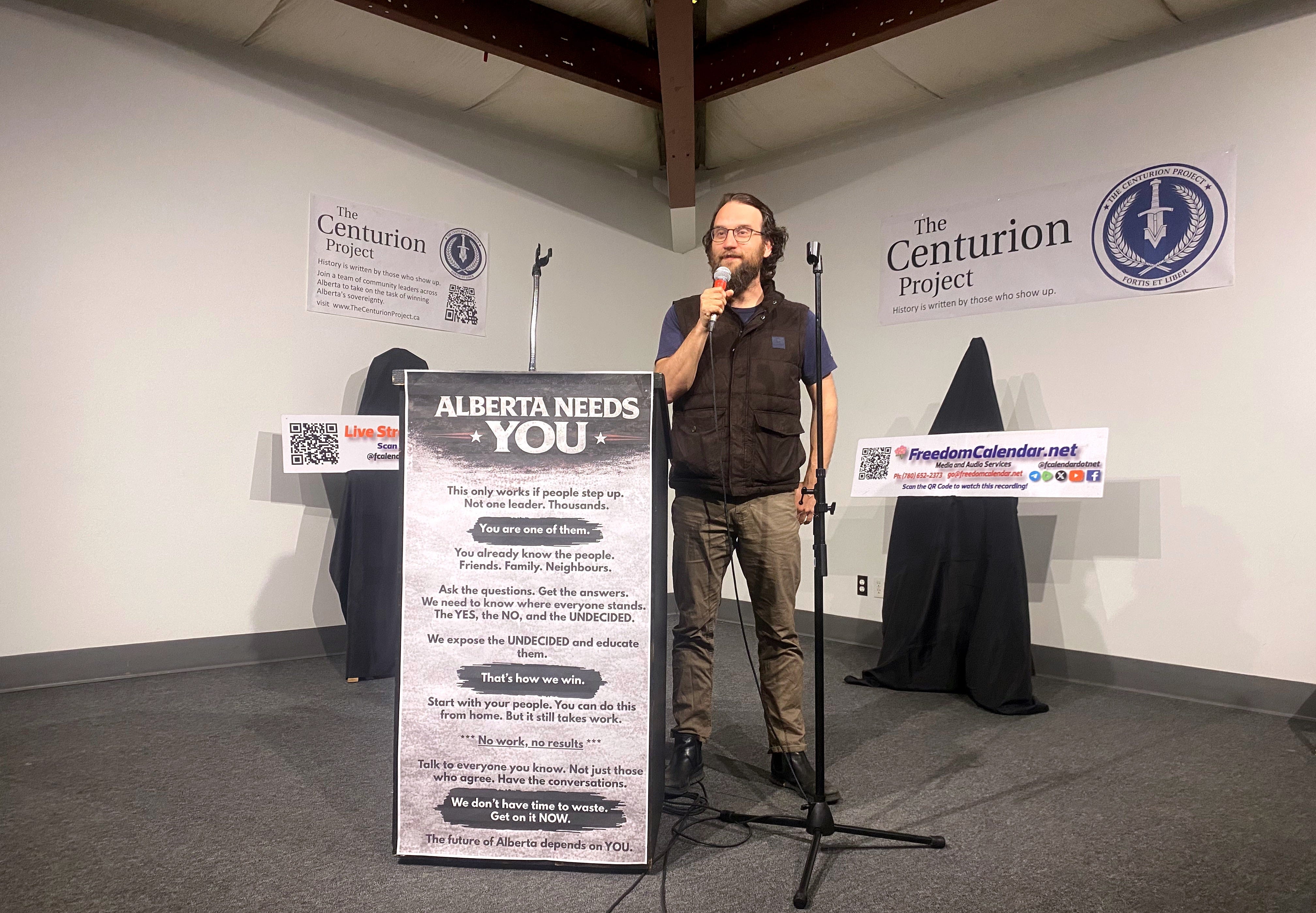
A retired lawyer in rural Alberta has launched a class action lawsuit on behalf of nearly three million Albertans whose personal information became publicly accessible in a separatist organization’s voter identification database.
The June 25 statement of claim names the Alberta government, chief electoral officer, the Centurion Project and its founder David Parker, the Republican Party of Alberta and “John Doe” as defendants.
“The breach has exposed millions of Albertans to loss of privacy, misuse of personal information, identity-related risks, profiling, targeting, harassment, and significant distress arising from the loss of control over their personal information,” reads the statement of claim.
The lead plaintiff is Cliff Docken, a retired class action practitioner lawyer, in Bragg Creek, Alta. As a result of the breach, Docken had to purchase identity theft insurance, according to the statement of claim.
The Centurion Project is under RCMP, Elections Alberta and Office of the Information and Privacy Commissioner of Alberta investigation for allegedly building a database of 2.9 million voters for an illegally obtained provincial list of electors.
The plaintiff class for the lawsuit includes anyone whose information was included in the Centurion database, but the lawsuit proposes an additional “vulnerable person subclass.”
The subclass includes victims of domestic violence, peace officers and others who work in the justice system, health-care professionals, journalists, politicians and anyone whose physical safety could be demonstrably impacted adversely from their residential information being publicly accessible without their consent.
Readers may recall that Elections Alberta showed up with Edmonton police to the April 29 launch of the Centurion Project to inform organizers that they were under investigation for obtaining and using a copy of the province-wide list of electors, which is only supposed to be in possession of political parties.

I happened to be there. As my story went to press in the morning, Elections Alberta was in court to get a temporary injunction ordering the Centurion Project to take down its database, which anybody could sign up for. The Court of King’s Bench granted this request.
Because each copy of the list of electors is seeded with different fake names, Elections Alberta determined that the Centurion Project used the same list provided to the separatist Republican Party of Alberta in 2025, although it remains to be determined how the Centurion folks obtained this list.
Journalist Jen Gerson first received a tip that the Centurion Project’s database was ill-begotten, which she forwarded to Elections Alberta on April 1 — almost a month before the elections watchdog initiated its investigation.

On April 10, Gerson received a letter from Election Commissioner Paula Hale, claiming that “with the evidence currently available there are not reasonable grounds to allow me to direct an investigation.”
Hale called Gerson’s evidence “compelling,” but said she can’t “discount the potential that data you attributed to being from the list of electors was not from another legitimate source such as Canada Post or the various data brokers.”
Gerson, however, told me that she provided Elections Alberta with evidence that the Centurion database included voter identification and polling station numbers, which Elections Alberta lawyer Joey Redman said in court was how the watchdog determined the database could have only come from the electors list.

Gerson’s early intervention is absent from the statement of claim’s timeline of events.
The lawsuit separates the defendants into three categories: those who are responsible for the collection and safe retention of voter data (the Alberta government and chief electoral officer), those who obtained the data legally but failed to protect it (the Republican Party of Alberta) and those who obtained it illegally and distributed it (Centurion, Parker and John Doe).
John Doe is being used as a catch-all for the various actors who have “obtained, accessed, distributed, downloaded, disclosed, or used the personal information of Class members.”
“The Defendants knew or ought to have known that the List of Electors contained highly sensitive personal information requiring the highest degree of protection,” the statement reads.
“The Defendants knew or ought to have known that unauthorized disclosure, dissemination, or misuse of the information would create foreseeable risks of identity theft, fraud, harassment, stalking, intimidation, political profiling, doxxing, threats to personal safety, and other harms.”
The data breach represents a violation of the Canadian Charter of Rights and Freedoms sections 7 and 8, which uphold the right to “life, liberty and security of the person” and protect against “unreasonable search and seizure,” respectively, the claim contends.
The statement includes several alleged breaches of the Election Act, including section 19(1), which requires political parties to “take all reasonable steps to protect the list and the information contained in it from loss and unauthorized use,” and section 20, which outlines acceptable uses for the list.
It’s noteworthy that this lawsuit isn’t only targeting the actors who allegedly improperly disseminated the list of electors but also includes the government, says political scientist Lori Williams of Mount Royal University in Calgary.
“As always with lawsuits, they go after the deepest pockets, generally speaking, because there are costs associated with this,” Williams said in an interview, adding:
There are people who are going to have to subscribe to services to protect their information, or to monitor whether that information has been disclosed or is being improperly used, and of course, there may be security costs that are associated for some people. Those costs are things that people want to recoup.
Williams also noted the inclusion of Parker personally as a defendant. Parker has twice come under Elections Alberta scrutiny for his activities — first with Take Back Alberta in relation to undisclosed advertising for the UCP during the 2023 provincial election, and then with the Centurion Project.

In both cases, Parker claimed that he was the victim of government persecution and has refused to co-operate with investigators.
“This isn’t about the government, this is about fellow citizens saying this is disrespectful of us, of our rights and our privacy — things that [Parker] says he cares about — and so it’s particularly damning for him,” she said.
Parker didn’t respond to The Orchard’s request for comment.
While the Court of King’s Bench ordered the Centurion Project to take the database down, and for Centurion and the Republican Party to provide a list of every person who accessed it, the statement notes that the “full extent of dissemination remains unknown.”
“The Plaintiff pleads that copies, extracts, screenshots, downloads, derivative databases, derivative datasets and reproductions of the List of Electors may remain in the possession or control of unknown individuals and entities both within and outside Alberta and Canada,” the statement reads.
The claim further alleges that this leak was “not an isolated incident but arose from systemic failures in governance, oversight, supervision including security controls, access management, auditing, monitoring, training, reporting and security compliance.”
Williams noted that in addition to providing financial remedy and acting as a deterrent against future abuse of the list of electors, a successful class action suit could spur legislative changes.
Two specific changes Williams said are necessary to prevent another Centurion scandal is removing political parties’ exemption from being investigated for privacy breaches, as well as reducing the amount of information parties can collect and narrowing who within parties can access it.
“All of those things need to be part of this process as well,” she said.
You can read the full statement of claim below.
