

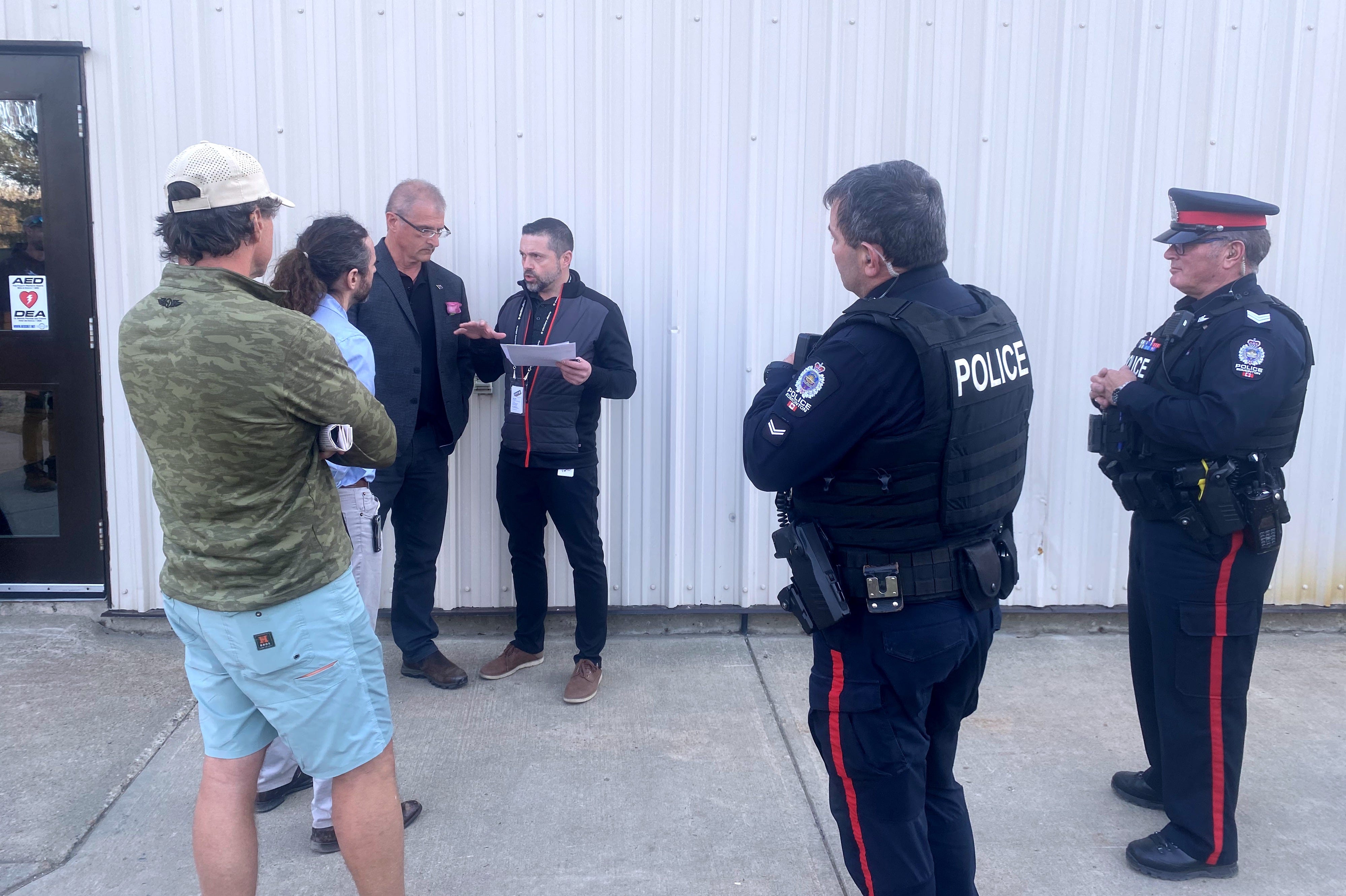
An Elections Alberta official showed up to the launch of David Parker’s new separatist scheme with several Edmonton cops to inform the group that they’re under investigation for allegedly accessing the province’s list of electors.
Only official political parties, MLAs, constituency associations and candidates are permitted to obtain the list, which includes voters’ names, addresses, phone numbers and voter registration numbers.
Parker launched the Centurion Project on Wednesday at the Edmonton Oilfield Technical Society in the city’s deep south, which I attended.
Minutes after Parker finished speaking, Elections Alberta and the Edmonton Police Service arrived. I happened to be outside for fresh air, pondering the privacy implications of what Parker had just unveiled.
“At this point, there’s a concern that your organization is in possession of and using the list of electors,” Elections Alberta investigator Ryan Tebb told Tim Hoven, a disqualified 2023 UCP candidate and separatist who also spoke at Wednesday’s event.
Tebb said the elections watchdog “has reason to believe” that the organization has built a “database” of voters from the electors list, and will be commencing an investigation.
The investigator told Hoven that chief electoral officer Gordon McClure emailed a cease-and-desist letter to one of the Centurion Project’s listed directors, Jordan Parker, on April 28. It’s unclear whether Jordan is related to David.
“It’s not clear to us that the people at this event tonight have knowledge of the cease-and-desist letter that was sent yesterday. We don’t know how well that was disseminated amongst the organization,” said Tebb.
He emphasized that “we’re not trying to shut [this event] down,” and it continued as planned.
Hoven, who ran as an independent candidate in Rimbey–Rocky Mountain House–Sundre after his disqualification, was fined $1,000 by Elections Alberta and his campaign’s chief financial officer was fined the same amount in November for exceeding the candidate spending limit.
Nor is this the first Elections Alberta investigation for David Parker.
In February 2025, Parker was individually fined $7,500 and his organization, Take Back Alberta (TBA), fined $112,500 for undisclosed election spending in 2023.
When he revealed that TBA was under investigation in January 2024, Parker claimed that it was an instance of “lawfare” by the union fat cats at Elections Alberta (which isn’t unionized) in retaliation for his advocacy, pledging not to co-operate.

Suffice it to say, the group of separatists who gathered around Hoven and the Elections Alberta investigator didn’t take kindly to his intervention.
One accused Elections Alberta of sending their “gestapo” to a private gathering, likening it to authorities’ behaviour during the Covid-19 pandemic.
Online, another separatist complained that the police showed up to their “public meeting.” “Nothing to see here,” wrote Jon Sedore.
Elections Alberta is normally precluded from commenting on an ongoing investigation, but it issued a statement on Thursday morning outlining the nature of the investigation.
“Due to the extremely sensitive nature of the information contained in the List of Electors, we believe it is critical for Albertans to be aware,” read the statement.
The elections watchdog emphasized that there was “no breach of Elections Alberta’s databases or systems.”
“The unfolding situation is believed to involve a third party and to have occurred as a result of the inappropriate use and/or distribution of the list of electors by a registered political party that was a legitimate recipient of the list,” said the statement.
The Office of the Information and Privacy Commissioner of Alberta has been informed.
So what is the Centurion Project? It wasn’t entirely clear from Parker’s rambly, albeit characteristically fiery, speech. But as I learned it was under Elections Alberta investigation for using the electors list, the initiative came into sharper focus.
In short, the Centurion Project is an app that separatists can sign up for and identify, or “claim,” potential supporters by sending them a survey to complete, which is where a database of voters might come in handy.
“I do not think that the current methods that we are using will get us independence,” Parker stated.
He praised the efforts of Alberta Prosperity Project CEO Mitch Sylvestre, who has been hosting town halls across the province to collect signatures for an independence referendum petition that is currently being held up in court.
Parker claimed that more than 300,000 people have signed the independence referendum petition, coming close to doubling the approximately 178,000 signatures required.
“However, we are not going to win independence with pop ups and town halls or door knocking or phone calling,” he said. “We’re not going to because what we face is every single institution against us.”
He claimed that Alberta’s treatment within Canada is “worse than the slavery they wrote about in Exodus.”
At this point, a member of the audience who appeared otherwise sympathetic shouted, “can you cut the bible belt crap?”
“Buddy, I’m speaking, you’re not speaking. Sit down,” said Parker to applause.
Parker said he learned about the technology when he was on tour with famed far-right American podcaster Tucker Carlson. The company that created it sponsored Carlson’s tour stop in Grand Rapids, Michigan, in September 2024.
Parker claimed that it helped President Donald Trump win Michigan in the presidential election two months later.
Noting the inefficiency of door knocking and making phone calls, he boasted that with the Centurion Project, it will take 15 minutes to identify 10 people. Those people can then go identify 10 people of their own, which has been dubbed the “10x strategy.”
“It’s not a multi-level marketing company,” Parker said, re-assuring the audience that nobody is being paid to participate.
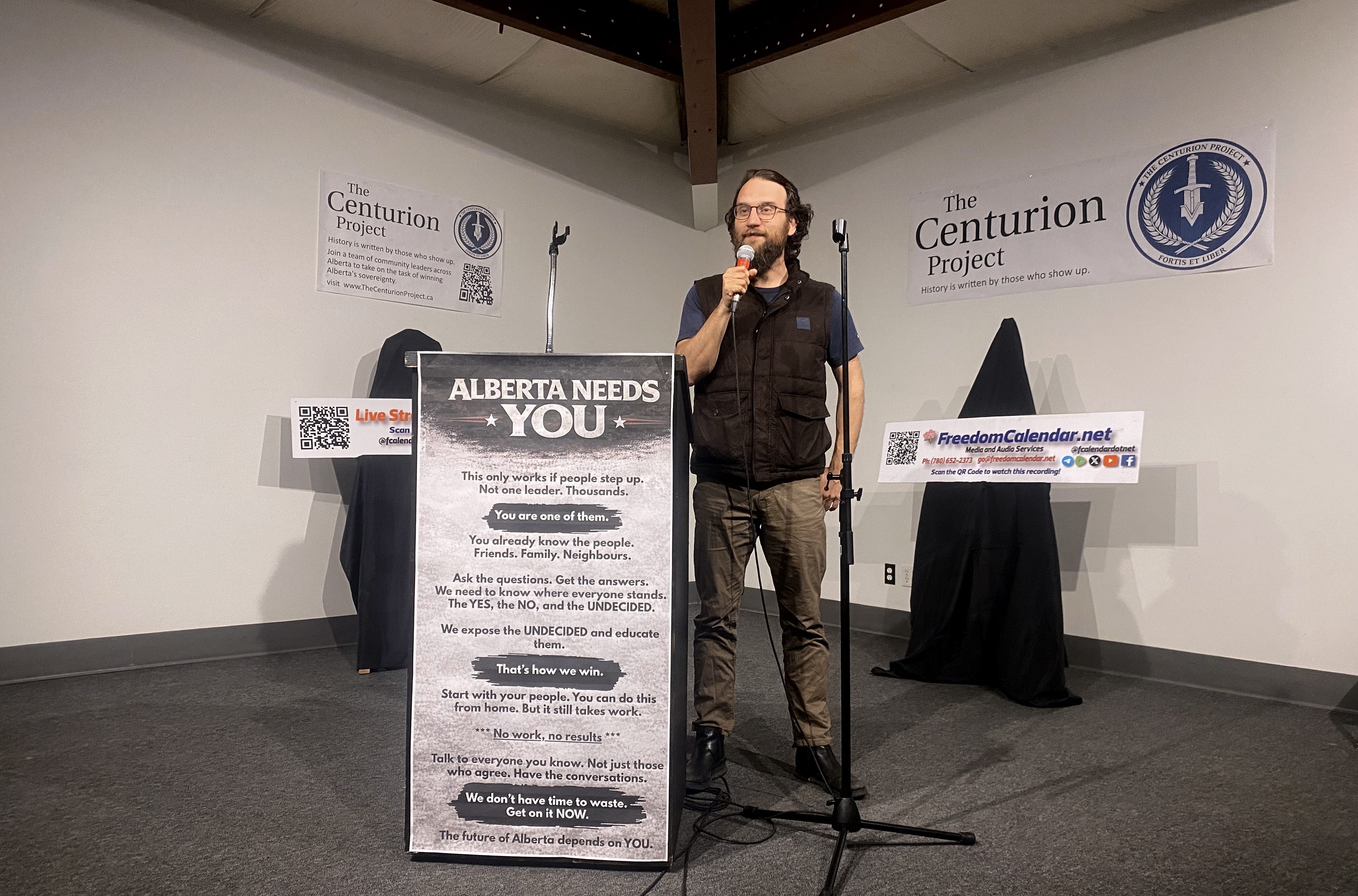
He recalled that during the 2023 election campaign, he urged supporters to find 10 people to vote UCP, but had no means of verifying that anyone had actually done that.
“Now we have a way of accountability,” he added, implying some sort of surveillance mechanism before emphasizing that the identities of voters that each participant has claimed are anonymized.
“Nobody in Alberta can see who you claim. It’s your list,” said Parker. “You take responsibility.”
Interestingly, section 18(7) of the Election Act states:
For the purpose of tracing the unauthorized use of the list of electors, the Chief Electoral Officer may have fictitious voter information included in a list of electors provided under this section.
If the Centurion Project does indeed have the list of electors, the obvious question is who gave it to them?
This story has been updated to include Elections Alberta’s statement on the investigation.
Great reporting, Jeremy. Since “only official political parties, MLAs, constituency associations and candidates are permitted to obtain the list, which includes voters’ names, addresses, phone numbers and voter registration numbers” it’s not difficult to determine who gave them the list.
Knowing that political parties are one of the permitted organizations to access the voters list but are also completely exempted from privacy regulation (even security measures), I think this underlines the need for parties to be regulated with regard to the (extensive) personal information they can access, collect and compile. BC political parties are subject to BC PIPA already. If Minister Glubish is serious when he says he wants Alberta to be a leader in privacy protection, he would address this gap when amendments to Alberta PIPA are put forward.