


This piece is being co-published with Lily Polenchuk’s newsletter.
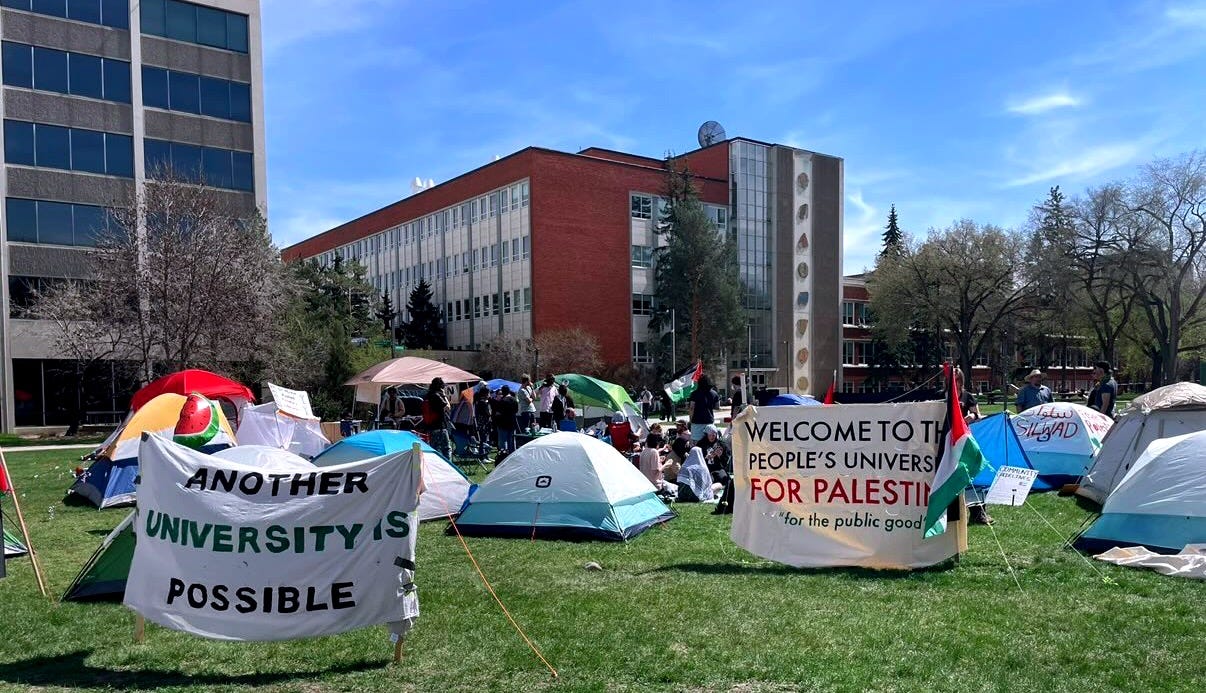
Alberta’s Ministry of Advanced Education removed references to the government’s commitment to campus free speech from early talking points regarding the May 2024 pro-Palestine encampments at the University of Alberta and University of Calgary, according to documents newly obtained through freedom of information.
The draft key messages, which were distributed the day encampments were established on May 9, also included a specific reference to encampments as an example of “illegal tactics” that aren’t permissible, which was similarly removed from the final version.
Roberta Lexier, a historian of social movements at Mount Royal University (MRU) in Calgary, reviewed the documents, noting that they show the government “trying to thread a very fine needle between these sort of claims they’re making around free speech and its importance on campus, and then what happens when free speech actually happens on campus in the form of an encampment.”
“Free speech only applies to the groups that they want to support,” Lexier added, referring to anti-trans and residential school denialist speakers who have attracted protests or had their events shut down on campus.
“As soon as there’s a protest about something that they don’t support, they have to find a different way to counter that. They can’t just clamp down on free speech, because that’s going to look really bad and be really contradictory, and so then they move to this idea that encampments are illegal.”
The ministry attempted to conceal changes between its draft and final messaging for almost two years.
The UCalgary encampment was forcibly dismantled by police before the end of May 9 and the UAlberta camp was removed in the early hours of May 11.
A co-author of this piece, Lily Polenchuk, filed a FOIP request with the Ministry of Advanced Education on May 14, 2024, seeking all correspondence pertaining to the UAlberta encampment sent between May 9 and May 12, 2024.
In June 2024, Polenchuk received partial access to the requested records. According to the ministry’s response letter, information was redacted because it contained advice from officials, was deemed non-responsive to the request, or was expected to cause harm to personal privacy, law enforcement, and the interests of a public body.
A few days later, Polenchuk requested a review of the redactions by the Office of the Information and Privacy Commissioner (OIPC).
On May 28, 2026, the OIPC told Polenchuk it had asked the ministry to “reconsider” some redactions, including internal discussions about government communications, the ministry’s role in responding to campus protests, and the planning surrounding the encampment’s removal.
Among the disclosed records was an early draft of the ministry’s messaging on campus protests.
The draft instructed officials to respond to questions about demonstrations on campus by saying, “I respect the right of students to protest, but illegal tactics - like encampments - are the wrong approach.”
The reference to encampments being an illegal tactic had been redacted from the original disclosure. In the final key messaging draft, “like encampments” was removed entirely.
Also redacted from the initial key messaging draft was background information on the Alberta government’s policy requiring post-secondary institutions (PSI) to report annually on free speech on campus. However, this background on free speech reporting was entirely omitted from the final messaging.
Michael Litwack, an English and Film Studies professor at UAlberta who participated in the encampment, reviewed the documents.
He said they show how the “government and the university are committed to freedom of expression and academic freedom in a very partisan way – which is to say, for Zionists [and] those who agree with the UCP’s policies, but for students, staff, and faculty who gathered to defend Palestinian human and political rights, those basic charter freedoms were not respected.”
Litwack is co-plaintiff to a lawsuit against his employer alongside two Palestinian-Canadian graduate students, Noor Abdo and Mustapha Yassin, alleging that the university violated their Charter-protected freedoms of association, assembly and expression.

The documents also include correspondences from members of the public. All but one expressed concern about police’s heavy-handed approach towards the encampment at UAlberta after it was taken down.
On the afternoon of May 10 – after the encampment at UCalgary was taken down but while the one at UAlberta remained – an email was sent directly to the Premier’s Office, which reads:
Honourable Premier Smith,
This image today on the UAlberta campus is not free speech. This morning you stated on the radio but encampments as long as they don’t insight, violence or antisemetic or hateful hurtful rhetoric might be OK? This is not OK globalizing me antifa [sic] calls for the destruction of the Jewish people. This is hurtful, Hateful and should not be allowed. As you know protest is one thing hate and intimidation is another. Please do the right thing for the Jewish people And [sic] students of Alberta and Edmonton…
This was the sole correspondence from a member of the public that received a formal response. The email from which it was sent is redacted.
On May 13, the Premier’s Office forwarded the email to the Ministry of Advanced Education, requesting that ministry staff “determine and prepare the most appropriate Ministerial Response for [redacted] and the attached correspondence on behalf of the Premier, due by June 03, 2024 [emphasis in original].”
The revised records disclosed previously withheld parts of internal correspondence from Ministry of Advanced Education director of business operations and strategic services Taylor Daum, which reveal how the ministry saw its role vis a vis the university encampments.
Daum wrote that emergency planners from PSIs met prior to the UAlberta encampment to discuss protest management, and that institutions should communicate with their local municipalities first.
Previously redacted portions of Daum’s memo state that the issue was “less about emergency management” and “more about public relations and issues management.”
Daum added that he could not identify any provisions in the Post-Secondary Learning Act that address protests, emergency management or law enforcement on campus that could guide the ministry’s response.
Instead, he suggested developing key messages outlining the government’s role while emphasizing that “the actual management of the protests rests with the PSI,” which “may or may not communicate those events to the department or [minister’s office].”
According to a third-party review of UAlberta’s encampment response written by retired Court of King’s Bench justice Adele Kent, then-minister of advanced education Rajan Sawhney and Public Safety Minister Mike Ellis met with the heads of Alberta’s universities in early May 2024 to discuss the possibility of pro-Palestine encampments.

The review notes that the university’s external relations department had repeated conversations with ministry officials on May 9 and 10, but administrators told Kent that the government didn’t attempt to direct their response.
“The U of A was very clearly trying to keep the government in the loop of what was happening,” said Lexier of MRU. “I understand from one perspective why that might be, but from another perspective, what does the government have to do with what’s going on on university campuses?”
“The U of A should have been managing this on their own, in their own way,” she added.
The Kent report notes that the university initially took a hands-off approach to the encampment. “Something changed during the morning of May 10,” wrote the retired justice.
At an unrelated press conference that morning, Premier Danielle Smith praised Calgary police’s forcible dispersal of the UCalgary encampment the night before.
“I’ll watch and see what the University of Alberta learns from what they observed in Calgary,” Smith told reporters.
Kent noted that most of the people she interviewed for her review insisted that this was not a “determining factor” in UAlberta administration’s decision to change its approach to the encampment, but acknowledged that it “might have been in the back of people’s minds.”
Kent’s report notes that a member of the university’s Crisis Management Team wrote in the team’s shared document on May 10 at 9:45 a.m.: “GoA has signaled that they may be more active in directing our response.”
“There seems to be at the very least mixed messages from the government concerning their role in the decision,” said Litwack.
Nour Salhi, a journalism student at MacEwan University on the other side of the North Saskatchewan River who was one of the UAlberta encampment leaders, said that while the university uses language of academic freedom and viewpoint diversity, its response to the encampment “says more than any of those words combined.”
“Does the province have a part to play in all this? Yes, absolutely. But the university does not get to rid itself of the blood on its hands and remove itself from this situation,” said Salhi.
“They are very much immersed in the genocide and occupation of Palestine, and their behaviour towards their students here just goes to further proving that.”
The original version of this story misidentified Taylor Daum’s employer.

Love it:
Previously redacted portions of Daum’s memo state that the issue was “less about emergency management” and “more about public relations and issues management.”
I really appreciate your continuing investigation of the events of May 2024. As I argued in my review of the report by retired judge, Adele Kent, on what happened at the UAlberta, nothing less than Canadians' political freedoms to assemble and peacefully protest are at stake in the legal decisions that will (or will not) ensue. Regarding your most recent findings, I note that while a decision may have been made to delete the mention of the encampments in the Minister of Advanced Education's messaging on the events at the UAlberta, the Premier herself said that the encampments broke "the rules," took place on "private property" (hence the supposed legitimacy of trespass notices), and were not "in compliance with the law." Here is one example: https://www.ctvnews.ca/edmonton/article/alberta-to-investigate-police-crackdown-on-pro-palestinian-campus-protests/. Is this not essentially the same as claiming that the encampments were "illegal"?