

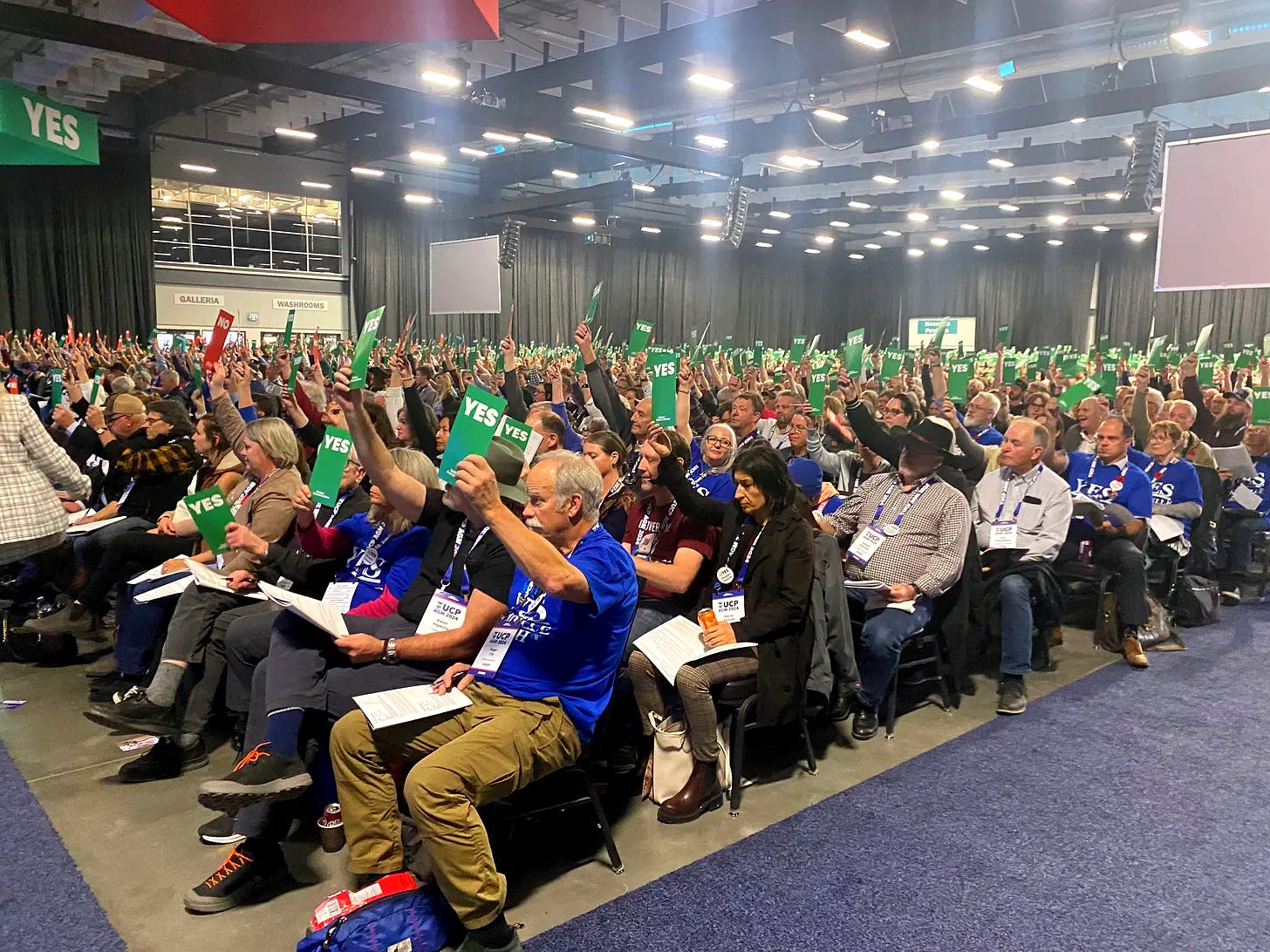
After the multimillion-dollar fiasco of Alberta’s referendum, the ruling United Conservative Party (UCP) appears set to dive headfirst into culture war politics at its upcoming convention.
UCP members attending the party’s annual general meeting (AGM) in Calgary next month will be debating a series of 22 policy resolutions, including proposals to segregate transgender women, surrender in the trade war with the U.S., ban Indigenous land acknowledgements and engage in large-scale union busting.
A few weeks ago, The Orchard reported on some of the policies that were being ranked by party members to determine which would make it to the convention floor.
Some of the reported policy proposals didn’t make it to the final list of resolutions that has now been released, including abortion restrictions, a vaccine injury fund and banning municipalities from imposing permanent water restrictions.

Chief among those rejected resolutions was a call for the UCP government to “pursue a lawful process to secure Alberta’s independence from Canada as a sovereign state,” an unsurprising development given the scale of the defeat for pursuing an independence vote in the Oct. 19 referendums.
Premier Danielle Smith is sending mixed signals on that question — forcing future candidates to sign a pro-Canada pledge from one side of her mouth while speaking at a spooky Oct. 31 Rebel News event alongside key separatist leaders and fellow travellers from the other.
But a look at some of the 12 governance resolutions up for debate, which focus on the party’s internal governance and are separate from the policy proposals, show that some members of the UCP are aiming to subtly purge separatists from the party.
A governance resolution proposed by the Edmonton-McClung constituency association (CA) and Calgary-based delegate Raymond Chang seeks to ban UCP members from belonging to other parties and require members disclose past partisan affiliations.
The rationale states that the intention is to prevent “cross-partisan infiltration” and protect “ideological cohesion.”
Although it doesn’t specifically mention separatists, the resolution would impact the membership of people like Jeevan Mangat, who was a UCP member while serving as leader of the Wildrose Independence Party and is now seeking the UCP nomination for Calgary-Acadia.
Another governance resolution, proposed by the Red Deer-South CA, would restrict voting at future AGMs to people who have been party members for at least 90 days (which the resolution text incorrectly describes as four months) — up from 21 days, which would remain the membership cutoff for voting in nomination contests.
Again, the resolution doesn’t explicitly mention separatists, but reasons that there’s been a pattern of “last-minute mass registrations solely intended to influence outcomes without long-term engagement in the party.”
Separatist organizer Mitch Sylvestre has pledged to bus in members from rural Alberta to get a separatist party board elected and Premier Danielle Smith is mobilizing her own supporters, which include some separatist leaders, ahead of the AGM.
But it’s the policy resolutions that will help set the tenor of the government’s agenda for the next year, and it is on these questions that the divided party will find common purpose in the lead up to the scheduled October 2027 election.
Below is a compilation of the policy resolutions I will be paying closest attention to at the convention next month. Expect all these motions to pass overwhelmingly.
Trans bathroom ban
A policy proposed by the Lac Ste. Anne-Parkland CA, a riding which is without an MLA after Shane Getson resigned, calls for the government to “adopt policies that protect the safety and privacy of women and girls in schools and public facilities (including washrooms and change areas) and promote consistent application across municipalities and school jurisdictions.”
“Washrooms and changerooms in public facilities are vulnerable spaces, and to ensure the comfort and safety of all biological women and girls we need these spaces protected,” the resolution rationale reads.
Rather than outright banning trans women from female facilities, the resolution proposes washrooms and changerooms that are “private and separate from the main washrooms and change areas, with single-occupancy lockable stalls, and separate private change areas.”
After claiming that this needs to be done for the “safety of all biological women and girls,” the text then suggests that the existence of trans people is at odds with the “safety and privacy for everyone [emphasis added].”
Trans people are far more likely to be victims of violent crime than the cisgender population.
At the 2024 UCP convention in Red Deer, party members overwhelmingly passed resolutions calling for trans women to be banned from all women’s spaces, activities and even award categories, and for gender affirming care to be defunded.

Neither of these policies have made it to legislation, but a week before the AGM, the provincial government introduced legislation restricting gender affirming care for minors, requiring parental notification when students seek to change their names and/or pronouns at school, and barring trans women from female sports.
A year later, Premier Smith invoked the notwithstanding clause to shut down a Charter challenge to these bills.
Updating the Human Rights Act to protect ‘biological sex’ from ‘gender identity’
A resolution proposed by the Lethbridge-West CA calls on the government to update the Alberta Human Rights Act “so that biological sex is expressly recognized as a separate protected ground from gender and gender identity.”
As it stands, the Act protects people from discrimination based on “gender, gender identity [and] gender expression.”
The resolution claims that the Act defines gender as the “state of being male, female, transgender, or two-spirited.” However, the Act doesn’t actually define gender.
The Alberta Human Rights Commission, which enforces the Act, defines gender as “being a woman, a man, cisgender, transgender, two-spirit, non-binary, or intersex.”
The resolution says it’s crucial for “biological sex” to exist as its own category to “allow for the legal and policy clarity needed to uphold fairness and privacy in sex-specific spaces, such as washrooms, showers and changerooms.”
“This proposal does not remove existing protections based on gender identity or expression,” the rationale emphasizes.
“Instead, it adds clarity and balance by recognizing that sex-based rights must also be safeguarded in situations where biological differences are relevant—for example, in sport facilities, healthcare, and corrections.”
While it wouldn’t outright remove protections for gender diversity, the rationale clearly envisions a hierarchy of rights, in which biological sex is placed ahead of gender.
Caving to the Americans
The Calgary-North West CA, represented in the legislature by Minister of Indigenous Relations Rajan Sawhney, wants the UCP government to “oppose any attempt by the federal government to impose tariffs on our energy or other products, or implement a ban on exports of these same products [emphasis added].”
Restricting or disincentivizing Canadian energy exports to the U.S. is one of the most powerful tools in Canada’s trade arsenal, considering that almost two-thirds of U.S. oil imports and nearly all of its natural gas imports come from Canada.
The resolution’s rationale calls it “inconceivable that Canada’s federal government would consider punishing its own energy-producing provinces with export tariffs or export bans.”
Decrying “federal trade posturing,” the resolution claims that restricting energy exports “will not stop U.S. protectionism.”
"Worse, these measures force deeper reliance on a single market—the exact issue Ottawa purports to solve,” the text adds without explaining how reducing trade with the U.S. would increase dependence on it.
Oil and gas is “not an enigma to be punished,” the Calgary-North West CA writes in what seems like an odd use of enigma.
The rationale continues:
If Ottawa truly wants to strengthen Canada’s negotiating position abroad, it should focus on expanding our global trade reach, not limiting it. That means building pipelines to tidewater, accelerating LNG projects, and fostering trade relationships beyond our southern border.
Every single one of these proposed actions is being pursued by Prime Minister Mark Carney as I write.
Appropriating the language of Indigenous leaders, such as Sturgeon Lake Cree Nation Chief Sheldon Sunshine, the resolution demands Ottawa start “treating Alberta not as an obstacle, but as a partner.”
The concluding paragraph emphasizes that this motion is aimed at “any federal move to restrict Alberta’s exports [emphasis added],” not strictly oil and gas.
This rationale fits nicely with Premier Smith’s strategy of ingratiating herself to U.S. President Donald Trump and politely asking him to lift the tariffs.
The results of that approach speak for themselves.
Banning land acknowledgements
This resolution calls for an end to the “use of land acknowledgements by the Government of Alberta, and all publicly funded institutions, agencies, and entities.”
Five CAs are cosponsoring it — Highwood (represented by Minister of Affordability and Utilities RJ Sigurdson), Edmonton-Gold Bar, Innisfail-Sylvan Lake (represented by Minister of Transportation Devin Dreeshen), Sherwood Park and Calgary-South East (represented by MLA Matt Jones).
The rationale reads:
Many Albertans view these statements as performative, politically compelled, and unnecessarily humiliating, particularly when citizens are repeatedly reminded that they are “guests” or “settlers” in their own country regardless of how many generations their families have lived, worked, and contributed to Alberta. This practice fosters resentment and social division by implying differing levels of belonging or legitimacy among Albertans.
Inverting the history that led to the practice of land acknowledgements, the text claims that they “risk reinforcing a perception of a permanent two tier or second class citizenship framework in which some citizens are treated as more entitled to the country than others.”
The resolution claims that “FOIP requests” (they’re now ATIP requests in Alberta) have “found that some indigenous consultants themselves question the use and validity of land acknowledgments in our communities.”
While the resolution doesn’t identify any specific Indigenous consultants or ATIP file numbers, it’s true that Indigenous community leaders have criticized the hollow symbolism of ritualistic land acknowledgements absent broader action to pursue reconciliation.
None of the policy resolutions up for debate discuss concrete actions that can be taken towards reconciliation, and one other in particular aims to move backwards on that file.
Restricting Indigenous land claims
The Edmonton-Gold Bar CA is sponsoring a motion for the provincial government to “use all possible legal options to block federal land claims,” which the resolution rationale emphasizes includes “Indigenous claims that may infringe on private property owners and their rights.”
The rationale says that this motion would encourage “resolving disputes through the courts and constitutional processes to protect Alberta’s interests while ensuring clarity, stability, and accountability in land governance.”
But the courts and constitutional processes are precisely the framework under which land claims are already resolved.
No doubt the freakout over Indigenous land claims abrogating private property rights is influenced by fear mongering about last year’s B.C. Supreme Court decision recognizing the Cowichan Tribe’s right to 300 hectares of land in Richmond, B.C., which explicitly stated that private property rights can co-exist with aboriginal title.
While Indigenous land claims are included in the motion, its real motivation is to push back against federal efforts to conserve land and water, which the current iteration of the federal Liberals appear to have little interest in doing.
“Albertans must take a stand against the federal government’s plan to ‘protect’ thirty percent of land and water in the country [hyperlink added]. This is a direct threat to private land ownership,” the text reads.
Union busting
A motion to adopt U.S.-style “right-to-work” legislation calls on the government to adopt “legal measures to ensure that union membership and union financial contributions are voluntary,” and not mandatory.
Right-to-work was a major plank of the old Wildrose Party’s platform, which was removed in 2013 in an effort to smooth the party’s hard-right edges. But now it’s back.
The resolution is co-sponsored by eight CAs — Edmonton-Gold Bar, Morinville-St. Alberta (represented by Minister of Red Tape Reduction Dale Nally), Cardston-Siksika (represented by Minister of Jobs, Economy, Trade and Immigration Joseph Schow), Grande Prairie-Wapiti (represented by MLA Ron Wiebe), Taber-Warner (represented by Minister of Environment Grant Hunter), Calgary-Currie, Calgary-Fish Creek (represented by Minister of Advanced Education Myles McDougall), and Leduc-Beaumont (represented by MLA Brandon Lunty).
The purpose of mandatory union membership and dues is to ensure that everyone who benefits from collective bargaining is contributing to the entity that bargains on their behalf.
Making union membership and/or dues voluntary undermines the collective solidarity that the entire labour movement is founded upon.

“Freedom of association is a foundational principle in a democratic society, and it should include the ability to choose whether to join or financially support a union,” reads the resolution rationale.
In 2001, the Supreme Court of Canada narrowly ruled that mandatory union membership does violate the freedom of association enshrined in the Canadian Charter of Rights and Freedoms, but that this violation is a justified limitation of this right.
More recently, the Supreme Court ruled that the right to strike is protected by freedom of association.
In 2020, then-premier Jason Kenney passed the Restoring Balance in the Workplace Act, which required that workers be forced to explicitly opt in to the portion of their union dues that go towards activities the government deems to be outside its “core” function of collective bargaining.
As a result of this imposed artificial distinction, unions scaled back millions of dollars in charitable contributions, reducing their involvement in their communities.

Right-to-work goes even further, enabling workers to opt out of funding the collective bargaining process, enabling them to instead “negotiate a personal compensation package,” per the resolution text, and scab in the event of a strike.
This policy would grossly undermine unions’ bargaining power, which is precisely the point.
Backtracking on carbon capture, utilization and storage (CCUS)
In another throwback to the Wildrose era, Grande Prairie delegate Karen Peters has sponsored a resolution to “review provincial carbon-pricing and CCUS policies to ensure they protect Alberta’s economy and autonomy.”
Regular readers of this newsletter will know my thoughts about the financial and environmental viability of CCUS. This motion, however, is tailored towards the drill, baby, drill mentality of Alberta’s political elite.

The resolution is a proposed addition to a policy passed last year to reject any federal efforts to achieve net-zero CO2 emissions, so it must be regarded in the context of rejecting any emissions mitigation policies.
After correctly identifying the massive costs of CCUS projects and the necessity of carbon pricing to make them work, the resolution concludes that they represent “an unnecessary and crippling cost burden on Alberta’s energy sector.”
The resolution’s author, for what it’s worth, is a chemtrails believer and anti-vaccine conspiracy theorist who was disqualified from pursuing the UCP nomination in Grande Prairie-Wapiti earlier this year.

Subsidizing CCUS and increasing the industrial carbon price are key components of the agreement signed by Premier Smith and Prime Minister Mark Carney last year to pursue the Pacific Link tar sands pipeline to the B.C. Lower Mainland.
Thank you for calling Pacific Link what it is, a tar sands pipeline. The daintier term, "oil sands", was part of the language laundering that accompanied the expansion of this industry. It's not hard to find publications, like from the Geological Survey of Canada, which used the former term back in the 1950s.