

Alberta’s ruling UCP is considering debating policy resolutions calling for Alberta independence, restrictions on abortion and a transgender bathroom ban at its forthcoming convention in November, according to screenshots of an online dashboard for party members obtained by The Orchard.
Other potential resolutions include banning Indigenous land acknowledgements from public events, creating a Vaccine Injury Support Program and restricting municipalities from imposing “permanent water or utility restrictions.”
From Sept. 19 to Sept. 25, party members were asked to rank their preferences for proposed policies that will make it to the floor of this year’s annual general meeting in Calgary on a scale from -4 to +4.
Dave Cournoyer was the first to report that a policy resolution for the party to “pursue a lawful process to secure Alberta’s independence from Canada as a sovereign state” was part of the ranking process.
Screenshots obtained by this newsletter show other contentious policy resolutions being ranked by party members.
SPONSORED BY PLAN INTERNATIONAL CANADA
Proof She Exists
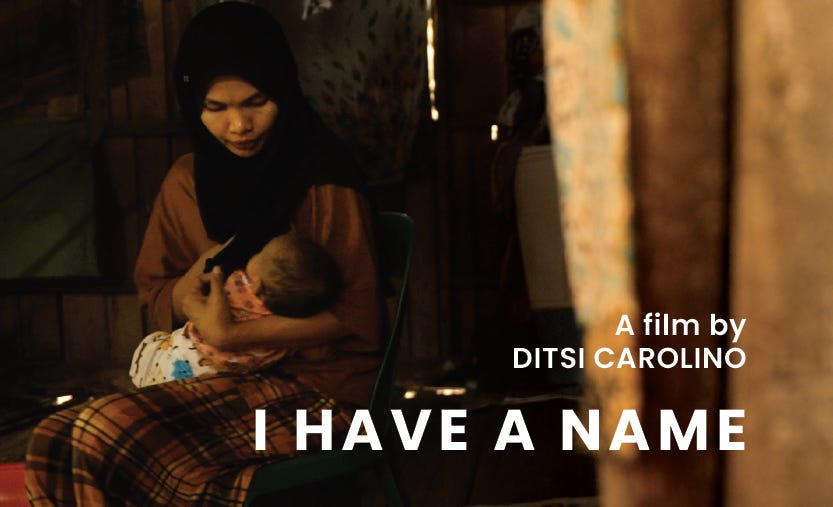
One in five children worldwide doesn’t officially exist.
Globally, nearly 150 million children under age five remain unregistered. Without proof of her identity, a girl can be denied education, health care and protection, putting her at greater risk of exploitation, abuse and exclusion.
On October 11, International Day of the Girl, Plan International Canada is making the invisible visible. It’s a day we helped establish at the United Nations over 15 years ago, and a reminder that before a girl can access her rights, she must first be seen.
A birth certificate is the first step. But being seen also means having your voice heard and your potential recognized.
When girls can shape their own futures, everyone benefits. Families are healthier, economies grow, and communities become more resilient.
Watch the six-minute film: I Have a Name.
The screenshots were provided by TikToker Kit Rose (@KitsPath), a former journalist who found a link to the dashboard posted to a public Facebook page for UCP members, entitled “The Road to the UCP AGM: Citizens Making Alberta Better,”
The images include text of select resolutions and do not indicate what ranking each resolution received.
Rose, who’s trans, was particularly concerned about a proposed resolution to segregate trans women from female washrooms and change rooms.
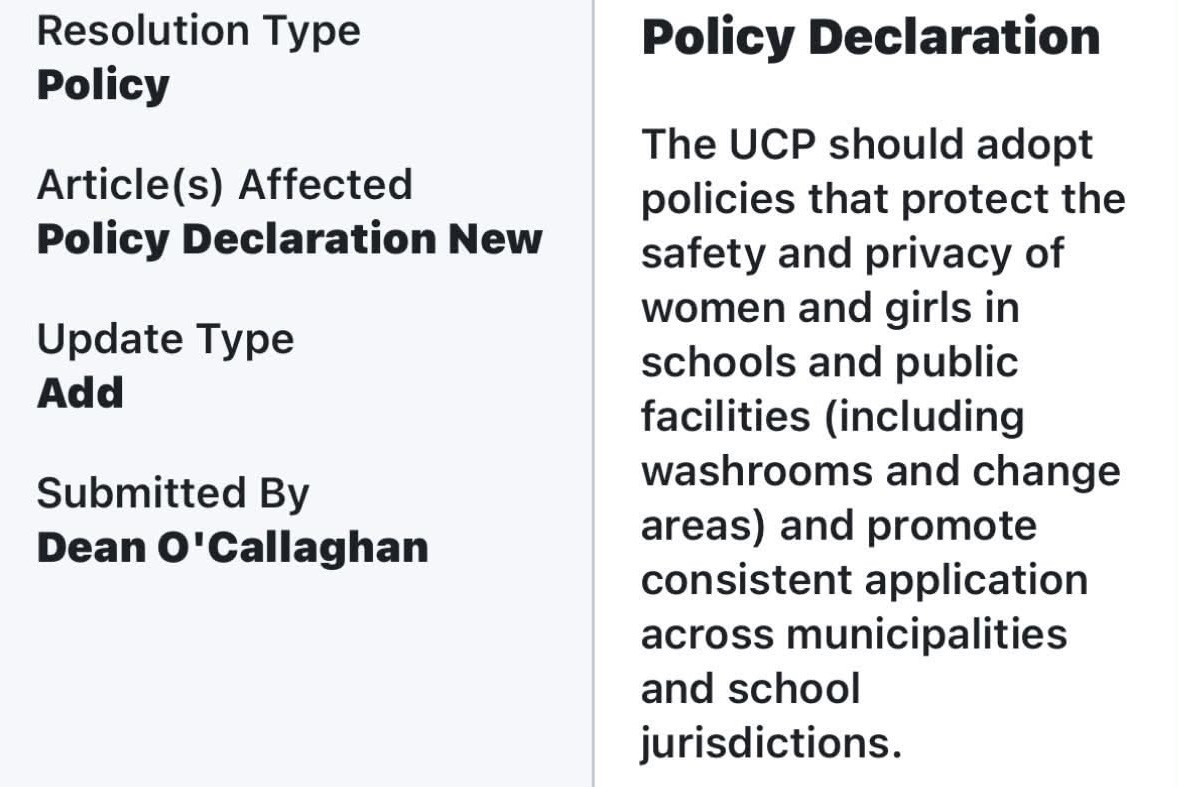
The proposal calls on the party to “adopt policies that protect the safety and privacy of women and girls in schools and public facilities (including washrooms and change areas) and promote consistent application across municipalities and school jurisdictions.”
It was submitted by Dean O’Callaghan, who appears to be a party member from Lloydminster.
While the resolution text itself cites washrooms and change rooms as examples of the facilities it wants to ban trans women from, its rationale makes it clear that they are the proposal’s primary target.
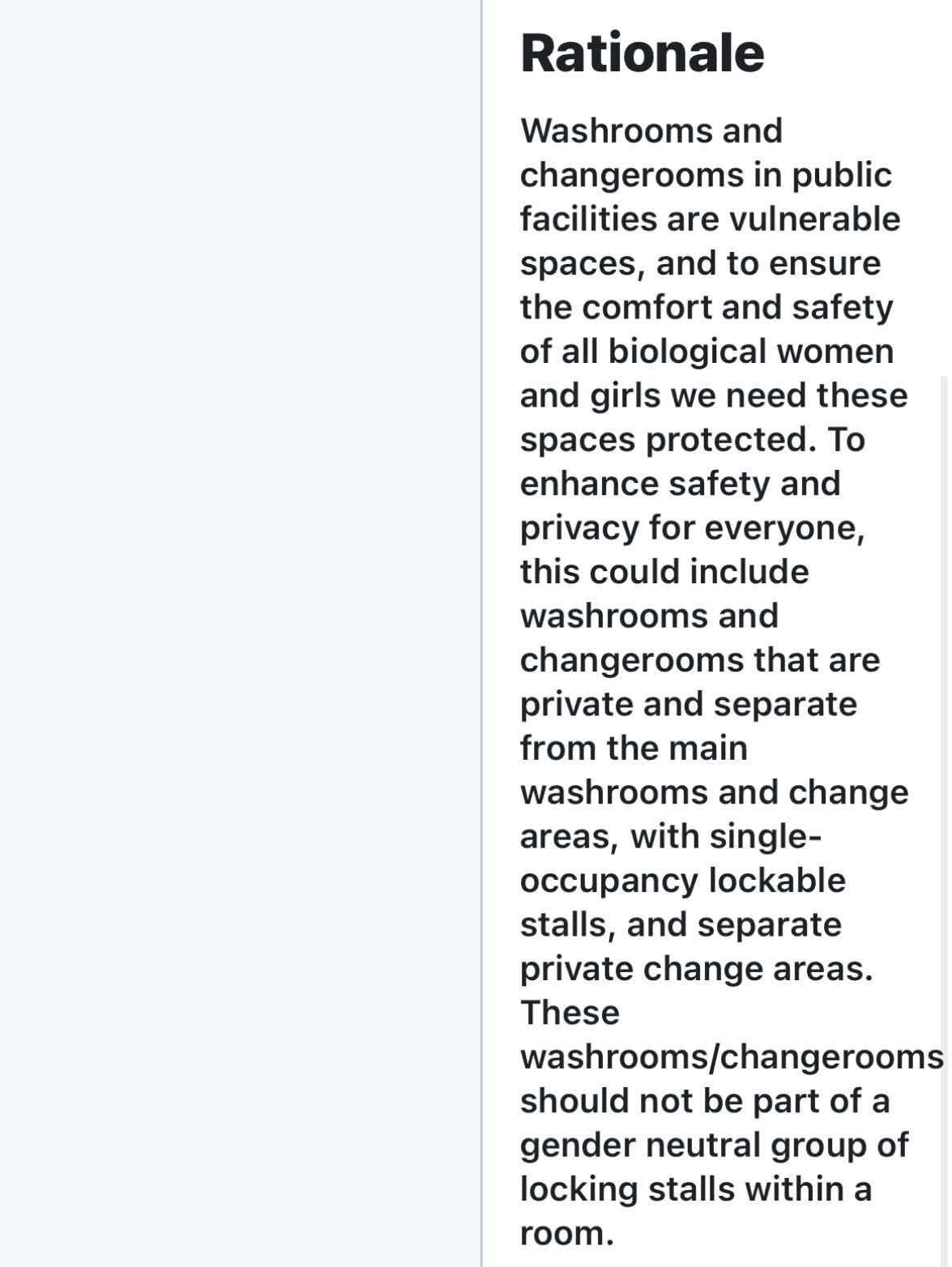
“Washrooms and changerooms [sic] in public facilities are vulnerable spaces, and to ensure the comfort and safety of all biological women and girls we need these spaces protected,” reads the rationale.
Rather than outright banning trans women from female change rooms and bathrooms, the rationale suggests possibly creating separate “single-occupancy lockable stalls, and separate private [changing] areas.”
It’s possible that none of these proposals will make it to the AGM floor in November, or that some will be amended before being approved, but some of the most contentious are extensions of policies already approved by the party membership in previous years.
The party passed far more wide-reaching anti-trans resolutions at its 2024 convention in Red Deer to ban trans women from “exclusively female spaces and categories” and defund gender affirming care, both of which passed with overwhelming support.

At last year’s AGM in Edmonton, party members voted in favour of a resolution calling for Premier Danielle Smith to ban “public funding for third-trimester abortions, except in cases where the physical health of the mother is at serious risk.”
This year, at least some members are seeking to go a step further, despite last year’s policy not having been implemented.
A proposed resolution calls on the province to defund second and third-trimester abortions, with the same caveats as the 2025 resolution.
“This resolution does not restrict access to second or third-trimester abortions, but establishes a responsible, values-based funding policy for medically necessary cases,” the resolution’s rationale reads.
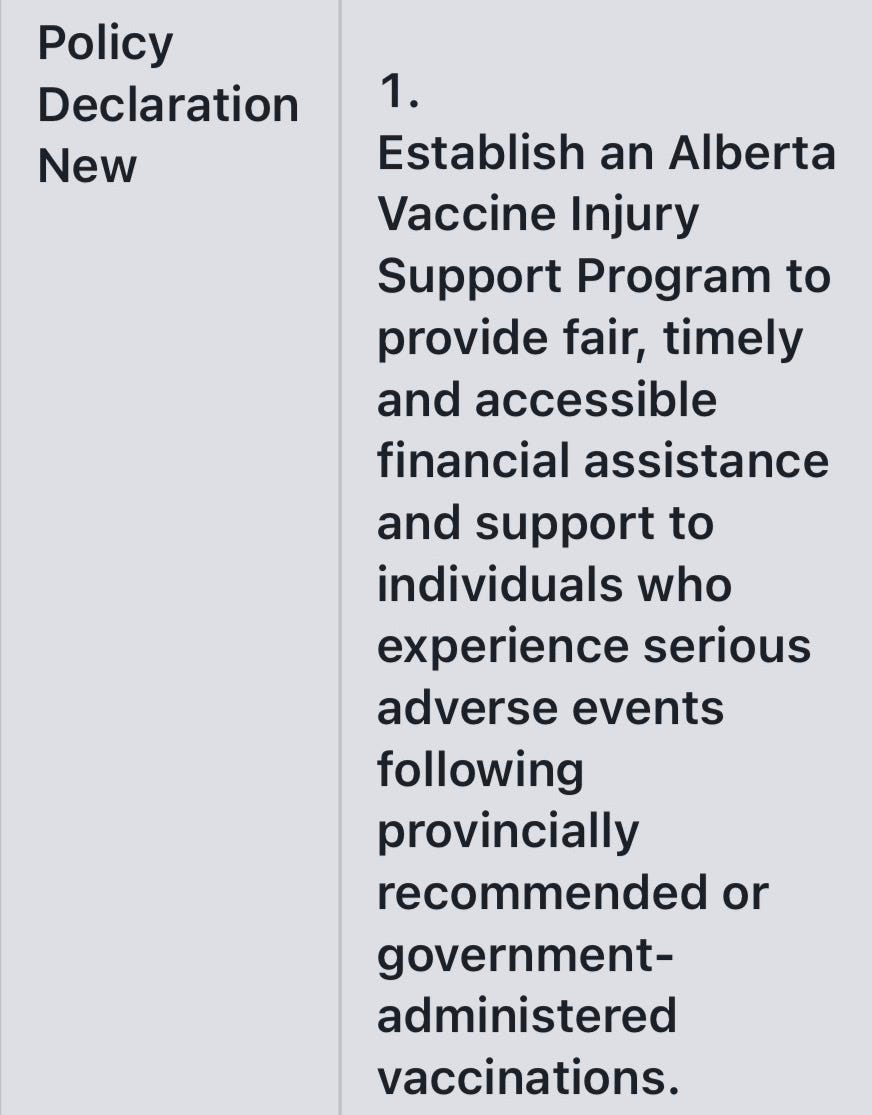
There’s also a resolution to provide “fair, timely and accessible financial assistance and support to individuals who experience serious adverse events following provincially recommended or government-administered vaccinations.”
No doubt, this proposal was inspired by Niagara West Conservative MP Dean Allison’s unsanctioned four-day hearing into alleged vaccine injuries on Parliament Hill, which included testimony from U.S. Republican Sen. Ron Johnson.
The federal government already offers restitution for the rare instances of people who have suffered “serious or permanent injury" from vaccines. The Vaccine Injury Support Program paid out $21 million to 252 approved claimants from June 2021 to November 2025.
According to Health Canada, of 105 million Covid-19 vaccine doses that were given out across Canada from 2020 to 2023, there were 11,072 serious adverse reactions, representing 0.011% of all doses.
Another resolution seeks to “limit the ability for municipalities to impose permanent water or utility restrictions,” which if approved and implemented would represent another instance of the provincial government overriding the will of local elected bodies.
Some other proposed resolutions could be gleaned by perusing “The Road to the UCP AGM” Facebook page, where members encouraged each other to rank various proposals a certain way.
Bonnie Meikle, one of the page’s administrators, urged members to rank a resolution calling for the provincial government to prohibit Indigenous land acknowledgements by “all publicly funded institutions, agencies, and entities” as +4.
“Land Acknowledgements are not harmless. It's a trojan horse to abolish private property,” wrote Meikle.
In another post, she urged party members to rank as -4 a resolution calling for the party to open its membership to permanent residents, which would reverse a resolution from last year to only permit citizens to become UCP members.
“With the vast number of immigrants we have now it's imperative that only citizens have access to influencing the governing Party of Alberta [sic], and retain the values that created it,” explained Meikle.
UCP director of communications Dave Prisco didn’t acknowledge a request for comment.
Buy the book!
If you appreciate my reporting on Alberta politics, you’re going to want to read my news book, Dark Phoenix: The Rise, Fall, and Re-emergence of Danielle Smith, which comes out a week from today.
It tells the story of the Alberta premier’s ascent, the nefarious forces that brought her to power and the threat she represents, not just to Alberta but Canada.
I think you should preorder it, which will contribute to its first-week sales numbers and hopefully place it on bestseller lists. I’m more than a bit biased here, so don’t just take my word for it.
Dark Phoenix has received high praise from several journalists, authors and artists whom I greatly respect.
Carmen Celestini, author of God’s Angry Men:
Understanding the path Danielle Smith took to the helm of Alberta politics provides an understanding to this moment in time in Canada’s political landscape. Canadians wanting to understand the politicizing of grievances in Alberta owe a debt to Appel for this in depth understanding of the political movements that led to the political division in the province, and the charming manipulation of Smith to lead the charge.
Mark Lisac, author of The Klein Revolution and The Carbon Eaters:
Dark Phoenix presents a well-researched portrait that will likely become the standard account for anyone curious about Danielle Smith’s career to date.
Jeet Heer, national affairs correspondent for The Nation and host of The Time of Monsters podcast:
In an age of authoritarian populism, Danielle Smith has emerged as an unsettling political superstar. Smith is resilient, dynamic, adaptive, media-savvy as she sells a politics of reactionary nostalgia in the service of the powerful. She is reshaping not just Alberta but Canada. Jeremy Appel’s incisive and crisply-written biography, drawing on deep reporting and research, is essential reading for understanding both Smith’s appeal and the dark future she is promoting.
Dan Boeckner, musician in Wolf Parade:
Not just a biography, but an incredibly detailed overview of an emergent form of authoritarian anti-politics wherein the candidate subscribes to an ideology of nothing except the acquisition of power for powers sake. Jeremy Appel is one of the best journalists working in Canada today. A necessary voice.
You can preorder Dark Phoenix from the publisher or to your local independent bookstore here. Amazon and Indigo both have it on sale, if that’s your thing.
I’ve also got two book events lined up that I’d love to see you at!

If you’re in Edmonton, you’re welcome to come to my Oct. 13 book launch at the Aviary, where I’ll be in conversation with my friend Dani Paradis.
And if you’re in Calgary, I’ll be hosting a just-announced free event at High Line Brewing on Nov. 6 at 7:30 p.m., with my pals at the Alberta Advantage podcast. There will be a live podcast recording, followed by a book signing and social.
I should have something lined up for Toronto in early 2027. Stay tuned, Torontonian readers!