

I was biking through Edmonton’s River Valley on Tuesday evening on my way to the Kinsmen Leisure Centre for a workout and sauna session, as I’ve done many times this summer. But then I hit a puddle.
Little did I know in that brief instant, but I would soon be set on a nearly day-long journey that would intimately familiarize me with the ailments in Alberta’s public health-care system.
I’ve biked over too many puddles to count in my lifetime, but this one was particularly slippery, which I later learned was runoff from an overfull upstream storm drainage facility — a consequence of Edmonton’s record rain this summer.
I flew off the side of my mountain bike, landing first on my left knee and elbow, which broke the fall for my right knee and left hand.
'“FUUUUUUUCCCKKKKK,” I screamed at the top of my lungs more than a few times.
My fall occurred right beside an outdoor rock climbing business, whose employee quickly came to bandage up my pretty badly cut left knee.
We were soon joined by a very kind Parisian tourist and his young daughter, who are touring across Canada, who wanted to make sure I’m OK.
It’s times like these that I’m reminded of people’s fundamental decency.
Hearing stories of long wait times in emergency rooms across the province, I wanted to avoid a trip to the ER at all costs — for myself, yes, but also hospital staff and other patients, whose time I didn’t want to waste on what appeared to be a minor injury.
I was in a bit of pain when I got home, so I popped some acetaminophen and naproxen and went to bed.
I woke up at 4 a.m. in a lot of pain, so I called 811, hoping they would tell me that I was fine and to go back to bed.
I wouldn’t be writing this if they did. The nurse told me to go to an ER and ordered me a taxi to the Royal Alexandra Hospital — the closest facility nearby.
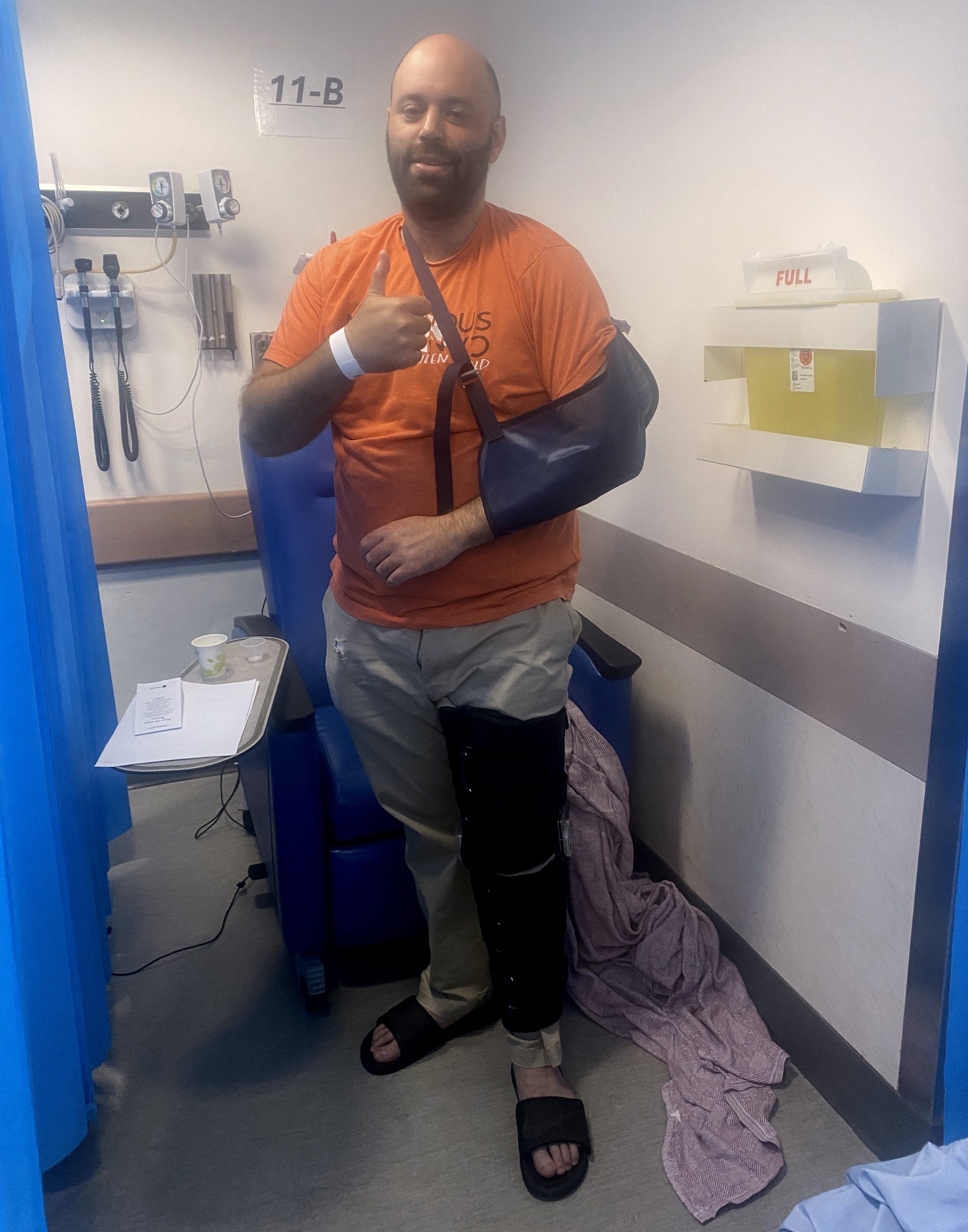
I limped into the waiting room around 5:30 a.m. on Wednesday. Twenty hours later, I would be discharged with a brace on my leg and arm in a sling.
The hospital staff were all incredibly kind and patient, showing immense grace under pressure that wasn’t always reciprocated by patients, who whether under the influence of substances, suffering from mental health issues, general dickishness, or some configuration of the above, could be quite nasty and abusive.
The staff were clearly overworked and doing their utmost best.
It’s no doubt a frustrating experience having to wait indefinitely for care. Time moves incredibly slowly to the point of meaninglessness.
You feel like a cog in a machine, rather than a patient with needs. Sometimes you wonder if you’ve been forgotten in the constantly shifting queue.
But some people’s needs are simply more urgent than yours. Naturally, someone who comes into the ER on a stretcher is going to be prioritized over someone with a minor fracture.
You try to avoid watching the clock, but what else can you do? You tell yourself, OK, maybe I’ll be out of here by noon. After noon comes you say 3 p.m.
Eventually, you accept you’ll be there as long as it takes, but I couldn’t help but negotiate with myself how much longer I’d be there. Is it human nature or just my neuroticism?
Alberta Health Services, or what remains of it, keeps a rolling list of estimated ER waiting times at each of the province’s hospitals. At Royal Alex, it was listed at somewhere in the realm of four hours — not too bad.
I ended up in the waiting room for seven hours, after which I figured it would be clear sailing. I would see a doctor, get an X-ray, get fitted with a cast or brace, and be out of there in due course.
It would be another 13 hours in the actual ER before I could go home.
I did get to see a doctor fairly quickly once I moved past the waiting room, who sent me for an X-ray. But he had Lord knows how many other patients to see in between, as did the nurses and technicians.
After the X-ray, I was taken to an ER room with a busted recliner chair, an unfortunate circumstance given the nature of my injury. I asked if I could move, but the nurses politely declined, saying they might need that room for another patient.
The doctor eventually returned to confirm that, yes, I had relatively minor fractures of my elbow’s radial head, which I misheard as Radiohead, and my tibial plateau, which connects the shin to the knee.
For the latter injury, the physician wanted to get me a CT scan to have a closer, 3D look to confirm his hunch that I won’t need surgery.
"Oh boy, I’m going to be here for a lot longer,” I said, or something to that effect.
The doctor replied affirmatively, asking if I had somewhere to be. I did not, so I continued waiting as he went to his next patient and his next patient, etc.
Knowing the rough extent of my injuries and accepting I wouldn’t be discharged any time soon led to the most mentally taxing stretch of my time in ER.
Don’t want to support me on Substack? I totally get it. You can also send a one-time payment or become a paid subscriber on Ko-fi. I also accept e-transfers to appel[dot]jeremy[at]gmail[dot]com.
As I awaited the CT scan, somewhere around 7 p.m., I would guess, I mentioned to a nurse that I’d been in the ER since 5 a.m.
“I wish I could say that was unusual,” he replied. “We’re working in a broken health-care system.”
An hour or two after this interaction, I got my CT scan and then waited, met with an orthopedist, waited some more, met with him again, waited some more and then around 1 a.m., I received a brace for my leg, a sling for my arm and my discharge papers.
Indeed, the health-care system is broken. I witnessed this first hand. But I was one of the lucky ones, given my relatively minor injuries.
Prashant Sreekumar wasn’t. The 44-year-old father died in the Grey Nuns Community Hospital ER in December 2025 after waiting eight hours with chest pains.
The question is what are we going to do about it?
Premier Danielle Smith has an idea. Bill 11, passed in December 2025, enables physicians to work in both the public and private system, and establishes a list of medically necessary procedures that patients will be able to pay for with private insurance or out of pocket to receive expedited care at a private clinic.
This will enable doctors to use the public system as a financial cushion while they establish private practices, which will serve as a medical fast line for those with the means to purchase private insurance and assume the risks of claims being denied.

For the rest of us, that’s going to mean longer waiting times as physicians move into private care after they’ve completed their minimum number of hours in the public system. Public health care needs more employees, not fewer — full stop.
In order to do that, we need to address why there are so few staff per patient. Money is only part of the equation.
Privatization proponents point to how much Canada already spends on health care — 11.2% of GDP, which is significantly higher than the Organization of Economic Cooperation and Development (OECD) average of 9.1% and growing.
Never mind that many parts of Canada’s health-care system are already privatized.
A full 29% of health-care expenditures in Canada are paid either out of pocket or through private insurance. Bill 11 is going to increase that number, which doesn’t include surgeries that are increasingly publicly funded but privately delivered for profit, which increases public health-care costs.
In the U.S., which spends 16.7% of GDP on health care, 47% of health-care spending is privately financed. Alberta’s creation of new markets for procedures that previously had to be publicly funded is a clear move in this direction, and Prime Minister Mark Carney has provided no indication that he intends on stopping it.
According to a 2025 study from the Canadian Centre for Policy Alternatives, countries with lower proportions of privately financed and delivered health care, such as Iceland, Sweden, Norway and France, generally report higher life expectancy and lower mortality rates.
These countries spend varying amounts on health care per person, but what unites them is the low proportion paid by citizens themselves. The issue then isn’t so much funding but into whose hands those funds are going.
There’s a very real crisis in our public health-care system, which is being used to pursue privatization. Taking this route will exacerbate the problem in public ERs while pushing it out of sight and out of mind for the well to do.
An ER is, in many ways, a great equalizer. Patients are assessed based on their need and placed in the queue accordingly, regardless of income or social status. Of course, wait times should be shorter, but we can’t let go of the principle of prioritization according to need.
After spending 20 hours with a broken leg in emergency care, many would be tempted to push for blowing the entire system up. I’m by no means a public health policy expert, but the professionalism of health-care workers as they cycled through patient after patient suggests to me that they possess the answer.
I’m sure these workers, their unions and professional associations have some ideas on how to fix what’s broken in the health-care system. I’m far more interested in their proposed solutions than the self-serving proposals of the private insurance industry, which has boasted of being a “key partner” in Bill 11’s reforms.
We don’t need get rich quick and queue jumping schemes for elites; we need to give hardworking health-care employees the means to deliver equitable and timely patient care.
So Jeremy, your first stop should be to talk to Friends of Medicare and Dr Paul Parks, an Emergency Department doc who tours the province in his off time, such as that is, giving those interested the real lowdown on what is happening. He is a former president of the Alberta Medical Association. He has plenty of facts and figures as well as potential solutions to the problems in our healthcare. On big problem, just to address the issue of how much we are paying in Canada, or at least in Alberta, is that some surgeries are already being outsourced to private clinics where the cost of the surgery is several times more expensive than using public facilities. And those public facilities in some cases stand idle because the people to staff them are MIA. We just do not have enough doctors, nurses, physician assistants to make it happen. My son waited 12 hours at the Misericordia for “emergency” surgery in June. He is disabled and had a very hard time understanding why he had to wait so long without food or water. Staff were kind. Docs great, especially the surgeon, who came in once an OR was available and staffed, at 9:30 pm and after a full day on his feet to perform the procedure. But like you, in spite of it all, he was lucky. He survived and with luck will be healthy going forward.
But Jeremy, just imagine how fast you would have received the care you needed if only you were a well-heeled donor to the UCP! /s
Seriously though; your situation is all too common in ERs across this country, such as here in Ontario. And here, coincidentally, our Conservative government is also claiming that the "solution" lies in more privatisation. Well, there are only so many trained healthcare professionals to go around, so the more of them go private, the fewer there will be for the public system.
Another factor here in Ontario (and presumably elsewhere) is that the nurses are sick and tired of disrespect, lousy pay, and lousy working conditions, so they are moving themselves over to private temp agencies, which bill the public system (e.g. hospitals) at two or three times the hourly rate for the same nurses (who may not actually be making any more money themselves). This is a particularly insidious form of privatisation, because it misdirects the blame at the public system for allowing its costs to increase with no improvement in service levels. To which the solution proposed by governments is even more privatisation.
In 1995 John Snobelen, the Education Minister in Ontario's notorious Mike Harris Conservative government, was caught on tape stating that his government needed to "manufacture a crisis" in the public school system to justify sweeping, unpopular funding cuts and restructuring.
I believe that's exactly what is happening with Canada's healthcare now, in many provinces.
One last question, Jeremy; did you happen to observe how many of the people attending to you appeared to be relatively recent immigrants, whom the UCP government are currently demonising paradoxically for overburdening the healthcare system? The hypocrisy never stops...