

Almost all illegal lobbying activities in Canada, representing tens of thousands of incidents, have gone unenforced since 2018, according to a new report from Democracy Watch.
The non-partisan government transparency watchdog says that, moreover, the nature of the violations are being improperly withheld from the public.
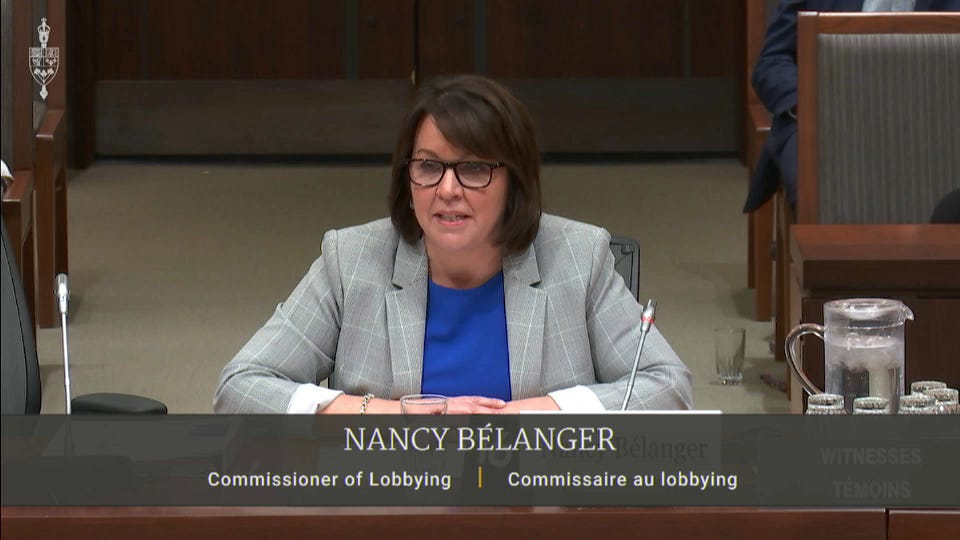
The report, provocatively titled Negligently Weak Lapdogs, examines Federal Lobbying Commissioner Nancy Bélanger and the RCMP’s record of enforcing violations of the Lobbying Act and Lobbyists’ Code of Conduct from January 2018 to April 2026. In this period, just three out of 31,806 violations were penalized.
Duff Conacher, executive director of Democracy Watch, told The Orchard that cracking down on illegal lobbying is a democratic imperative.
“Secret unethical lobbying is a recipe for corruption, waste of the public’s money, and other abuses of the public interest. There are thousands of cases of secret unethical lobbying every year that are violations of the law, along with thousands more because of huge loopholes that make it legal to lobby secretly and unethically,” Conacher explained.
“All of that corrupts federal government decision making in ways that will harm the public.”
The Lobbying Act establishes who has to register as a lobbyist, timelines for registration and filing a return, and criminal sanctions for violations. Just two people have faced criminal charges for violating the Act under Bélanger’s tenure.
In a statement to this newsletter, Office of the Commissioner of Lobbying spokesperson Manon Dion emphasized that the commissioner doesn’t have the ability to determine whether a lobbyist has broken the law.
“If, during an investigation the Commissioner has reason to believe that an offence has been committed under the Lobbying Act, she must suspend her investigation and transfer the file to a peace officer,” wrote Dion. “The RCMP then conducts its own investigation.”
The commissioner, however, does have a mandate to enforce the Lobbyists’ Code of Conduct, which applies ethical standards for people who have registered as lobbyists under the Act.
The only punishment for violating the Code is being publicly named and shamed.
Bélanger has publicly reprimanded just one person — Dan Lovell in 2024 — for violating the Code after the lobbyist arranged meetings for clients with his former boss, Liberal MP Vance Badawey.
In annual reports during the first three years of her mandate, Bélanger didn’t provide a breakdown of the types of violations her office found. These would include late registrations and monthly reports organized by delay duration, as well as inaccurate registration information being corrected more than once.
Dion noted that late registrations and filings are noted in the Registry of Lobbyists.
In Bélanger’s 2020/21 report, the commissioner began including the number of inaccurate registrations. In 2021/22 and 2022/23, Bélanger added the number of monthly reports that were late by 31 to 90 days, 91 to 180 days and more than 180 days.
From 2023/24 onwards, the report also included late registrations by the same intervals. However the 2025/26 report left out inaccurate registrations entirely, with no explanation for the commissioner.
Based on the incomplete data in Bélanger’s reports, Conacher concluded that there were at least 5,054 significant infractions, which the commissioner defines as failing to register or file monthly reports for more than a month, or repeatedly providing inaccurate registration information.
According to the Democracy Watch report, from 2021 to 2026, there were 2,326 instances of filing reports at least a month late; from 2023 to 2026, there were 1,462 instances of registering at least a month late; and from 2022 to 2025, there were 1,266 cases of inaccurate registration.
Per Dion, the commissioner only initiates an investigation “where it would be necessary to ensure future compliance.”
Conacher accepts that there’s a significant ethical difference between filing paperwork a month late and three months late.
The data shows 534 cases of registration being filed at least three months late, with six years of data missing, and 932 cases of monthly reports being filed at least six months late, with four years of data missing.
“No matter what, you’re talking about thousands of violations that are very serious, according to the commissioner herself,” said Conacher. “It’s a cover-up.”
Dion noted that earlier this year, Bélanger recommended to the Standing Committee on Access to Information, Privacy and Ethics that the Act be updated to “introduce a broader range of sanctions, including administrative monetary penalties.”
“This would provide greater flexibility in applying remedies that are both appropriate and proportionate to the nature of the incident of non-compliance, such as instances of late filings, ensuring a more effective and responsive enforcement framework,” she added.
Under Bélanger’s tenure, 19 cases were deemed serious enough for the commissioner to refer them to the RCMP. Just one resulted in prosecution, one was initially charged but permitted to sign a peace bond, and three remain under investigation.
In her statement, Dion emphasized that the Act “requires that all investigations be conducted in private.”
The commissioner has named those who were criminally charged, which are readily available in media reports.
In March 2024, Thunder Bay, Ont., consultant Gerald Paulin was charged by the RCMP for receiving payment to lobby on behalf of Cat Lake First Nation for federal housing funding without registering.
Paulin went public to the CBC in 2019 claiming the First Nation owed him a $1.2-million consulting fee after the federal government agreed to provide $12.8 million to address the band’s severe housing crisis.
“I worked for 18 months getting that project up and running,” the unregistered lobbyist told the CBC.
This is how Bélanger’s office learned about Paulin’s alleged illegal lobbying. Paulin is scheduled to go to trial in December.
In 2018, the commissioner’s office referred Andrew Burns, who lobbied on behalf of Marine Land without registering, to the RCMP, but he was able to sign a peace bond promising to remain on good behaviour and continue lobbying.
Conacher filed freedom of information requests with the RCMP and commissioner’s office regarding 13 cases that were referred to the Mounties but not prosecuted.
The heavily redacted documents he received included a section reading “SNC.”
Conacher said this suggests that one of these cases involved Montreal-based global engineering firm SNC-Lavalin, which rebranded as AtkinsRéalis after pleading guilty to fraud in December 2019 over its dealings in Libya.
This was the case in which then-prime minister Justin Trudeau allegedly attempted to pressure then-justice minister Jody Wilson-Reybould to drop charges against the company, promoting Wilson-Reybould’s high-profile resignation.
Conacher said he suspects that other cases dropped by the RCMP were high-profile and politically sensitive, including former Liberal staffer Kevin Chan’s alleged unregistered lobbying of Trudeau’s government on behalf of Facebook and Imperial Oil CEO Rich Kruger’s alleged unregistered lobbying of then-leader of opposition Andrew Scheer at a company-hosted gala.
Bélanger could invoke the Code, which has no time limitations, to reveal the identities of those she referred to the RCMP and didn’t get charged, or any of the 31,806 people she found to have potentially breached the Act, argues Conacher.
He added that the evidence contained in his report shows that the commissioner “doesn't enforce the law 99.99% of the time when it comes to requiring transparency in lobbying and ethical lobbying.”
“We're paying this person to be our watchdog, and in the last seven years, she has not really done her job at all,” said Conacher.
The Orchard reached out for comment to the Treasury Board of Canada, which oversees the Office of the Lobbying Commissioner, but didn’t receive a response by deadline.
Buy the book!
Dark Phoenix: The Rise, Fall, and Re-emergence of Danielle Smith, my new book, comes out Oct. 13. It tells the story of the Alberta premier’s ascent, the nefarious forces that brought her to power and the threat she represents, not just to Alberta but Canada.
I think you should preorder it to help its first-week sales numbers and get it on bestseller lists. But don’t just take my word for it.
Dark Phoenix has received high praise from several journalists, authors and artists whom I greatly respect.
Jeet Heer, national affairs correspondent for The Nation and host of The Time of Monsters podcast:
In an age of authoritarian populism, Danielle Smith has emerged as an unsettling political superstar. Smith is resilient, dynamic, adaptive, media-savvy as she sells a politics of reactionary nostalgia in the service of the powerful. She is reshaping not just Alberta but Canada. Jeremy Appel’s incisive and crisply-written biography, drawing on deep reporting and research, is essential reading for understanding both Smith’s appeal and the dark future she is promoting.
Independent journalist Rachel Gilmore:
When encountering a politician like Danielle Smith, it's sometimes hard to truly grasp why they do the things that they do — and, more importantly, how they keep getting away with it. In Dark Phoenix, Jeremy Appel demystifies these questions. Through gripping writing and immaculate research, he paints a clear picture of what drives Smith: naked opportunism. It's a chilling tale of a woman who appears to be motivated by nothing more than her own ascent — and it's only in understanding both her thinking and the tactics she uses to achieve her goals that we can truly push back. Dark Phoenix is an important read for anyone seeking to understand Alberta politics and its unhinged premier. It's even more essential as a case study of a kind of politician that is all too common these days.
Jordan Foisy, comedian and head writer for This Hour Has 22 Minutes:
Like Rick Perlstein’s Nixonland, Appel uses the details of Danielle Smith’s life, from the shocking and enraging to the banal and deeply hilarious, to capture a cultural and political shift in Canada. Appel reveals Smith, with her uncanny ability to project empathy and normalize extremist ideas, as the defining figure in our “neo-authoritarian” age; where the role of government is to enact and enforce the policies of capital, while acting as the stage for reactionary grievance theatre. A must read for anyone interested in Canadian politics.
You can preorder Dark Phoenix from the publisher or to your local independent bookstore here. Amazon and Indigo both have it on sale, if that’s your thing.

If you’re in Edmonton, you’re welcome to come to my Oct. 13 book launch at the Aviary, where I’ll be in conversation with my friend Dani Paradis.
And if you’re in Calgary, I’ll be hosting a just-announced free event at High Line Brewing on Nov. 6 at 7:30 p.m., with my pals at the Alberta Advantage podcast. There will be a live podcast recording, followed by a book signing and social.
Andre Corbould and Aileen Giesbrecht lobbying Edmonton City Hall to rezone for data centres? Does that fit the pattern?