

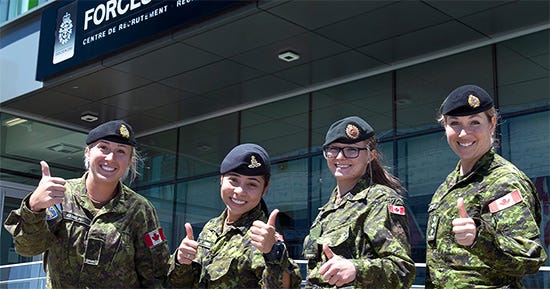
Last month, Immigration, Refugees and Citizenship Canada (IRCC) announced that foreign military recruits to the Canadian Armed Forces (CAF) will be prioritized for a program that fast-tracks skilled immigrants to permanent residency.
This comes as the Canadian government has been shutting its doors to major sources of temporary and permanent immigration, leading to zero immigration growth for the second year in a row, and the Strong Borders Act, which critics contend will create a “deportation machine,” makes its way through the legislative process.
On Feb. 18, the government announced that an “eligible foreign national who is serving in a recognized foreign military [emphasis added]” can now apply for permanent residency through a specialized category of the Express Entry program.
A day earlier, Prime Minister Mark Carney unveiled his $500-billion defence industrial strategy, which aims to reduce Canada’s dependence on the U.S. for military procurement.
Immigration Minister Lena Metlege Diab told the Globe and Mail that attracting foreign military recruits is part of this strategy, but the government hasn’t said how it defines recognized foreign military.
Globe reporters Vanmala Subramaniam and Pippa Norman noted in a Feb. 19 story that IRCC didn’t answer “questions on whether there would be country-based restrictions for prospective applicants.”
I’ve already recounted my saga trying to get basic information about this new immigration pathway from IRCC, which ultimately resulted in me being told that IRCC doesn’t have information on foreign military recruits to Canada.
A spokesperson told me to reach out to the Department of National Defence (DND) for information on CAF recruitment practices.

According to DND spokesperson Dan Blouin, the CAF has recruited permanent residents with foreign military service from NATO member nations, plus Australia and New Zealand, from the general Express Entry program since November 2022.
While foreign military applicants recruited by the CAF were already able to apply for permanent residency through Express Entry, they’re now being shuffled to the top of the deck with their own unique category.
This would include recruits from Türkiye’s military, which Human Rights Watch found to have targeted civilian infrastructure, including water and power stations, hospitals and roads, in its campaign against Kurdish rebels in northeastern Syria in late 2023 and early 2024.
Given the Canadian government’s stated goal of reducing dependency on the U.S. in military matters, it’s ironic that the CAF continues to recruit from the U.S. military, which appears to have been responsible for the Feb. 28 bombing of Iran’s Shajarah Tayyebeh elementary school, killing 175 people, mostly young girls.
Blouin said that all recruits undergo “security screening” prior to their acceptance, but didn’t respond by deadline to a follow-up question about how this process ensures that foreign recruits haven’t participated in human rights abuses.
IRCC says that the purpose of adding a specific category for skilled military recruits to Express Entry is to “prioritize” the recruitment for “key roles such as military doctors and nurses, and pilots.”
Applicants need at least a decade of continuous military service in positions that are equivalent to the CAF’s commissioned officer, specialized member, or operations member roles. Of these roles, only operations members can potentially participate in combat.
The national occupation classification system lists examples of job titles for each of these positions, none of which are doctors, nurses or pilots.
Applicants are required to have already been recruited by the CAF to work full-time for at least three years and need to have at least a two-year post-secondary degree.
The addition of this stream to the Express Entry program is a “welcome change that will significantly streamline processing for this specialized talent,” wrote Blouin.
But Grazia Scoppio, a professor of defence studies at the Royal Military College of Canada in Kingston, Ont., told the Globe and Mail that the CAF’s problem isn’t attracting new military recruits, it’s processing them.
“Young people are coming to CAF’s doors, they are just not getting through,” said Scoppio.
Between 2022 and 2025, the Globe reported, applications for joining the CAF increased by 76%. Despite this apparent enthusiasm, as of March 2025, the CAF remained 12,350 members shy of its recruitment target.
In the same time period, per the Globe story, 30,000 permanent residents applied to join the CAF, but fewer than 500 were recruited.
Toronto-based Immigration lawyer and geopolitical commentator Aidan Simardone told The Orchard that even as the Canadian government cuts overall immigration targets, it’s making “carve outs to accept certain people and not others.”
Simardone said that he sees “massive problems” with adding foreign military service members to the Express Entry program, which he regards as a product of Carney’s “hyper-militarization” of Canadian society.
“Global militaries are the single largest cause of mass displacement and forced migration,” he explained.
“While the Canadian government is restricting people’s ability to come to Canada, they’re rewarding those who may have been responsible for the very actions and war crimes that are leading people to flee in the first place, and I don’t really see why.”
This is shocking but not surprising. We've been importing doctors, nurses and other folks trained abroad for years........its a cost saving device as it avoids the expense of having to train/educate our own Canadian young people............it's a form of neoliberal globalization that has stolen from poor countries for decades.
That it is now being used to bring in military personnel, from places that may well have committed the war crimes we've been ignoring for decades......is an ominous sign.
Looks to me like this central banker we've chosen to save ourselves from a right wing Canadian politician might be more amorally right wing than we suspect. As usual, our belief in the 'Liberal alternative' may be dragging us into another debacle like the one that brought so many Ukrainian Nazi Collaborators to our shores, in the years following the end of WWII.
While the Jewish victims were refused, the guys that may well have participated in the horror of Babi Yar were allowed to 'goose step right up' and become good Canadians.
This kind of exception to our immigration laws is traditional with us........or so it seems to me after reading this column.
It would be wiser to recruit peaceniks. How about members of the Quaker or Mennonite communities?