

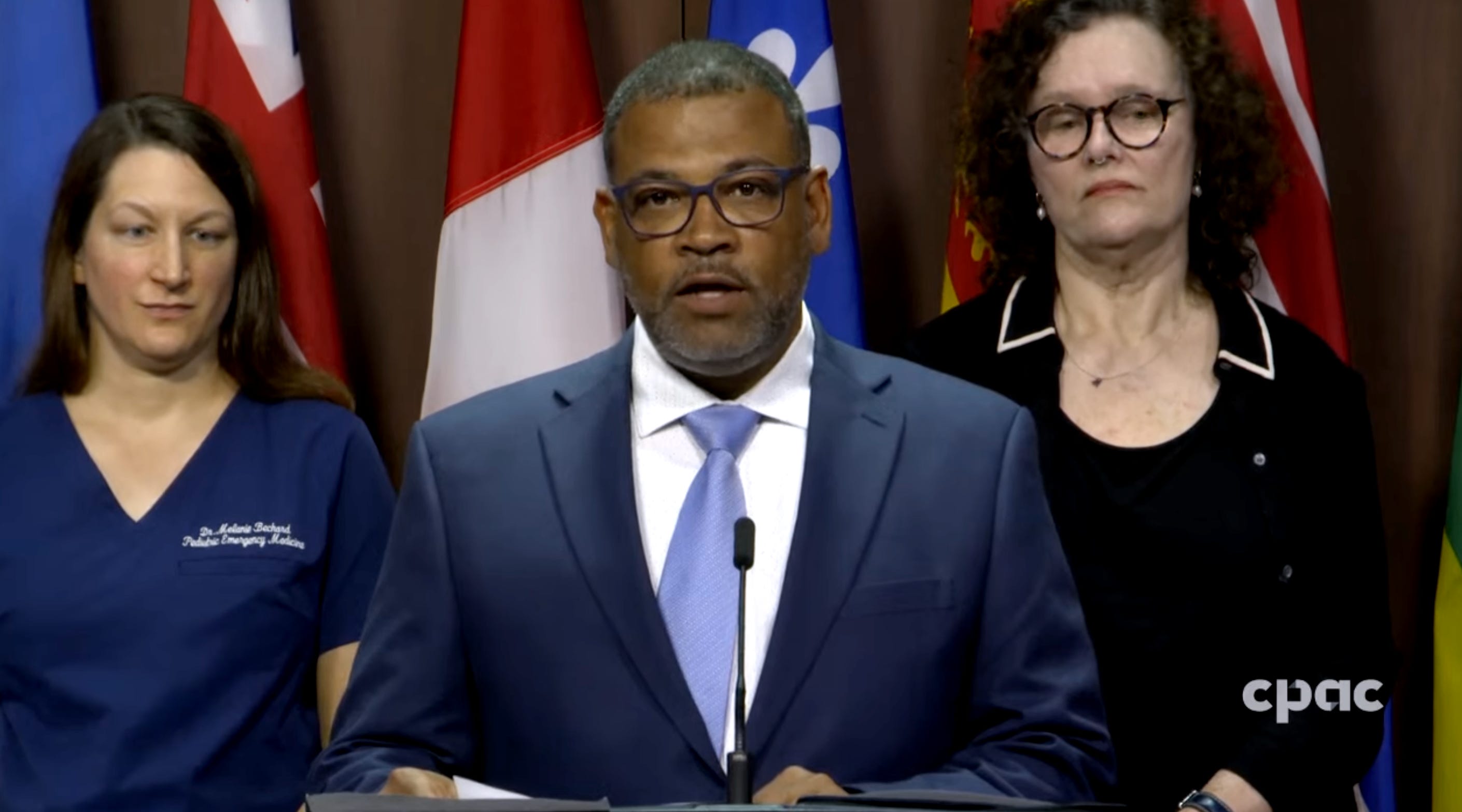
Regulations won’t fix Alberta’s legislation enabling physicians to work in both publicly funded and privately insured practice, according to a new legal analysis presented on Parliament Hill.
Lawyer Emma Phillips publicly shared her findings via video feed at a Tuesday news conference. Attending in-person were representatives of the Canadian Health Coalition, which solicited her analysis, Canadian Doctors for Medicare, Action Canada for Sexual Health and Rights, and Alberta’s Friends of Medicare.
The group of public health-care advocates assembled in Ottawa to call on the federal government to intervene against Alberta’s impending two-tiered health care by withholding health transfer payments from the province.
Bill 11, or the Health Statutes Amendment Act, which goes into effect in September, will make Alberta the first Canadian province to permit physicians to work in both the publicly funded and privately insured systems.
The legislation establishes a list of normally publicly funded procedures for which physicians will be able to charge privately for expedited care, in effect creating a paid fast lane for health care.
The Canadian Life and Health Insurance Association, which has 18 registered lobbyists representing the interests of the insurance industry in Alberta, has boasted that Bill 11 treats them as a “key partner in the healthcare system,” as reported by The Breach.
The Canada Health Act requires that provinces “must provide for insured health services on uniform terms and conditions and on a basis that does not impede or preclude, either directly or indirectly whether by charges made to insured persons or otherwise, reasonable access to those services by insured persons.”
“It has been evident since Bill 11 was passed into law in December that nothing in any regulation can undo the fundamental harm created by the legislation, it is the very structure of dual practice introduced by Bill 11, which is inherently offside the Canada Health Act,” explained Phillips.
On June 18, Minister of Hospital and Surgical Health Services Adriana LaGrange announced regulations for dual practice, which she claimed would protect the public health-care system.
These include establishing a minimum number of hours that physicians must work in the public system before becoming eligible for dual practice, which will be different for each physician based on their region and the number of hours they normally work.
Dual-practice physicians will also be required to keep separate records of their public and private practices, which Phillips emphasized is the only regulation that has been legislated thus far.
Procedures for life-threatening conditions, including cancers, will not be eligible for the dual-practice model.
“The regulations continue to allow Albertans to be charged extra billing and user fees. They continue to permit some Albertans with the ability to pay to jump the queue, regardless of medical need, and they create inequitable access to health care for Albertans based solely on ability to pay,” said Phillips.
She added that by permitting physicians to bill privately for otherwise publicly insured services, the government has established “structural incentives to shift other critical health resources already in short supply into the private payment sector, thereby increasing wait times and reducing access in the publicly insured sphere.”
After the regulations were unveiled, federal health minister Marjorie Michel said the ministry is “taking the time to review them carefully and engage with Alberta officials to better understand their components and potential impacts before they are implemented.”
Under the Canada Health Act, Phillips noted, the federal government is obligated “to deduct amounts equal to the extra billing and user fees” from the Canada Health Transfer, from which Alberta is due to receive $7 billion this year.
“Legally,” she emphasized, “these deductions are mandatory. It is not up to the discretion of the minister.”
The federal health minister also has the discretionary ability to withhold additional funds “over and above the dollar for dollar deductions resulting from extra billing and user charges” if they believe the “core principles” of the Act are being violated, added Phillips.
“What Minister Michel cannot do is to continue to sit on the sidelines as Alberta prepares to dismantle Medicare when the Canada Health Act itself requires the federal government to act,” she said.
Prime Minister Mark Carney has himself been conspicuously silent about Bill 11.
Portraying public health care as the sort of “nation-building project” for which the prime minister has expressed fondness, Friends of Medicare executive director Chris Gallaway noted that Carney’s quiescence “has been interpreted purposely by those seeking to privatize and profit off of our health in Alberta as consent for what is being implemented in Alberta.”
A June open letter signed by leaders of several right-wing think tanks and advocacy groups applauded Carney for his “openness to health care reforms being pursued in Alberta.”
Canadian Health Coalition chair Jason MacLean cautioned that if Carney fails to meaningfully challenge the erosion of universal health care embodied by Bill 11, that “will be his legacy.”
With Alberta’s Oct. 19 quasi-independence referendum approaching, MacLean argued that Carney’s intervention to protect Albertans’ public health care would demonstrate “exactly what staying in Canada delivers for them.”
“None of us are here to defend the status quo,” emphasized Dr. Melanie Bechard, an Ottawa-based paediatric emergency physician who chairs Canadian Doctors for Medicare.
“Too often, I see young patients, children who are desperately waiting for surgeries, who come to the emergency department with medical complications related to their delayed treatment.
“But let me be clear: the solution to this issue is not dual practice.”
Want to support my work without giving Substack money? You can do so through Ko-fi or by sending an e-transfer to appel[dot]jeremy[at]gmail[dot]com.
Other countries that have adopted the dual-practice model, including Australia, Ireland, the U.K., Brazil and Chile, have seen an increase in wait times in the public system, according to a May 2026 correspondence in leading British medical journal The Lancet from University of Calgary public health researcher Babatope Adebiyi.
Australia, whose model is the closest to the one Alberta is introducing, has longer wait times than Canada for key procedures, such as cataract surgery, coronary artery bypass graft, hip replacements and knee replacements.
“Better solutions exist,” said Bechard. She cited team-based care, centralized intake referrals and enabling surgeons to earn overtime pay as “proven strategies” for strengthening public health care.
Ana Laura Zarco Fuentes of Action Canada for Sexual Health and Rights explained that her work is dependant upon a “strong public health-care system.”
“When access to essential care depends on the ability to pay, we put individual and public health at greater risk, and we create new barriers to essential and timely care,” said Fuentes.
“These barriers fall hardest on those already facing challenges: young people, workers in precarious employment, newcomers, survivors of domestic violence, and families struggling to afford groceries.
“These are the people who cannot simply pay their way to the front of the line.”
The Ministry of Hospital and Surgical Health Services didn’t acknowledge a request for comment from LaGrange by deadline.
Meanwhile, not a peep out of recently-elected Liberal MP Dr. Danielle Martin, one of the founders of Canadian Doctors for Medicare. During her byelection campaign, she recycled video of her testimony before the U.S. Congress where she defended Canadian public healthcare.
Since then ... crickets.
Perhaps we should organize a tax revolt if the federal government does not act.