

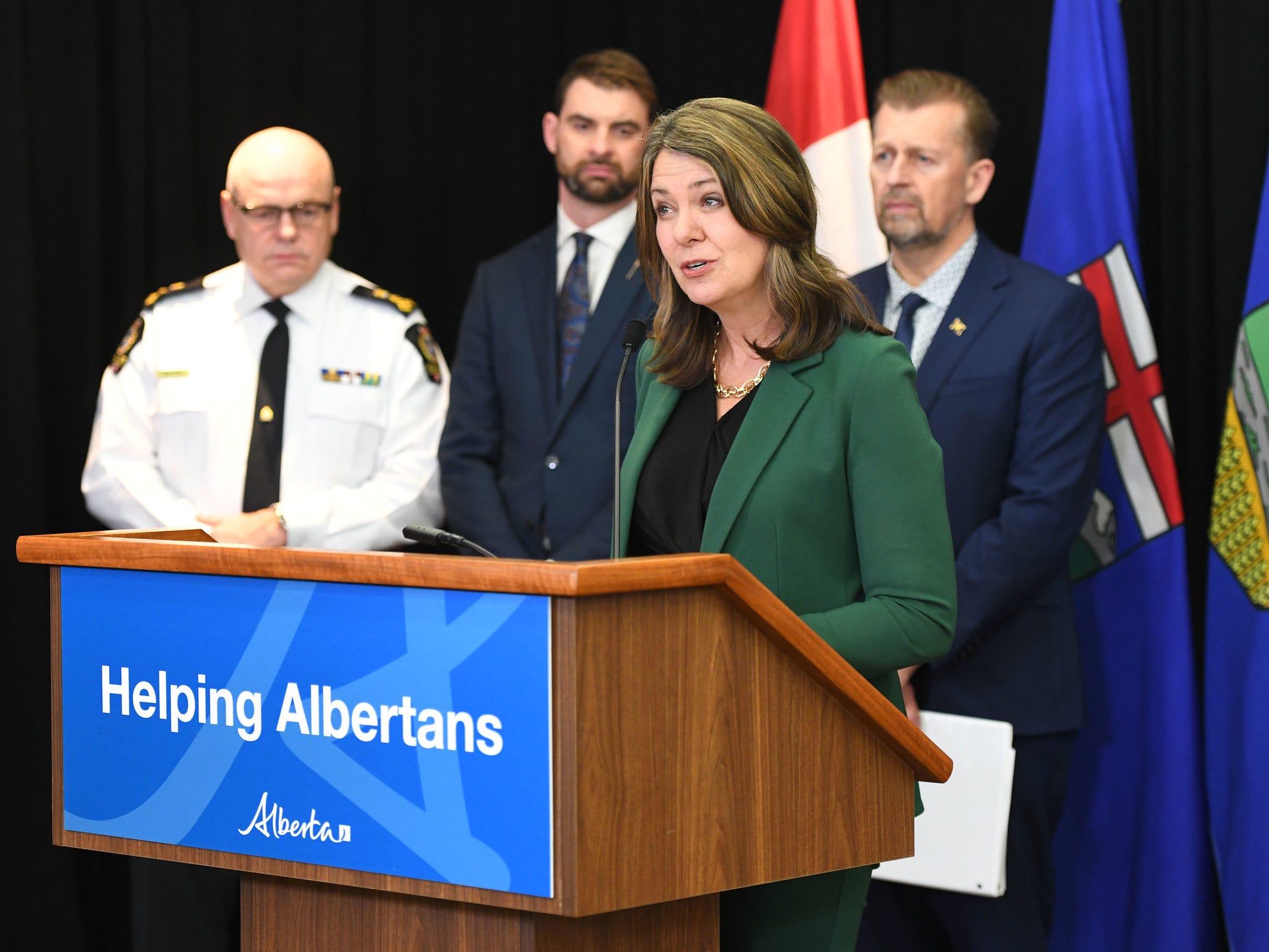
At the outset of 2024, the Edmonton Police Service (EPS) launched Project Enlightenment to evict thousands of unhoused people from encampments that Premier Danielle Smith described as “organized crime and gang-run drug-use centres and drug-dealing centres.”
“They're dangerous dudes,” Smith told a February 2024 black-tie dinner at Calgary’s exclusive Ranchman’s Club. “They're threatening people. They're making them pay protection money. If they don't pay protection money, they burn them out. There are people who have been burned to death in these tents because they won’t pay protection money to the gangs.”
Minister of Public Safety Mike Ellis, a former Calgary cop, echoed this rhetoric, referring to “gang-run drug camps that enable drug dealing, human trafficking, rape, crime, and violence.”
EPS Staff-Sgt. Michael Dreilich told Global News that the encampments were loaded with weapons.
“[It’s] almost a given that there would be a knife within any encampment. Bear spray is common. There’s also concerns with replica firearms and real firearms,” Dreilich said.
“No tent is safe,” proclaimed then-EPS chief Dale McFee. So impressed was the premier with his work on the encampment file that by the end of the year, she appointed him the province’s top bureaucrat.
This narrative of rampant gang violence at the encampments was relayed largely uncritically by mainstream media.
But almost three years later, internal police, municipal and provincial documents obtained through access to information by a coalition of organizations that work with people who are unhoused call this framing into question.
Operation Enlightenment cost the public $6.5 million over two years, with two-thirds of its cost spent by the provincial government, the documents show.
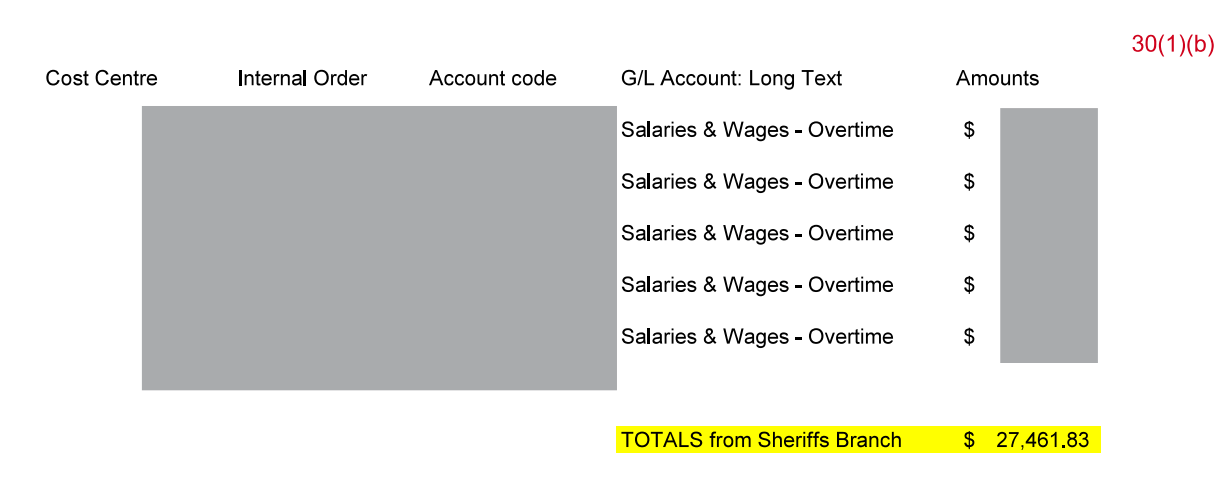
It involved near-daily deployments of EPS officers and municipal enforcement teams, as well as 16 Alberta Sheriffs, five of whom earned a combined $27,461.38 in overtime for their participation.
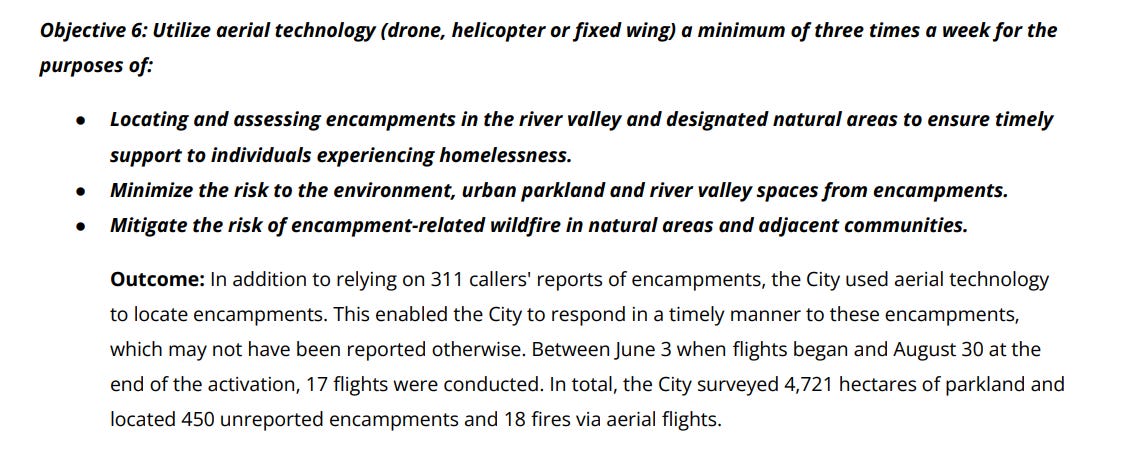
Additionally, authorities used drones, helicopters and a $5-million EPS surveillance plane to seek out encampments for closure “at least three times a week,” a Jan. 30, 2025 report from the City of Edmonton’s Community Services department reveals.
These efforts resulted in the closure of a total of 8,068 tents in 2024 and 2025, according to EPS shift records from the end of each year.
These records also show the number of arrests issued, knives and other weapons seized, as well as the value of drugs seized.
On Dec. 31, 2024, the EPS reported 4,431 structures that were taken down that year, with 21 criminal charges laid, 143 knives and 133 other weapons removed, and $1,000 of drugs seized.

The Jan. 2, 2026, record shows 3,637 tents torn down in 2025, with 14 charges laid, 516 knives and 361 other weapons removed, and $440 worth of drugs seized.

This means that over two years, 0.4% of encampment closures resulted in a criminal charge, 8% of tents had a knife, 6% had another weapon, and that each encampment had an average of 18 cents worth of drugs seized.
“The criminality in these encampments was grossly exaggerated to sell Project Enlightenment to the public,” said Chris Wiebe of the Criminal Trial Lawyers’ Association’s Policing Committee.
Wiebe, who filed the ATI requests, represented encampment leader Roy “Big Man” Cardinal, one of the few people arrested during the encampment sweep, who held up an eagle feather while refusing to leave his encampment.
Arrested alongside Cardinal was independent journalist Brandi Morin, whose charge of obstructing a peace officer was dropped, thanks at least in part due to a campaign from several prominent press freedom and journalist advocacy organizations.
Minister Ellis’s office did not acknowledge an inquiry about how he squares his rhetoric of “gang-run drug camps” with the EPS data.
In addition to lurid tales of gang violence, the provincial government said that a major aim of the encampment crackdown was to get encampment residents long-term housing.
On Jan. 17, 2024 — the same day that Project Enlightenment began — the province opened Edmonton’s Navigation and Support Centre, which was touted as a centralized location where unhoused people could get connected with income and housing supports, ID services, addictions treatment, and Indigenous cultural supports.
Wiebe conceded that the Navigation and Support Centre “helped a little bit” in getting people who accepted its assistance onto housing waiting lists and providing them with ID.
In the summer of 2024, the Edmonton Journal reported that 80% of displaced encampment residents were refusing its services, compared to a two-thirds refusal rate during the centre’s first month of operations.
So where did they go?
One possibility is that rather than accepting a police escort to the Navigation and Support Centre, many unhoused people set up encampments in Edmonton’s exurbs, including Strathcona County, St. Albert, Parkland County, Leduc and Fort Saskatchewan.
Data of complaints to surrounding municipalities about encampments show increases correlating with the onset of Project Enlightenment next door.
St. Albert had zero encampment complaints from 2021 to 2023, but logged 26 complaints in 2024 and 75 in 2025.
None of Strathcona County, Parkland County and Leduc had any encampment complaints in 2021 and 2022.
In 2023, Strathcona County had 21 complaints, which more than quadrupled to 95 in 2024 before decreasing to 85 the following year.
Parkland County had four complaints in 2023, nearly tripling to 11 in 2024 and more than doubling to 24 in 2025.
Leduc saw eight complaints in 2023, which increased to nine in 2024, but had none in 2025.
Fort Saskatchewan didn’t track encampment complaints until they had 81 in 2024, which more than quadrupled to 235 in 2025.
Wiebe attempted to obtain any EPS records of correspondence regarding the displacement of encampment residents to surrounding municipalities, but was told they don’t exist.
“The assault on people living without housing in Edmonton solves nothing but is pushing people to surrounding communities,” Housing Rights Action Coalition in Strathcona County spokesperson Annie McKitrick said in a statement.
She added that local residents are attempting to provide services for unhoused people in the county, but that they need provincial support, which hasn’t been forthcoming.
Project Enlightenment didn’t reduce homelessness in Edmonton either.
According to Homeward Trust’s count of people who are unhoused, there were 2,730 people experiencing homelessness in Edmonton in December 2023, the month prior to Project Enlightenment and the Navigation and Support Centre opening. Of these, 637, or about a quarter, were without shelter or other provisional accommodations.
By October 2026, there were 3,936 people experiencing homelessness in Edmonton — a 44% increase — with 753 people entirely unsheltered, representing one-fifth of the unhoused population.
While the proportion of unhoused people who were without shelter or other temporary accommodations decreased, the total number increased by 18%.
For Wiebe, these statistics demonstrate the folly of a “law enforcement-first” approach towards homelessness, which sacrifices the important long-term “relationship building” required to meaningfully assist people living on the streets.
“They come every morning. They say, ‘pack a bag and leave the city.’ Trucks come, and anything that people don't pack with them in the short amount of time given them gets thrown in the dump,” he said of the Project Enlightenment team’s attitude towards encampment residents.
“It’s very humiliating and defeating. Trust is eroded, not built, and people are alienated and degraded.”
Policing is half of Edmonton’s City Budget.
I wonder what would have happened if that $6.5million had been divided up between the homeless on that day: about $2300 each?
Would some make it home to another Province?
Add that $2300 to getting counselling and health checks, a whole lot of good might have happened instead of having Danielle’s SA break up encampments, throwing people’s useful items and tents into dumpsters and passing the homeless “can” literally “down the road!”
Don’t forget the fascist tactics used to remove the Pro Palestine “encampment” at the U of A, “special munitions and batons, but no gas” the police said, but observers claimed otherwise.
The cost and efficacy of the operation are one thing , but the sheer brutal inhumanity of the operation is stunning.
These are the tactics Israeli police use on Palestinians in apartheid Israel.
Tactics updated, no doubt, with the recent visit to Israel by Chief Driechel.
Alberta is going down a dark path.
“I'm almost certain that they are probably likely to maybe catch those dastardly gang members with all the drugs in one of the next series of encampment raids.” - Edmonton city council at their annual increase of policing budgets next month.