

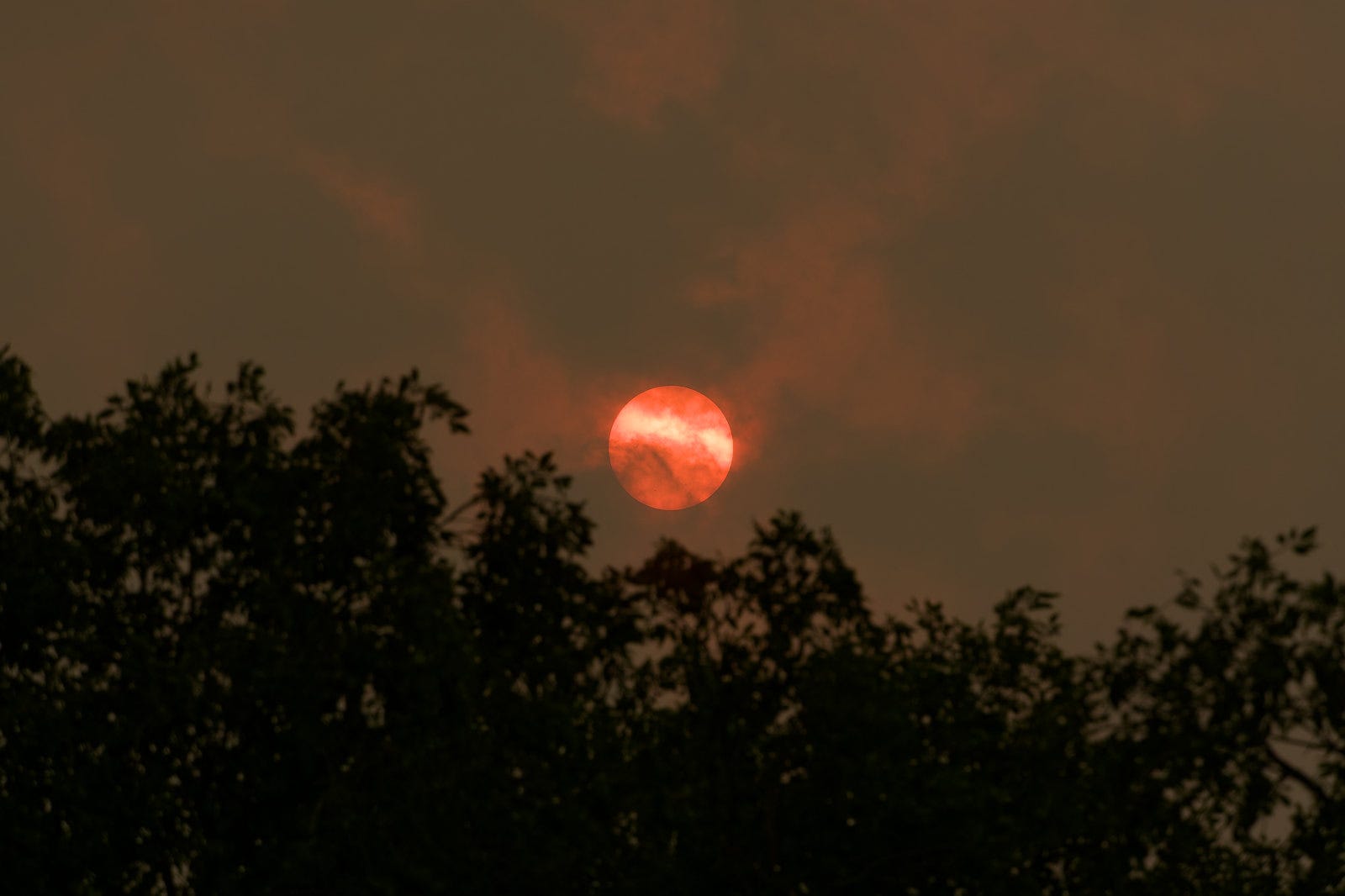
Nearly 1,000 communities representing a majority of Canadians have been directly impacted by extreme weather events exacerbated by the climate crisis, according to newly released figures from a national climate advocacy group.
The organization that put the numbers out, Elbows Up for Climate, is a coalition of 300 municipal elected officials formed last year to push for policies that address climate and affordability concerns in equal measure.
Its researchers found that 934 communities with an estimated total population of 26 million faced extreme heat, unsafe air quality, flooding, severe storms, wildfires, droughts and/or declared states of emergency in 2026 so far.
“These numbers are sobering, they’re simple to understand, they’re real, and they show that Canadians are suffering,” former Toronto mayor David Miller, who co-chairs Elbows Up for Climate with former Montreal mayor Valérie Plante, told The Orchard.
This year’s figures represent a sharp increase from last year, when Elbows Up for Climate found that the same weather events impacted about a quarter of Canadians spread across 220 communities.
The numbers were compiled from official emergency alerts and media reports.
Miller, who travelled across Canada with his wife this past summer, said the climate impacts across the country were impossible to ignore.
“Every single day we were surrounded by wildfire smoke,” he said. “It was extraordinary.”
According to the data, Saskatchewan had the most communities facing climate emergency events with 289, followed by Ontario with 236, Quebec with 109, Manitoba with 104, B.C. with 62 and Alberta with 45.
The reason Saskatchewan’s numbers are so disproportionately high is that its heat and air quality warnings cover “a large number of small communities and rural municipalities,” a backgrounder on the numbers explains.
Don’t want to give money to Substack to support me? I get it. You can also support my work through a one-time payment or recurring subscription on Ko-fi, or send an e-transfer to appel[dot]jeremy[at]gmail[dot]com.
Miller cautioned that not everyone is impacted equally by these events.
The numbers capture the “health impacts of wildfire smoke in Toronto, just as much as the horrific wildfires in some Indigenous communities,” flooding and communities being “evacuated because there was a risk, even [if] it didn’t happen.”
The most common weather emergency in Canada this year was extreme heat, with 669 communities impacted, compared to 320 communities with unsafe air quality warnings, 138 facing flooding, 68 local emergencies, 49 wildfires, 40 severe storms and 12 droughts.
A United Nations report released Wednesday suggests these events will become increasingly frequent as the world exceeds average temperatures of 1.5 degrees Celsius above pre-industrial levels in the coming years.
With ambitious climate policies, the world can limit warming to a peak increase of 1.8 degrees by mid-century before entering a cooling off period, the report notes.
But on the current trajectory of ramping up fossil fuel production and gutting climate policies, as Prime Minister Mark Carney has done, the world will reach a 2.6-degree increase by 2100.
Miller said he sees hope in the popular backlash against fossil fuel-hungry hyperscale AI data centres that Big Tech is attempting to impose on communities across North America to build technology that is being used to eliminate jobs and enable state surveillance.
A Leger poll from July 2026 shows four out of five Canadians concerned about data centres’ impact on their electricity bills and the environment, drawing together affordability and climate concerns, even as a plurality of survey participants characterized data centres as a positive development.
Notably, opposition is most acute in Alberta, where 90 per cent of proposed AI data centre capacity in Canada is being pitched. Almost half the Albertans surveyed described data centres as a “bad thing.”
“Even people who might be supportive of the fossil fuel industry often seem to see the data centres as a step too far,” said Miller. “Why do we need to burn fossil fuels so that Elon Musk and Mark Zuckerberg can get even richer?”
PS - Buy my book
My new book, Dark Phoenix: The Rise, Fall, and Re-emergence of Danielle Smith comes out Oct. 13.
It takes an in-depth look at the wild trajectory of the Alberta premier’s career in politics, media and corporate lobbying, detailing how she became the conduit for dark, authoritarian forces that are reshaping not just Alberta but Canada writ large.
I’m encouraging Orchard readers to preorder it, which signals broader interest in the book to vendors and media, helping it reach as many readers as possible.
You can preorder Dark Phoenix to your local indie bookstore by hitting the “shop local” tab here. It’s also on sale at Indigo and Amazon, if that’s your thing.
By preordering the book, you can help me outsell former deputy prime minister Chrystia Freeland’s memoir, Unreliable Boyfriend, which comes out the same day.
Wouldn’t that be something?