

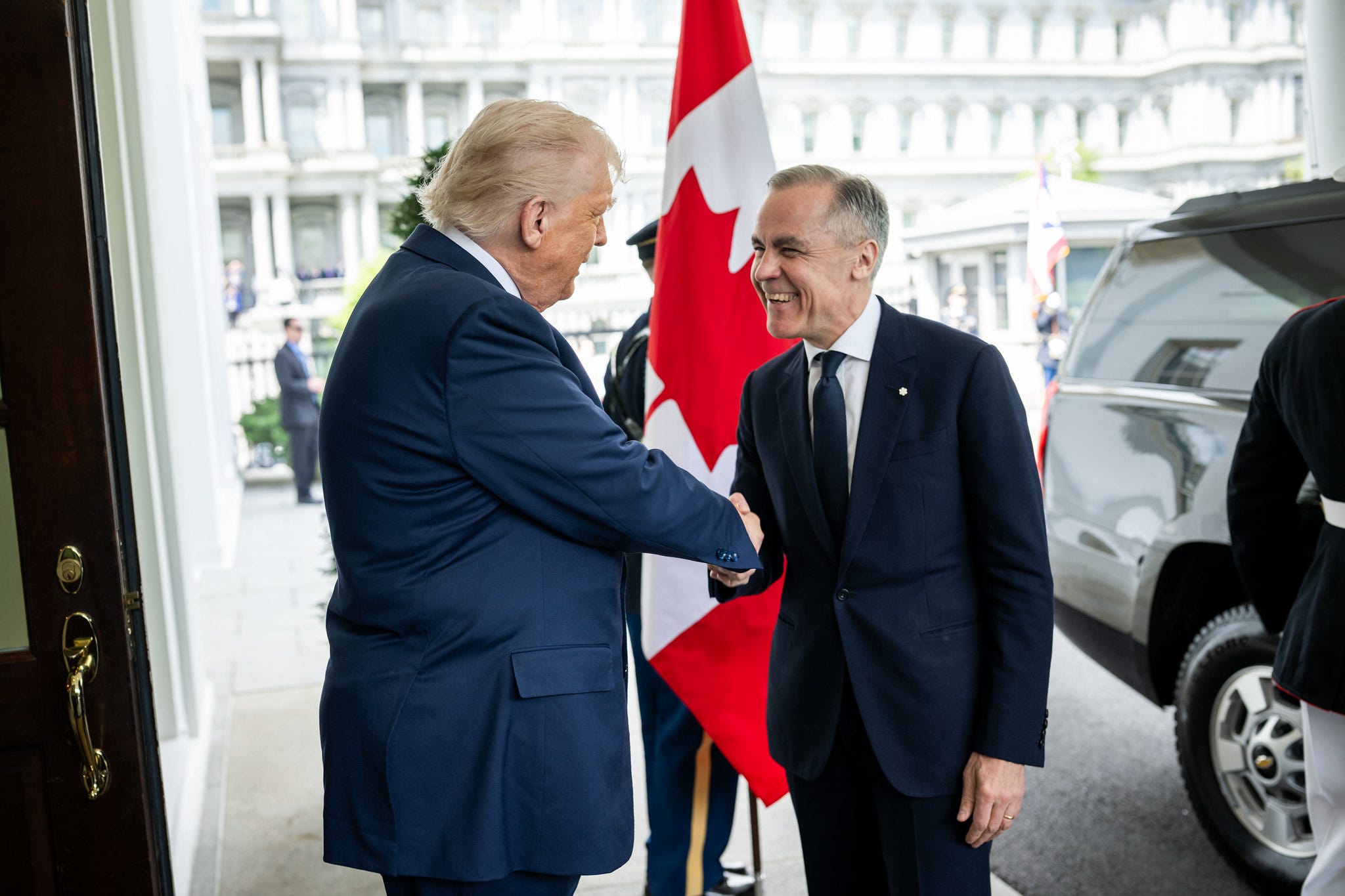
In June 2025, Prime Minister Mark Carney nixed the Digital Services Tax, which would have charged American tech giants just 3% of their Canadian revenue for the privilege of doing business here.
The prime minister explicitly pitched this rollback as a goodwill gesture to restart moribund trade negotiations with U.S. President Donald Trump and avoid the prospect of future tariffs.
This became overarching justification, whether implicit or explicit, for Carney rolling back capital gains taxes, dismantling various environmental regulations, engaging in a rapid military buildup, enabling increased deportations and state surveillance with the Strong Borders Act, and sending representatives to the Trump administration’s preposterous summit on the scourge of left-wing extremism.

None of it was enough. With Trump announcing on Monday that he is imposing 50% tariffs on $20 billion of Canadian goods, or 5% of exports to the U.S., under a previously unused section of the 1930 Tariff Act, the material results of Carney’s approach are clearer than ever.
“The lesson they taught Carney and most Canadians is that if you give up something pre-emptively, you’ll get nothing in return,” Christopher Sands, director of the Center for Canadian Studies at the Johns Hopkins University School of Advanced International Studies in Washington, D.C., told the Globe and Mail.
While it’s easy to write off Carney’s unrequited policy concessions as a failed negotiating tactic, I suggest it’s more helpful to understand them as part of a broader corporate authoritarian consensus that Carney is willfully facilitating, acting less as a head of state and more as the CEO of Canada Inc., maximizing value for shareholders.
Remember, the initial impetus for tariffs was border security. When the Canadian government gave Trump what he wanted on the border, the justification shifted as the tariffs ramped up.
The major tariffs Canada faces are 50% on steel and aluminum, 25% on auto parts, 10% on softwood lumber (a long-time trade irritant between Canada and the U.S.), 30% on selected upholstered wooden furniture, and 50% on cabinets and vanities.
Canada has its own retaliatory tariffs of 25% on steel and aluminum, 25% on auto parts, and 25% on steel derivatives. The federal government has dropped every other retaliatory tariff in a stated effort to convince the Americans to renew USMCA with some modifications.
All provinces except for Alberta and Saskatchewan have banned U.S. alcohol from their shelves in response to American tariffs. Trump cited that, alongside protectionist measures to protect Canadian dairy farmers from U.S. competition — the elimination of which is a perpetual obsession of Canadian conservative commentators — and the retaliatory steel tariffs as justification for the latest round of tariffs.
And now U.S. Trade Representative Jamieson Greer says the administration is pursuing interim bilateral agreements with Canada and Mexico before negotiating a deeper restructuring of USMCA — one which will no doubt put U.S. corporations at an even greater advantage.
“There will always be another agenda on the table, another imagined slight, a goalpost to move, or just a need to make others dance,” writes National Post comment editor Carson Jerema in a rare flash of insight.
But then the right-wing ideological enforcer immediately — and almost certainly inadvertently — urges the Liberal prime minister to stay the course.
“There isn’t much Canadians can do, except to look inward, cut taxes, deregulate and, yes, cut trade barriers, to bring up our productivity and incentivize businesses to invest here,” Jerema added.
Through all these trade measures and countermeasures, it’s important not to lose sight of the way Carney is fundamentally restructuring the Canadian state to serve the interests of largely foreign capital and in so doing “help make America great again.”
In this sense, the trade dispute provides Carney with a necessary crisis to build popular consensus for restructuring the Canadian state along corporate lines.
Whether by ramming through fossil fuel and other industrial projects on an expedited timeline, abandoning Canada’s climate commitments while wildfires rage, supporting the U.S. and Israel’s aimless war on Iran, permitting Canadian companies to profit off the Trump administration’s violations of migrant rights, and continued military procurement from American defence contractors, Carney is largely operating in tandem with Trump.
And what are Canadians getting in return? The beginnings of two-tiered health care, which Carney could stop at any time by reducing health transfer payments under the Canada Health Act; the proliferation of AI into all aspects of our lives without our consent; a carbon capture hub that is already slated to cost more and reduce emissions less than initially advertised; a 60% cut to nature conservation; and the authorization of pesticides that the government has deemed harmful to our health.

With Trump’s annexationist threats and “51st state” taunts, I’m sympathetic to the notion that any Canadian leader would need to tread lightly in disentangling Canada from the U.S. orbit, lest we become Ukraine to America’s Russia.
There’s no doubt a delicate balance to be struck in pursuing alternate trade relations and alliances, especially as Alberta’s impending quasi-independence referendum poses a homegrown opportunity for the U.S. to destabilize Canada.
But when we examine the grand scheme of Carney’s approach to U.S. relations, it becomes increasingly clear that this balance is entirely off kilter, with hollow rhetoric of protecting Canadian sovereignty used to obscure Carney and Trump’s shared ambition of restructuring their states as profit-making enterprises for a select few.
At a certain point, one must concede that Carney is doing all this simply because he wants to be the CEO of Canada Inc.
What? Carney shares NOTHING with Trump in any way, shape or form. The trouble with many political writers is how that activity can supersede reading or otherwise following daily events, which I do and so am disappointed to see you fall into lockstep with the environmental community that refuses to cede the righteous higher ground of ACTIVISM that can be increasingly compared to the conservative "grievance" perspective, one that feels SO good because it can soar safely beyond the fray by COMPLETELY IGNORING CONTEXT. You at least make some concessions to the "delicacy" required in what would be any current PM's context due to Trump's threats to our sovereignty, which are as UNPRECEDENTED as the economic tariff threats, SURELY loaded context that would shoot to the top of any Maslow-style hierarchy of needs. But you'll admit it might require SOME adroitness on Carney's part? The condescending, arrogant ignorance rivals that of consistently context-free CONSERVATIVES! But wait, why not also jump on the con bandwagon with ZERO respect for education, experience and expertise (ALL absolutely top-drawer) and casual trashing of the guy's character for good measure!? You think Carney's a lying shill for big oil or something FFS?
A reminder of context when it comes to a monstrous right wing that's not only lost its mind, but has actually become the banality of evil: THEY currently hold most of the POWER in the U.S., and fill HALF our own House of Commons along with provincial power in the majority of the provinces in this country. And that we BARELY dodged a bullet in our last election thanks to Carney and the Liberals, but he's got everyone working together like we've never seen at a time when we most need it.
He's old and has made a name AND his millions, so I for one believe him when he says he wants to give back to the country that has "given him everything" because he has personal integrity, brilliance, and a sense of humour. We're lucky to have him because only HE could be so quickly fast-tracking our vital re-alignment with the EU from whence he ALSO comes.
He knows what he's doing with these recalcitrant, nasty cons, he's stick-handling them and giving them enough rope to hang themselves while allowing the neutral market (AND cleverly, the monarchy) to pull rank, gradually.
So how about some good old-fashioned trust, and knocking off the stupid, derivative "grievance" culture that permeates right now and has only ever spawned all our worst behaviours as human beings.
One thing that displays his classiness and basic integrity is how he refuses to "take the bait" perpetually dangling thanks to our true enemy, "techno-fascism." He's too busy actually governing.
I thought we got rid of Stephen Harper in 2015. But I rejoiced too soon. He's back in the guise of Carney.