
Lewis-adjacent slate sweeps NDP executive election
In a surprise development, the 'non-establishment' slate swept the party's president, vice-president and treasurer positions, suggesting change is in the air.

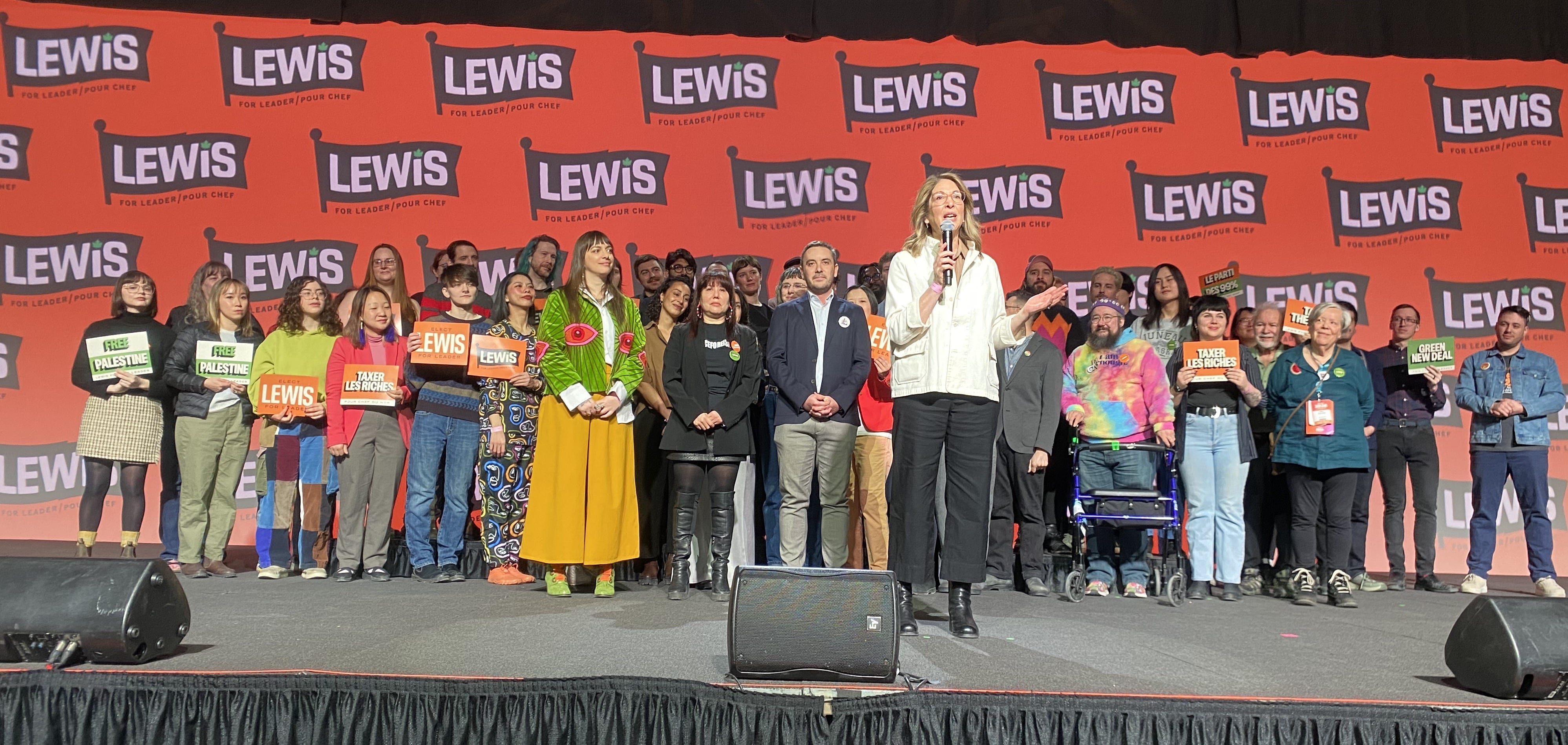
In a major rebuke to the party’s old guard that could presage tomorrow’s leadership result, federal NDP delegates have elected a new executive slate that pledges to empower local electoral district associations.
While the leader is the party’s public face who sells their policies to the broader public, the executive team is responsible for the party’s internal governance structures.
The Change, together slate swept Saturday’s executive vote, which was confined only to delegates attending convention, unlike the leadership vote, which was conducted online and will be revealed Sunday morning.
Delegates elected labour lawyer Niall Ricardo of Montreal as the party’s new president and University of Calgary math professor Keira Gunn as treasurer. They will be replacing incumbent president Marty Shorthall, who didn’t seek re-election, and incumbent treasurer Susanne Skidmore, the sitting president of the B.C. Federation of Labour.
Skidmore ran on a slate with incumbent VP Laurie Antonin, a strategic campaigner with the Action Network, and presidential candidate Malcolm Lewis-Richmond, who works for the Professional Institute of Canada.
Ricardo defeated Lewis-Richmond by just 25 votes out of 1,179, or two percentage points, and Gunn beat Skidmore by 137 out of 1,197, representing 11 percentage points, according to a leadership campaign source.
“It’s not just my victory,” Ricardo told The Orchard in an interview. “It’s the victory of a lot of folks who wanted to see some change in this party, and more transparency, more democracy.”

Under the NDP constitution, if the elected president is an anglophone, the vice-president needs to be a francophone, and vice versa. Because Ricardo and Antonin are both francophones, anglophone Libby Davies, the former MP for Vancouver East and Change, together candidate, was acclaimed as VP.
The executive leadership also includes a VP labour, which is selected by a caucus of labour delegates, who renominated Siobhan Vipond, representing some degree of continuity.
Rounding out the executive team is the party’s national director, currently Lucy Watson, who serves at the rest of the executive’s discretion. Given the success of the change slate in the wake of the party’s catastrophic 2025 election result, it’s unlikely Watson will have her job much longer.
Change, together was widely regarded as friendly to leadership frontrunner Avi Lewis. Davies has endorsed Lewis for leader and donated $500 to his campaign.

Ricardo was on stage with Lewis’s team during Saturday morning’s leadership candidate showcase, in which Lewis was introduced by Winnipeg Centre MP Leah Gazan, campaign manager Savannah Wilson and Lewis’s spouse, author and journalist Naomi Klein.
Ricardo, however, preferred to refer to his slate the “non-establishment slate,” noting that he spoke at a campaign event for Lewis leadership rival, Edmonton-Strathcona MP Heather McPherson.
“We just want to open up and democratize the party in the sense of actually making it more accessible,” he explained.
The president-elect noted the prohibitively expensive cost of delegates from across Canada travelling to Winnipeg to participate in the party’s governance process.
“We have to get better at the NDP having these exercises in internal democracy more than just at convention every few years,” said Ricardo.
He suggested taking a page from the “digital tools” Quebec solidaire, the left-wing provincial political party, uses to reach its members across the province, as well as the “decentralized democracy” of Spanish leftist party Podemos.
“We have to find ways to organize in a decentralized manner, where we’re giving power back to the organizers on the ground to organize within their communities, because those are the people that know how the NDP should lead in their communities,” said Ricardo.
He suggested that the supply-and-confidence agreement former leader Jagmeet Singh entered into with former prime minister Justin Trudeau to advance NDP priorities, such as expanding dental coverage, pharmacare and anti-scab legislation, was a strategic mistake.
“The Bloc Quebecois ate our lunch with regard to that deal,” enabling the Bloc to present itself as the only non-Conservative alternative to the Liberals, Ricardo said, adding that the party needs to focus more on “bred and butter issues.”
The NDP went from a high of 59 of Quebec’s 75 seats in 2011 to one seat in 2025. Alexandre Boulerice, the party’s lone Quebec MP, is pondering about leaving federal politics to run for Quebec solidaire in la belle province’s upcoming provincial election.
Boulerice donated $500 to McPherson’s leadership campaign and is in Winnipeg for convention.
Ricardo noted that there are clear divisions within the party, which requires a “team of rivals approach” from whoever is the next leader.
“We need all of the people that were in this leadership race to stay involved in the party, and we need the members that they brought in to stay involved in the party, so the leader has to reach out and create those bridges,” he said.
Arushana Sunderaeson, a former staffer for ex-MP Niki Ashton who now works for United Steelworkers (USW) in Toronto, supported the incumbent executive slate, which has deep ties to organized labour, but was conciliatory to the new executive team and whomever the new leader is.
“We’re looking forward to working with them and ensuring that labour is being put in the centre of the party, and that we continue to fight and advocate for that as well too,” Sunderaeson told The Orchard.
USW supports International Longshore and Warehouse Union president Rob Ashton for leader, but Sunderaeson said her union intends on working with whomever the next leader is to ensure that labour “is being put in the forefront of the party,” including the needs of “racialized workers.”
Elizabeth Strange, an old friend from Medicine Hat who now works as a lawyer in Edmonton, voted a split ticket for the executive, supporting Lewis-Richmond for president and fellow Albertan Gunn for treasurer.
Strange supports McPherson for leader, citing her electoral track record and personal warmth, describing McPherson as “caring, compassionate” and a “normal person.”
“She’s able to have regular conversations with folks, and can meet us at the level that we’re at. She doesn’t talk down to any member or any citizen or any person in this country,” said Strange.
Regardless of who wins tomorrow — and it will either be Lewis or McPherson — the new leader will face the challenge of navigating both a divide between the federal party and its provincial counterparts, as well as divisions between the leadership campaigns’ supporters.
Either Lewis will have to win over McPherson’s supporters or McPherson will have to win over Lewis’s supporters, said Strange.
“Being a leader for all of the members will be a challenge for any of the leaders,” she said.