

Although it occurred more than six years ago, the fatal Covid-19 outbreak at the Cargill’s High River meatpacking plant provides valuable lessons about the encroaching corporate capture of government that are crucial for responding to future crises.
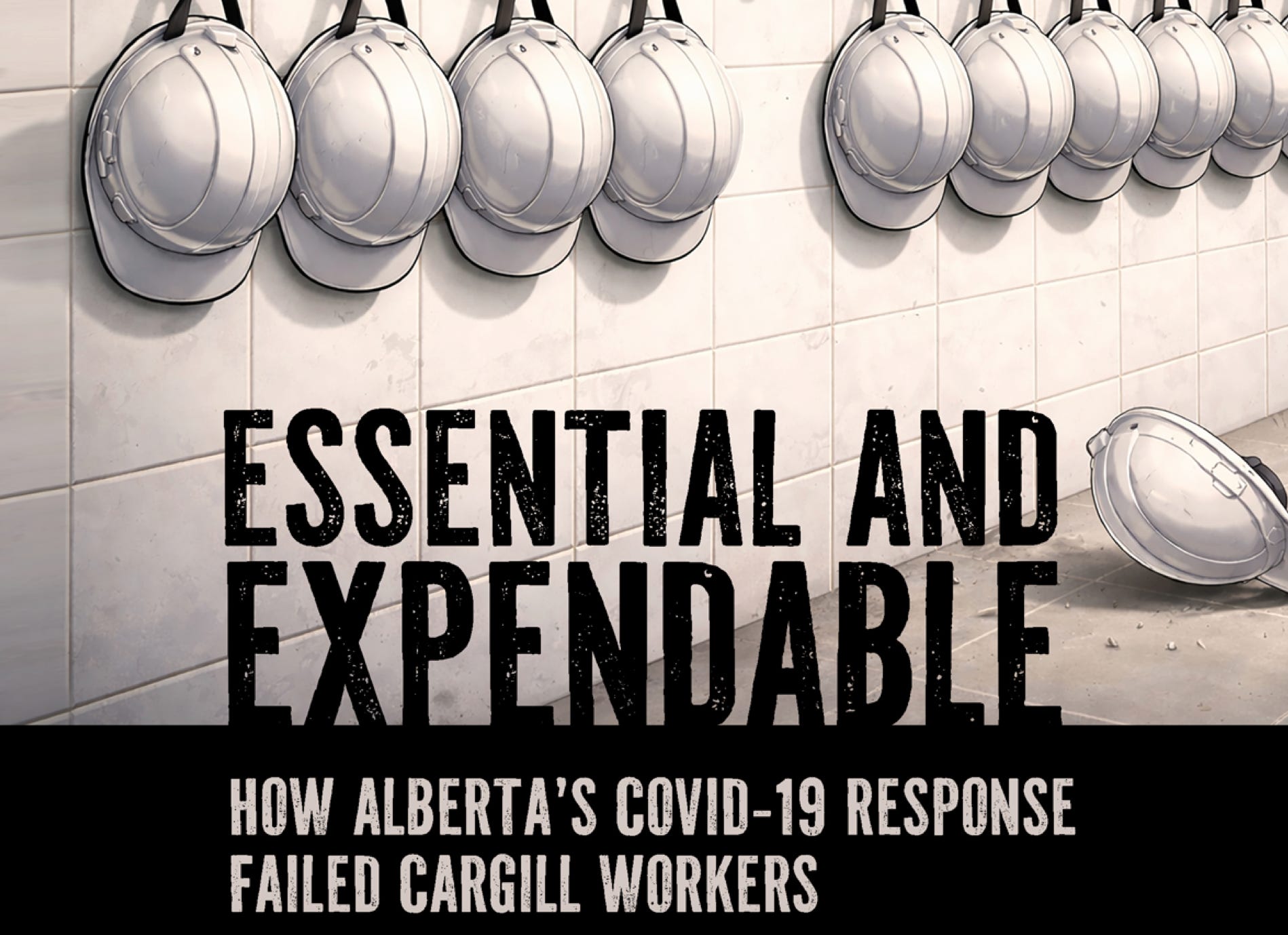
That’s according to the co-authors of a sprawling 200-page report from the University of Alberta’s Parkland Institute released Monday, entitled Essential and Expendable: How Alberta’s Covid-19 Response Failed Cargill Workers.
The study, co-authored by Parkland Institute director Jason Foster and University of Regina occupational health and safety academic Sean Tucker, details the myriad ways Alberta Health Services, Alberta Occupational Health and Safety (OHS), and the UCP government enabled Cargill to become the site of the biggest Covid outbreak in North America at the time, infecting 950 and killing four people.
“The Cargill story is, at its heart, a story of systemic regulatory failure defined by inaction, a lack of preparedness and overconfidence, cultural stereotypes, incompetence and aversion to using available enforcement measures,” reads the report.
“This tragedy occurred in a political environment that prioritized economic growth over the health and safety of a vulnerable group of workers. The result was a large-scale, tragic outbreak, the scope of which was preventable.”
Foster told The Orchard that this is a bigger story than just one workplace, or even the pandemic.
“This is about a systematic breakdown of the Alberta government’s regulatory capacity,” he explained. “That could be in any workplace. That could be in any kind of dynamic situation.”
In an interview, Tucker said there’s been little apparent appetite among Canadian researchers to revisit the failures of the early pandemic response.
“I've been surprised now that five years later, that there haven't been more independent reports done on the response to the pandemic — purely for readiness for the next one,” he said.
There’s been a tendency to dismiss the response’s shortcomings as the product of officials scrambling to manage a new virus of which little was known.
Be that as it may, Tucker emphasized, there were major errors and derelictions of duty made at the earliest moments of the plague that made an already bad situation worse.
The report includes dozens of recommendations for major reforms to Alberta’s occupational health and safety regime to ensure workers are adequately protected when the next pandemic occurs.
Because little was known about the virus at the time, said Tucker, the Ministry of Labour should have taken a proactive role to “implement maximum protections” for workers, such as providing them with respirator masks and improving the facility’s ventilation.
Cargill also should have been prohibited from offering bonus pay to workers who came into work, which effectively incentivized people to come into work sick beginning on March 23, 2020.
The Parkland researchers obtained an April 8 email from Alberta Health Services (AHS) manager of environmental and public health Sarah Nunn to Cargill calling these incentives “quite concerning.”
“I think we are all keen to stop the spread of this organism,” Nunn added.
The report notes that this reflects the “cordial and supportive” approach public health officials took vis a vis industry.
“There's no reason that public health couldn't have ordered Cargill to stop their incentive pay,” said Foster. “They didn’t act as a regulator. AHS acted like a partner with Cargill.”
So close were AHS officials with Cargill management that AHS Calgary Zone medical officer of health Dr. Jia Hu provided Cargill health manager Katie Robinson with a gift during an April 17 visit to the plant.
“Pleasure meeting you today in person, super appreciate the work you’ve been doing and hope you use that wine gift card,” Hu wrote in an email the researchers obtained through freedom of information.
On March 27, the meatpacking industry was one of 100 industries declared an “essential service,” exempting it from public health measures regarding gathering sizes, physical distancing and temporary closures.
“If workers are deemed essential, that they should be provided with sufficient income replacement, so that it removes that necessity of them going to work when they’re potentially ill or they’re asymptomatic and spreading the virus,” said Tucker.
He added that the process for declaring services essential lacks transparency. “We could not find any legal justification for the list of essential services in Alberta,” said Tucker. “It seems like it was something that was just published on a government website.”
On April 3, about three weeks into the pandemic, AHS was made aware of a Cargill worker testing positive for Covid for the first time, although it was subsequently revealed that workers began testing positive in March.
The government was determined to ensure the plant remained open. “No disruption to the plant operations is expected,” a Ministry of Agriculture and Forestry bureaucrat wrote on April 6, with more positive tests coming out of the plant.
The following day, upon the invitation of Cargill, AHS conducted its only in-person inspection of the plant prior to its temporary closure, making advisory recommendations on discouraging carpooling, requiring workers to wear masks and installing barriers between workers.
The workers, many of whom were racialized immigrants, weren’t reassured. On April 12, Filipino residents of High River signed an open letter demanding the plant’s closure, and UFCW Local 401 president Thomas Hesse wrote a letter to Cargill, Premier Jason Kenney and Minister of Labour Jason Copping requesting the same.
A representative of the company dismissed Hesse’s correspondence as “highly inflammatory.”
Declining attendance led the company to cut one of the plant’s two shifts on April 13, and an outbreak was officially declared the following day.
On April 15, OHS conducted a half-hour virtual inspection of the plant, even though OHS officials were deemed essential workers, just as meatpacking workers were.
The inspection was recorded by a Cargill manager, who was accompanied by a UFCW representative and worker. The report, which concluded that the workplace was made as safe “as far as it is reasonably practicable for the employer to do so,” was sent to OHS the following day, but it took three days for UFCW to receive a copy.
The union steward later told the Alberta Labour Relations Board that the inspection “was not a fair depiction of the plant.”
“There is no excuse to do an occupational health and safety inspection via iPad,” said Foster. “There's no excuse for that ever.”
Foster and Tucker filed a freedom of information request for correspondences between AHS and OHS regarding the virtual inspection, which yielded no results.
Cargill management and the government hosted a telephone town hall for the workforce on April 18, with Minister of Agriculture and Forestry Devin Dreeshen and chief medical officer of health Dr. Deena Hinshaw in attendance.
Despite a majority of Cargill workers not speaking English as their first language, no translation services were offered at the town hall. The workers’ union, UFCW Local 401, was not invited.
At the town hall, Dreeshen urged workers not to “get distracted by misleading noise or inflammatory rhetoric” about conditions at the plant, ensuring the workforce that it was “completely safe” based on the findings of AHS and OHS.
Dr. Hinshaw blamed carpooling and crowded housing conditions, rather than anything to do with the workplace itself, for the outbreak. The report suggests that Hinshaw didn’t actually know this to be the case. Hours after the town hall, she asked health officials to determine how many cases were tied to workplace, carpool, housing and community transmission.
“We need people early in a public health emergency who will speak truth to power, make evidence-based decisions and won't make public statements that are not based on evidence,” said Tucker.
On April 19, UFCW held its own town hall for the workers, at which 85 per cent of workers said there are days when they fear going into work. On the same day, 67-year-old Bui Thi Hiep, who worked at the plant for 23 years, died of Covid, which led Cargill to announce the plant’s temporary closure on April 20.
On May 4, as the plant was set to reopen, an internal briefing note to Dreeshen and Premier Jason Kenney incorrectly stated that workers do not have a right to refuse unsafe work because the plant was deemed safe by public health officials.
“The right to refuse dangerous work, however, exists outside the authority of public health, and is meant to protect workers in situations where there isn’t scientific certainty about the transmission and health impacts of a new airborne hazard,” the report notes.
For Tucker, a more proactive role for the ministry of labour, which oversees OHS, could have saved lives. Throughout the crisis at Cargill, then-minister of labour Jason Copping maintained he was simply following public health directives.
This is a problem, said Tucker.
“Public health didn't have any experience with inspections and compliance with large industrial meatpacking plants,” he explained.
Foster noted that the role of agriculture and forestry in managing the outbreak was particularly problematic.
“They were there basically as an advocate for the industry and an advocate for keeping the plant open,” he said. “[They] shouldn't have been within 50 feet of this process.”
The report says it cannot explain for certain “why Alberta OHS abdicated its important responsibilities in response to the largest outbreak of COVID-19 in Canada.”
“Whatever the causes, their inaction represents a clear case of industry capture and regulatory failure,” it reads.
Foster called the case of Cargill a “canary in the coal mine” for workers’ health and safety rights.
“It's definitely a warning signal that when push comes to shove, the state will side with the employers. They will side with capital, and so that means if workers are going to protect themselves, they need to do it themselves,” he said.
“They have to find a way through their unions, through their communities, through their solidarity together to try and protect their rights.”
Read the full report here.
Ah, but we trust them to get the data centres right. The well clean up. The interbasin water transfers. The tailings ponds. The impact assessments. Right?
Shocking but not surprising. THis months Alberta Views has a dialogue between two men as to what immigration levels might be 'good for Alberta'. I'd suggest we start asking ourselves what immigrants to Alberta can expect from us.....because the calloursness with which we abandoned Cargill workers to fend for themselves........and the indifference that was both exposed......and maintained, to Long term care workers who had to work part time in two or three facilities because management didn't want to have to include benefits in their pay package, suggested at the time that EXPLOITATION OF IMMIGRANTS...was Albertan policy.
This report doesn't change my negative impression of how we treat newcomers to our province. It does confirm my fears that there is something monotonously MAGA about a lot of us....
By now we're way past exploitation of immigrant workers and all in on expulsion of them from our god given 'white system'. Check out a majority of the stupid questions on the referendum if you think I'm being too hard on our province.