

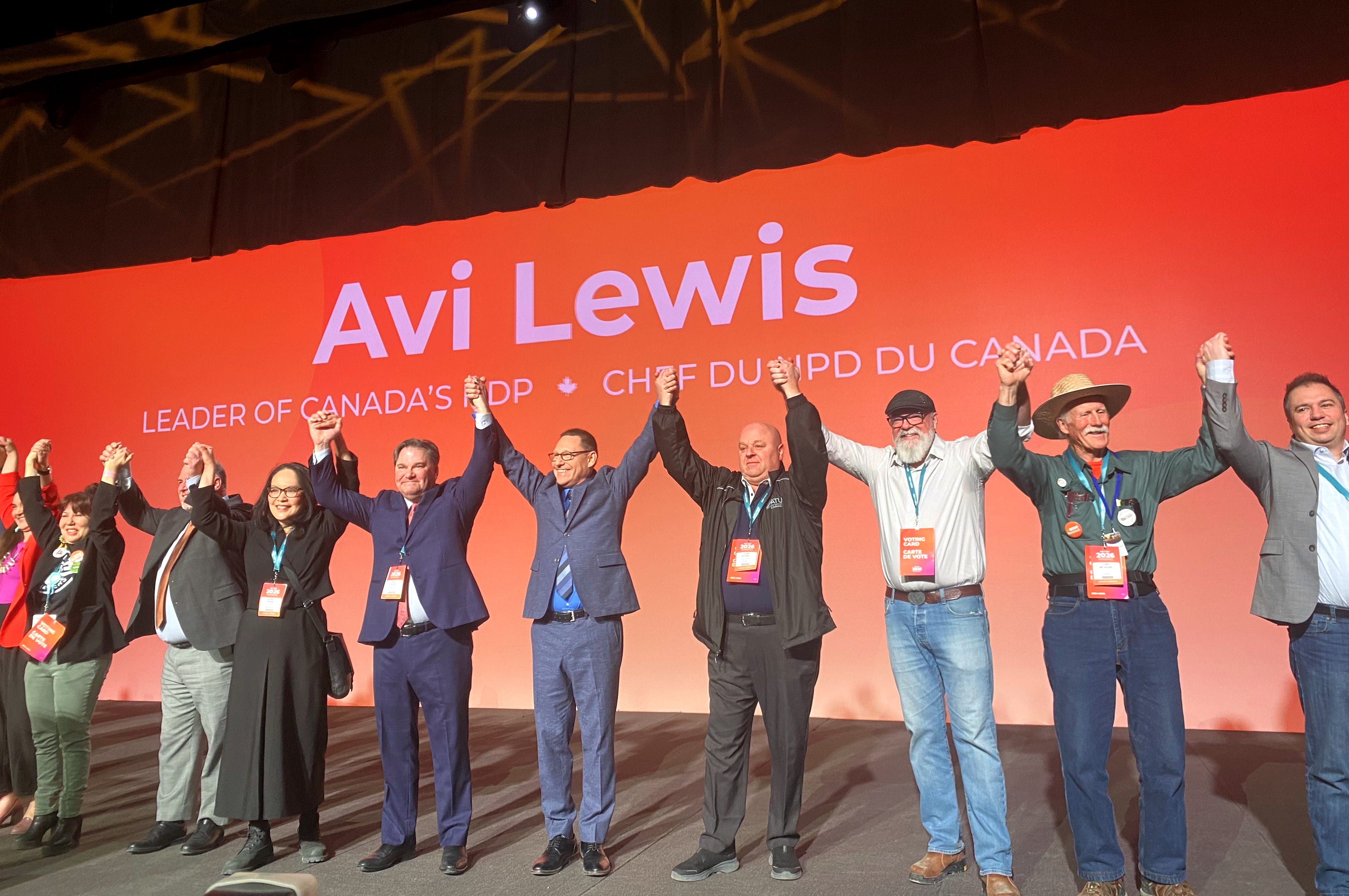
Winds of change blew through Winnipeg on Sunday as Avi Lewis won the highest number of individual votes in a federal NDP leadership race ever, with 39,734 votes representing 56% of the total 70,390 votes cast.
Buttressing the scale of Lewis’s first-ballot victory was the election of a Lewis-aligned slate to the party executive and the utter conniptions his win have caused among the overwhelmingly conservative Canadian pundit caste.

As I was writing this piece, Lewis announced his transition team. Savhanna Wilson, who managed Lewis’s leadership campaign, is his chief of staff; Peyton Veitch, Lewis’s policy director, is principal secretary; and Donya Ziaee, a former journalist who served as a senior editor at The Breach, remains Lewis’s communications director.
Having spent the past few days in and out of Winnipeg’s RBC Centre for the convention, I want to focus on how Lewis was able to pull his winning campaign together, but first some context on the scale of Lewis’s win.
In 2017, ex-leader Jagmeet Singh won with 35,266 votes, or 54% of the votes cast on the first ballot. It’s tougher to directly compare with Tom Mulcair’s 2012 victory, in which Mulcair defeated Brian Topp on the fourth and final ballot with 33,881 votes (57%), but received just 19,728 of those votes on the first ballot.
These were the only NDP leadership races with a simple one-member, one-vote system. In 2003, the party used a hybrid system, in which the votes of individual members were weighted for 75% of their total, with the other 25% consisting of delegated votes from unions.
In that race, Jack Layton won on the first ballot with 22,453 votes from members and 572 from delegates.
Prior to Layton’s win, the party had an old school delegated convention that simply isn’t comparable to one-member, one-vote results.
It’s worth noting, for the sake of fairness, that Alberta NDP leader Naheed Nenshi won far more votes in his 2024 leadership victory, with his 62,746 votes representing a whopping 85 per cent of the 72,930 votes cast.
The difference is that Nenshi, the three-term mayor of Calgary, was running to lead the largest Official Opposition in Alberta’s history; Lewis, whose prior electoral track record was lacklustre, was running to lead a party whose caucus could fit into a taxi van. There’s almost nowhere to go but up for a Lewis-led NDP.
Friend of The Orchard David Climenhaga had a great column yesterday on Alberta NDP leader Naheed Nenshi and Saskatchewan NDP leader Carla Beck’s “churlish commentaries” on Lewis’s victory, which I would highly recommend reading if you’re looking for that angle.

I raise this dynamic because the way Lewis has handled attacks on his purportedly adversarial approach to the NDP’s provincial wings was a major factor in disarming his opponents.
These attacks, rooted in Lewis’s ambition to begin an immediate transition from fossil fuels by rejecting new pipelines, offshore oil projects and liquified natural gas terminals, were expressed primarily by runner-up Heather McPherson’s surrogates and fourth-place finisher Rob Ashton.
“No, we will not always agree on every issue,” said Lewis in his Sunday victory speech, “but here’s the thing — our debates are a sign that our party is back and our tent is growing. It’s big enough to hold some differences of opinion in it.”
This put Lewis’s opponents in the awkward bind of arguing no, it’s not while accusing Lewis of being divisive.
This might be one reason why Nenshi already appears to be walking back his needlessly harsh assessment of Lewis that was posted the second Lewis’s victory was announced.
But I suspect Lewis will serve as a specious scapegoat in the likely event that Nenshi is unable to defeat Premier Danielle Smith.
By way of contrast, Manitoba Premier Wab Kinew, the country’s most popular premier, had a one-word response when asked whether he was concerned about an incongruence between Lewis’s opposition to the fossil fuel expansion that Kinew supports: No.
Joel Harden, the former Ontario NDP MPP (what they call MLAs in Ontario; weird, I know) for Ottawa Centre, announced he was working on Lewis’s long-rumoured campaign the day it officially launched in September 2025.


In an interview on the convention’s first day, Harden told The Orchard that Lewis had contacted him over the summer about working on his leadership campaign.
Harden, who ran in Ottawa Centre during the 2025 federal election, felt he “needed a little time off” before making a commitment and went to Ireland with his partner.
“When we got back, I called him back and said, ‘Let’s go. Let’s bring something exciting to the party,’” said Harden, who served as Lewis’s events director.
“He wanted me to help him go on the road and said, ‘When we do events, let’s put art into them. Let’s put music into them. Let’s make them fun. Let’s let people bring their kids.’”
Every night on tour was different, Harden explained, with local organizers helping plan each event to “attach their local meaning to it,” which was “purposefully designed by Avi, working with me.”
He said this empowerment of local volunteers reflects Lewis’s repudiation of an “almost messianic” leadership model that has plagued the party since the days of Layton.
“We have to have a leadership culture [that[ is very rooted to people at the local level, and it can’t just be about one person,” Harden said, adding that Lewis “lets us cook” and “trusts us to pull off stuff.”
At the end of each event, Harden would stand outside of the venue, thank attendees for showing up and solicit campaign donations.
After the campaign’s Peterborough rally, an elderly woman approached him, who said that she was raised in a household involved with the Cooperative Commonwealth Federation (CCF), the NDP’s harder left forerunner, of which Lewis’s grandfather David was a founder.
“'The CCF is back,” he recalled her saying. “When I was a young girl, my parents went to CCF [events] and it felt like this. There was music, there was food, there was fun, there was joy.”
“It wasn’t just, ‘There’s this messiah who’s going to save us,’” said Harden.
Lewis’s critics, of course, would argue his campaign represents a deepening, rather than a repudiation, of messianic politics.
This would appear to be refuted by Lewis’s own rhetoric, in which he portrays himself as a vehicle for the will of the people left behind by politics as usual.
“I didn’t do that. You did that,” Lewis exclaimed to his supporters at his Sunday victory party.

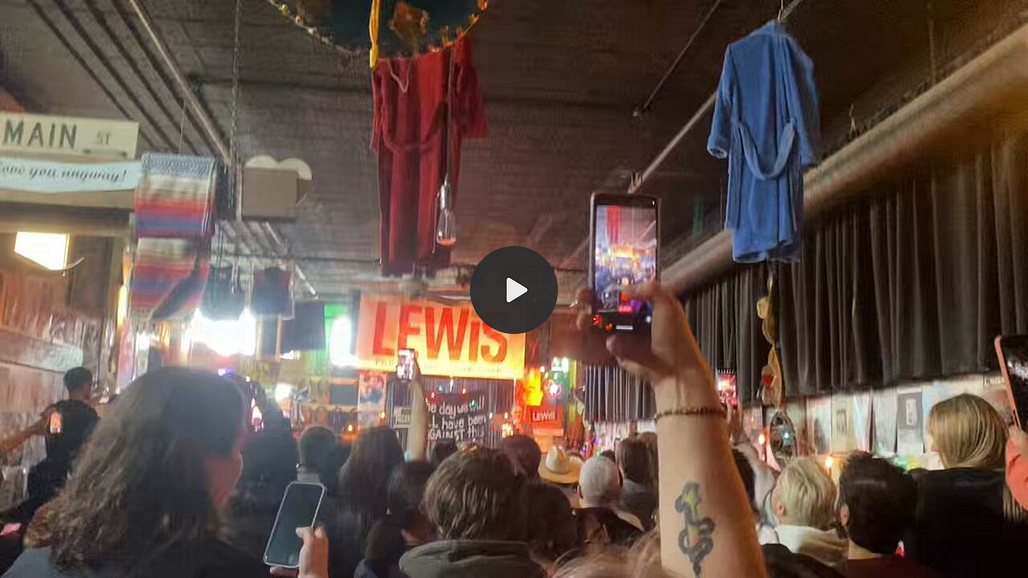
Lewis is doing populism, on which the right has had a near-monopoly in Canada. Progressives would be wise not to cede that ground to Danielle Smith and Pierre Poilievre.
The Lewis campaign’s distinct aesthetics played a role in it standing out from the rest. That was thanks to the work of campaign creative director Adam Warner.
Warner happened to be on my flight back to Edmonton on Monday (as was Heather McPherson, but she understandably didn’t seem to be in a talkative mood.)
We spoke while Warner was waiting for his connecting flight back to Victoria.
“It’s about getting attention from people that may not be paying attention to the race or to politics in general,” explained Warner, who’s done graphic design for the online news site The Maple and Marilyn North Peigan’s Calgary city council campaign.
“My mission is always to create full, striking designs that get people’s attention and that aren’t status quo. The philosophy of Avi is against the status quo and so is the design sensibility.”
He aimed to create a “bold but simple” design scheme that enabled grassroots Lewis supporters to “take it and run with it on their own.”
“I’d be walking down the street in Victoria, and I’d see a poster for an event that I didn’t even design, but it had our logo on it and had our branding,” said Warner.
One of the most distinctive elements of the Lewis campaign’s branding that stood out to me was the baseball card-like graphics of his campaign endorsements.
The team was evidently inspired by the graphics put out by New York City Mayor Zohran Mamdani, but Warner said he sought to avoid being “derivative of that campaign.”
“The brief that Avi gave me in the beginning was like, ‘We don’t want this to feel like a political campaign. It should feel fresh,’ and we really tried to capture the energy and some of that in the branding,” recalled Warner.
Warner initially joined the campaign on a three month contract beginning in August to oversee the campaign’s branding, including its logo and colour scheme, and “build out” his social media marketing.
He quit his job in advertising in October to work for the campaign full-time.
“I just believed so deeply in the cause and he had won me over by then,” Warner explained. “We didn’t really know what was gonna happen, but a month before it was gonna end, I was like, ‘Hey, can I just work for you?’”
Winnipeg Centre MP Leah Gazan was the only member of the party caucus to endorse Lewis. Nunavut MP Lori Idlout had kind words for Lewis’s positions on Indigenous issues and appeared alongside him at an Ottawa rally before she crossed the floor to the governing Liberals.
McPherson was publicly endorsed by Courtenay-Alberni MP Gord Johns and received a $500 donation from Rosemont—La Petite-Patrie MP Alexandre Boulerice.

Interim leader Don Davies and Vancouver East MP Jenny Kwan remained neutral in the leadership race.
After Lewis’s victory was announced Sunday, Gazan told me that the campaign was a success, “because we are a movement.”
Lewis was able to mobilize around this movement, which existed prior to the leadership race, taking many forms, whether it’s climate justice, Palestine solidarity or Indigenous liberation at home.
“It’s very clear that Avi comes from the movement. I also come from the movement,” Gazan added. “He galvanized the energy of the movement.”
During the federal election, I noted that there are essentially two contrasting visions for the NDP — one, embodied by McPherson, emphasizes pragmatism for the sake of electoral victory; the other, embodied by Lewis, is focused on driving the long-term change sought by social movements.

These tendencies exist on a spectrum, and it would be a vast oversimplification to portray McPherson as purely pragmatic or Lewis as strictly a conduit for social movements.
McPherson’s strident advocacy for Palestinian human rights shifted the conversation on Canadian support for Israel in a way that no Canadian legislators has done before, which came out of long-term pressure on the NDP from the Palestine solidarity movement.
And, contrary to Calgary Herald columnist Don Braid’s demented ramblings, there’s a clear pragmatic element to Lewis calling for a public alternative to private grocery oligopolies, rather than the outright nationalization his grandfather may have advocated in a different historical context.
Gazan took issue with McPherson using the phrase purity test at the Edmonton-Strathcona MP’s October campaign launch, referring to what McPherson regards as a tendency of pushing people who aren’t entirely ideologically aligned out of the party.
On the website once known as Twitter, Gazan said at the time that she was “appalled and deeply disappointed” that McPherson would approvingly invoke a phrase that is “frequently used to dismiss calls for justice from marginalized communities.”
When I asked her about this perceived rift with McPherson, Gazan declined to comment. Other comments she made in a mini-scrum with myself and Nick Seebruch of Rabble suggest that it’s water under the bridge.
Asked her thoughts on when and where Lewis will seek a seat in the House of Commons, Gazan emphasized that it will be a caucus decision.
“I’m looking forward to working with all of my colleagues and all of the leadership candidates as we move forward as a unified party,” said Gazan.
The more I saw (and heard) who was speaking out against Avi Lewis, the more I realized he was the only candidate who had more than a faint hope of making a difference. It won't happen overnight, but I will support him every step of the way
Excellent article Jeremy. It’s so refreshing to read an article on the NDP and the leadership race in full informed context versus the pundits playing catch up with their own skewed shifting sound bytes and rhetoric.
MPP only in Ontario (where I came from to BC, MLA, haha.)
It would be interesting to hear your thoughts on Naheed Nenshi. At this point in time, I think he is being more interested in stoking his political ambitions in trying to distance himself from the Federal NDP. He doesn’t have anywhere near the popularity he did since Danielle Smith came to power. IMO, most people outside of Alberta don’t know him versus Avi Lewis coming from a political family but still differentiating himself from his father and grandfather.