

This story was originally published in Alberta Native News.
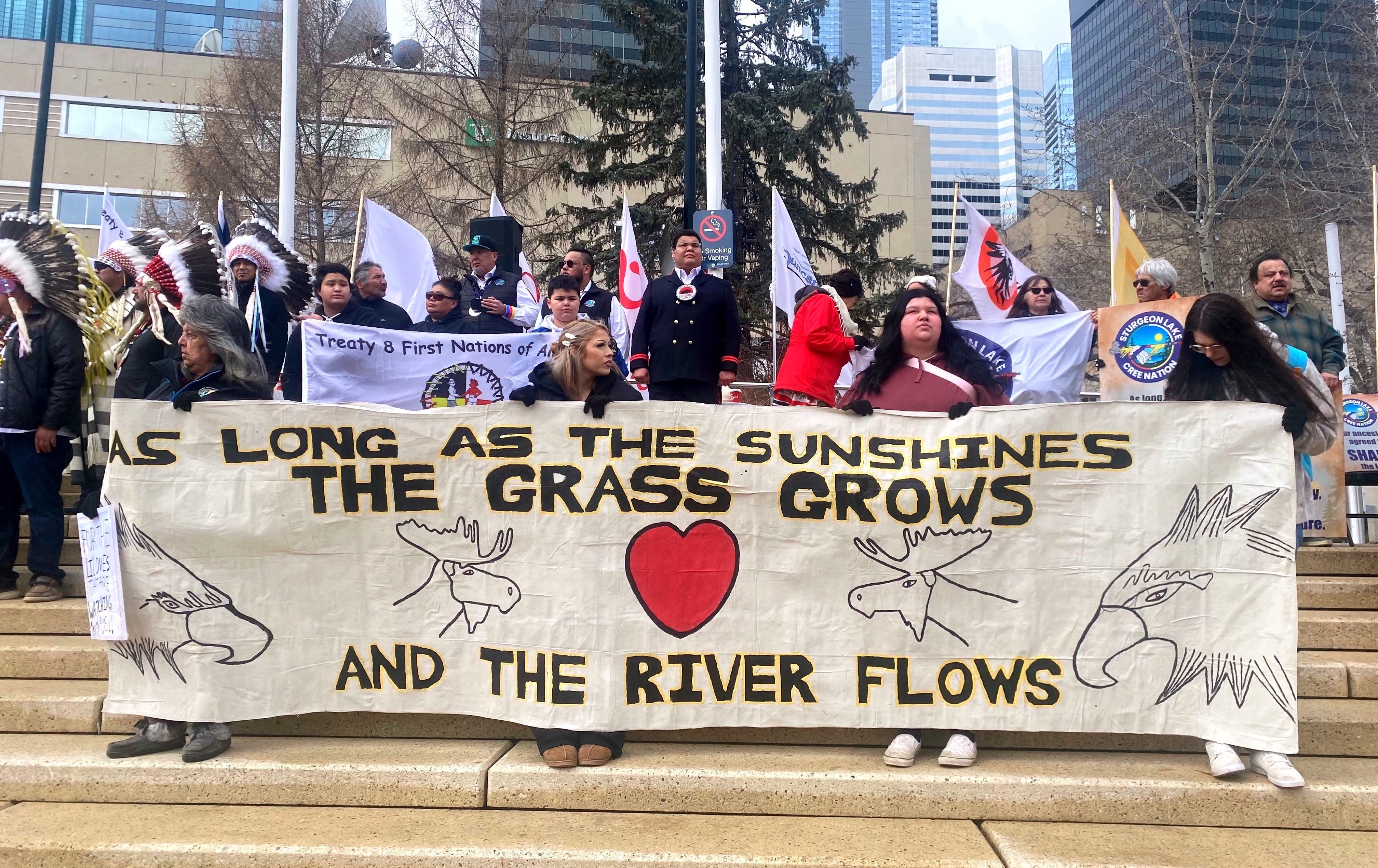
First Nations chiefs from Treaties 6, 7 and 8 spoke at an April 8 rally in Edmonton’s Churchill Square, across the street from the courthouse where lawyers for Athabasca Chipewyan First Nation (ACFN) and the Blackfoot Confederacy were attempting to halt the collection of signatures for an independence referendum.
“We gather here today in the heart of Treaty land to raise one message so loud, so clear that no government, no institution and no power can ignore it,” said Chief Sheldon Sunshine of Sturgeon Lake Cree Nation, whose lawyer made arguments against the separatist petition in court the previous day.

“The Treaties are alive, the nations who signed them are still here. They’re still strong.”
ACFN Chief Allan Adam told attendees that the reason why the Canadian government “sits there and does nothing” as Alberta’s government empowers the separatist movement is that First Nations are the “true government … of this land.”
“Canada and Alberta are only corporations to work with us,” Adam said. “They have no right to determine where we’re going or what we’re going to do as First Nations people. We determine where we’re going, where we live, and what we do on a day-to-day basis, because we determine this is our homeland for now and forever.”
The separatist movement represents a “group of individuals” who want to “extract the resources” without constraints, he added.
“The resources are protected by environmental laws. Those environmental laws are protected by aboriginal laws,” said Adam. “In order to exploit the natural resources, they have to go through us.”
He warned attendees not to “be tricked” by the appearance that the provincial and federal governments are in conflict.
“Canada is with them. They don’t say it, but they go hand in hand,” Adam said.
The three Blackfoot nations joining ACFN in asking the Court of King’s Bench to order a pause in the collection of separatist petition signatures are the Piikani, Siksika and Kainai bands.
Piikani Chief Troy Knowlton, who serves as the president of the Blackfoot Confederacy, met with Premier Danielle Smith and some cabinet ministers on Tuesday.
“I was able to tell her face to face, your separatism agenda is nothing more than political fantasy,” Knowlton told rally-goers.
“You allow the white supremacist racists and bigots to be able to come out of their homes and yell and scream, ‘I don’t like First Nations. I don’t like immigrants, I don’t like Blacks.’ She sat there with her head down as I told her this.”
The UCP government’s neglect of Treaty rights means that “First Nations are united more than ever in our existence,” he added.
Confederacy of Treaty 6 First Nations Grand Chief Joey Pete said that he often reflects on the “roads I drive on, the concrete I stand on, but what’s under that?”
“That’s our land,” he said to applause. “When you’re out there hunting, fishing, doing ceremony, everything, when you connect back to the land, you are the land.”
The rally was attended by local NDP MLAs Brooks Arcand-Paul, Jodi Calahoo Stonehouse, Janis Irwin and David Shepherd, as well as former NDP MP Blake Desjarlais, who now serves as Mayor Andrew Knack’s chief of staff, and former deputy premier Thomas Lukaszuk.
Arcand-Paul, a lawyer from Alexander First Nation, told reporters that Premier Smith needs to be beyond meeting with chiefs and actually address the substance of their concerns.
He noted that Alberta Environment is planning on exempting celebrity businessman Kevin O’Leary’s AI data centre proposed for SLCN’s traditional lands from an environmental review, despite concerns Chief Sunshine has expressed about its impact on nearby Little Smoky River.
“[First Nations] are constantly going to the courts because this government does not listen to our chiefs,” said Arcand-Paul.
Calahoo Stonehouse, a former band councillor for Michel First Nation, said that the rally represented a “movement of love.”
“It’s love for the land, love for the water, love for the people, love for our province and love for this country,” she said.
While Sturgeon Lake’s litigation named the provincial government, federal government and Alberta’s chief elections officer as respondents, ACFN and the Blackfoot nations were grouped together in court because they both list Stay Free Alberta CEO Mitch Sylvestre, the Crown and chief electoral officer as respondents.
ACFN lawyer Kevin Hille’s main argument focused on the impact of creating an international border on ACFN’s ability to exercise its Treaty rights.
“The implications of an international border are not abstract. They are readily apparent from the very beginning of sovereignty,” said Hille. “Sovereignty equals a border. Borders interfere with rights.”
Treaty 8 promised ACFN freedom of movement throughout the “entirety” of its traditional territory, he emphasized.
“The threat to that is Alberta independence and the international border that would come with it that would divide that territory,” Hille explained. “Those interests are diametrically opposed.”
ACFN’s legal team also focused on the Justice Statutes Amendment Act, or Bill 14, which removed a prohibition on citizen initiatives that would violate constitutional rights from the Citizen Initiative Act.
The legislation was signed into law after the Court of King’s Bench ruled that a citizen-initiated referendum on Alberta’s independence could not proceed because its desired outcome would by definition result in the removal of constitutional protections for Albertans, including First Nations.
On April 7, Sturgeon Lake’s lawyer Orlagh O’Kelly argued that Bill 14 was a deliberate effort by the government to circumvent the court’s ruling and enable a separatist petition to proceed, despite its impact on Treaty rights.
James Shields, another ACFN lawyer, took a different approach to the legislation.
He agreed with the provincial government that the purpose of Bill 14 was “to streamline the act to avoid delay and to avoid unnecessary waste of court resources,” but argued that it was done in an “overbroad” way.
Bill 14, Shields argued, “did not authorize” chief electoral officer Gordon McClure to retroactively approve the separatist petition, which had already been deemed to violate the old Citizen Initiative Act.
“We always apply presumption against the retroactive application of laws, and that is because the retroactive application of law is an assault on the rule of law itself,” he said.
In addition to removing provisions from the Citizen Initiative Act prohibiting a referendum that could remove constitutional rights, Bill 14 added a provision to the Referendum Act that says the government “is not required to implement” the results of an unconstitutional referendum.
Echoing O’Kelly’s argument from the previous day, the Blackfoot nations’ lawyer Paul Reid argued that this section of the legislation is “discretionary,” leaving the decision to proceed with the results of an unconstitutional referendum up to the government.
“In these circumstances, discretion is danger,” Reid said.
The amendment to the Referendum Act offers “completely insufficient protection” and is “constitutionally defective,” he added.
On April 9, the Blackfoot Confederacy will continue its arguments and separatist lawyer Jeffrey Rath will make his case for why the petition should proceed.