

No separatists showed up to speak at the Feb. 25 Canada Pension Plan (CPP) Investments town hall in Edmonton.
Leaving the CPP and establishing an Alberta Pension Plan is a long-time goal of separatists and their fellow travellers. This proposal is wildly unpopular, so the UCP government has shifted its focus to scapegoating immigrants.
Separatists were likely busy petitioning for a likely independence referendum in October, which will occur alongside referendums on excluding newcomers from public services and constitutional changes the provincial government has no control over.
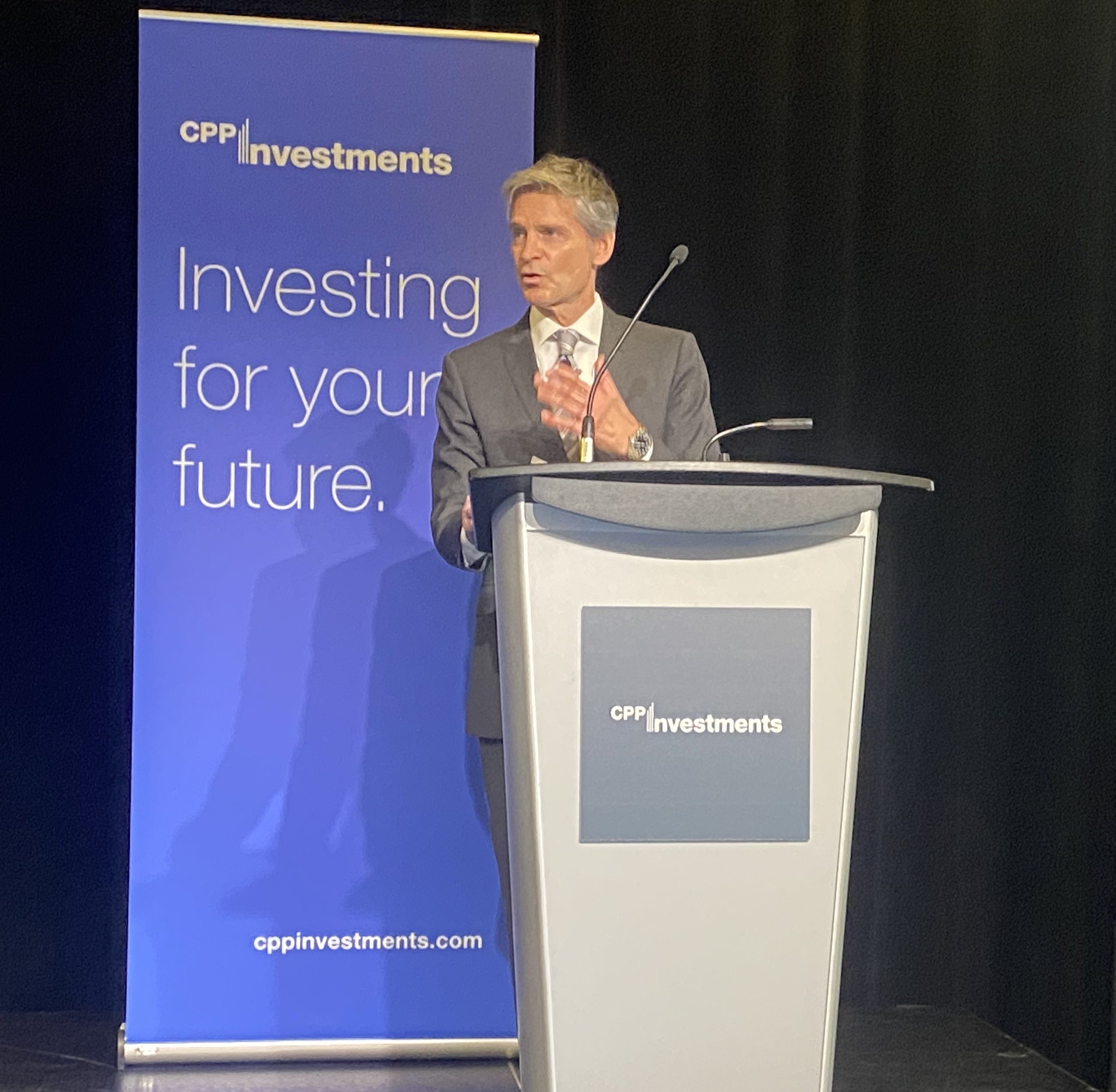
The result was some 100 or so people gathered at the Edmonton Expo Centre to hear CPP Investments senior managing director Michel Leduc field some thoughtful inquiries about the pension plan’s investments in fossil fuels and the machinery of genocide.
The $780.7-billion CPP is doing well, having earned a net return of 9.3 per cent, or $59.8 billion, during fiscal 2025.
Perusing through the CPP Investments 2025 annual report that was handed out at the event, one word stands out: risk.
In his opening remarks, Leduc explained the role risk plays in earning returns for pensioners:
Taking risk is necessary to achieve a maximum rate of return, but our job is to strike the right balance when seeking to achieve those strong returns. We must be prudent. We don’t swing for the fences in a way that could jeopardize the CPP ability to meet its obligations to all of you today and for the rest of your lives. We also do not pursue other public policy objectives or political priorities with our approach to investing.
One way the CPP leverages risk is through its fossil fuel portfolio, including $1.4 billion USD in tar sands giant Canadian Natural Resources Ltd., $1 billion in TC Energy, $536.6 million in Enbridge, $348.7 million in Suncor and $135.9 billion in Cenovus.
And those are just the Canadian companies. The CPP also invests $847.6 million USD in Exxon Mobil, $779.3 million in Cheniere Energy, $463 million in Chevron and $367.2 million in Targa Resources.
“We see climate change as the single biggest source of risk for the fund,” said Leduc.
Leduc boasted that the CPP has reduced its carbon footprint 41 per cent from fiscal 2020 to 2025. But that doesn’t necessarily mean a reduction in total emissions, given the portfolio’s overall growth. It didn’t this past year.
The report notes: “The key driver of the decrease in portfolio carbon footprint in fiscal 2025 relative to fiscal 2024 was the increase in the Fund’s size. Total carbon emissions remained stable year over year [emphasis added].”
Two CPP Investment board members — Barry Perry and Ashleigh Everett — are also directors of fossil fuel companies.
An attendee asked how CPP Investments plans “to align these fossil fuel assets with Canada’s climate commitments.”
Leduc claimed CPP is helping fuel the energy transition by investing in fossil fuels:
I know a lot of you really, really wish we would divest. If we move out, there’s a lot of short-term capital in the world. There’s capital out there that is just out there to make a profit until the very last drop, and then they’re just going to walk away. The world will be a lot slower to transition if you take out our type of money.
This argument would have much more weight if CPP Investments hadn’t abandoned its commitment to net zero this past year, arguing that “forcing alignment with rigid milestones could lead to investment decisions that are misaligned with our investment strategy.”
According to research from Just Peace Advocates, in fiscal 2025 the CPP invested $27 billion CAD in companies complicit in Israel’s genocide in Gaza and apartheid in the West Bank.
These include investments in non-Israeli companies, such as $2.9 billion in Amazon, $2.2 billion in General Electric, $1.7 billion in Meta, $233 million in Lockheed Martin, $203 million in Northrop Gunman and $264 million in Palantir.
Nora Salem, a local artist who has family in Gaza, noted the International Court of Justice’s July 2024 advisory opinion that called on all nations to cease “unconditional financial, economic, military or technological aid to the State of Israel.”
“How does the CPP Investment Board square its fiduciary duty with holding on to investments in companies that are directly implicated in violations of international law?” asked Salem.
Leduc said that CPP Investments finds “some of the things that are happening around the world to be horrible.”
There are certain “companies that we view to be a little bit beyond the pale in terms of the risks that would be exposed to, whether they’re human rights reasons or they have a non-sustainable business,” Leduc conceded.
But he said that “it would send an irresponsible signal to the world” for CPP Investments to keep a blacklist of publicly traded companies it won’t invest in, which he claimed “could expose us to lawsuits.”
Leduc defended CPP’s investments in military contractors by invoking Canada’s pledge to spend 5% of GDP on defence as part of its NATO commitments.
“We don’t see that as an illegitimate activity to be invested in,” he said.
Judy Garber, a retired political scientist at the University of Alberta who asked the final question of the evening, pointed out that the first form of risk referenced in the 2025 annual report is “geopolitical and macroeconomic uncertainty and complexity.”
“If the first risk includes the word political, then you certainly have to admit that there is something political about investment decisions,” said Garber.
The CPP’s investments in Israel aren’t exclusive towards U.S. military contractors. They include $338 million in investments in Israeli companies, chief among them $56 million in Bank Leumi, $50 million in Bank Hapoalim, $49 million in Teva Pharmaceuticals and $24 million in Israel Discount Bank.
Garber asked whether the CPP has invested in Russian “financial institutions” since the 2022 invasion of Ukraine.
Leduc clarified that when he says CPP Investments doesn’t make political decisions, he means they don’t take directions from politicians.
“We do not invest in Russia and never have,” he claimed.
“But you do in Israel,” Salem shouted from the audience.
“I want to make a distinction. We do not directly invest in Israel,” replied Leduc.
Nobody accused the CPP of purchasing Israeli or Russian state bonds.
This story has been edited to include more up-to-date data on the CPP’s holdings and the composition of its board.
Hard to be a Canadian Pensioner and NOT be passively involved in genocide and war.
We can't expect it overnight......but we're playing with extinction on steroids if we continue to believe that Canada's future prosperity depends on either War abroad, or Fossil Fuel extraction at home.
It may appear to swing that way just now, but a liveable future is going to depend on green technologies (already cheaper than much fracked gas infrastructure), restorative agriculture, actual regulations that protect the commons (our oceans come to mind), and real jobs in the Care economy that we are cheating just now..............
..............to invest in Israeli banks?? fracked gas wells??? 5-35's that are so expensive to run and maintain that they can't do the job required, of patrolling our vast Arctic???
Lockheed Martin??? Palantir???
A lot of naive seniors working hard to get their 'elbows up' are living off war graft that includes genocide. Why not look into ICE........seems that's a money making proposition waiting for some 'conservative investment" consideration.